ART & IMAGE: INTERVIEW
The Eternal Form: Abe Odedina
Identity, Everyday Beauty And The Magical Mundane
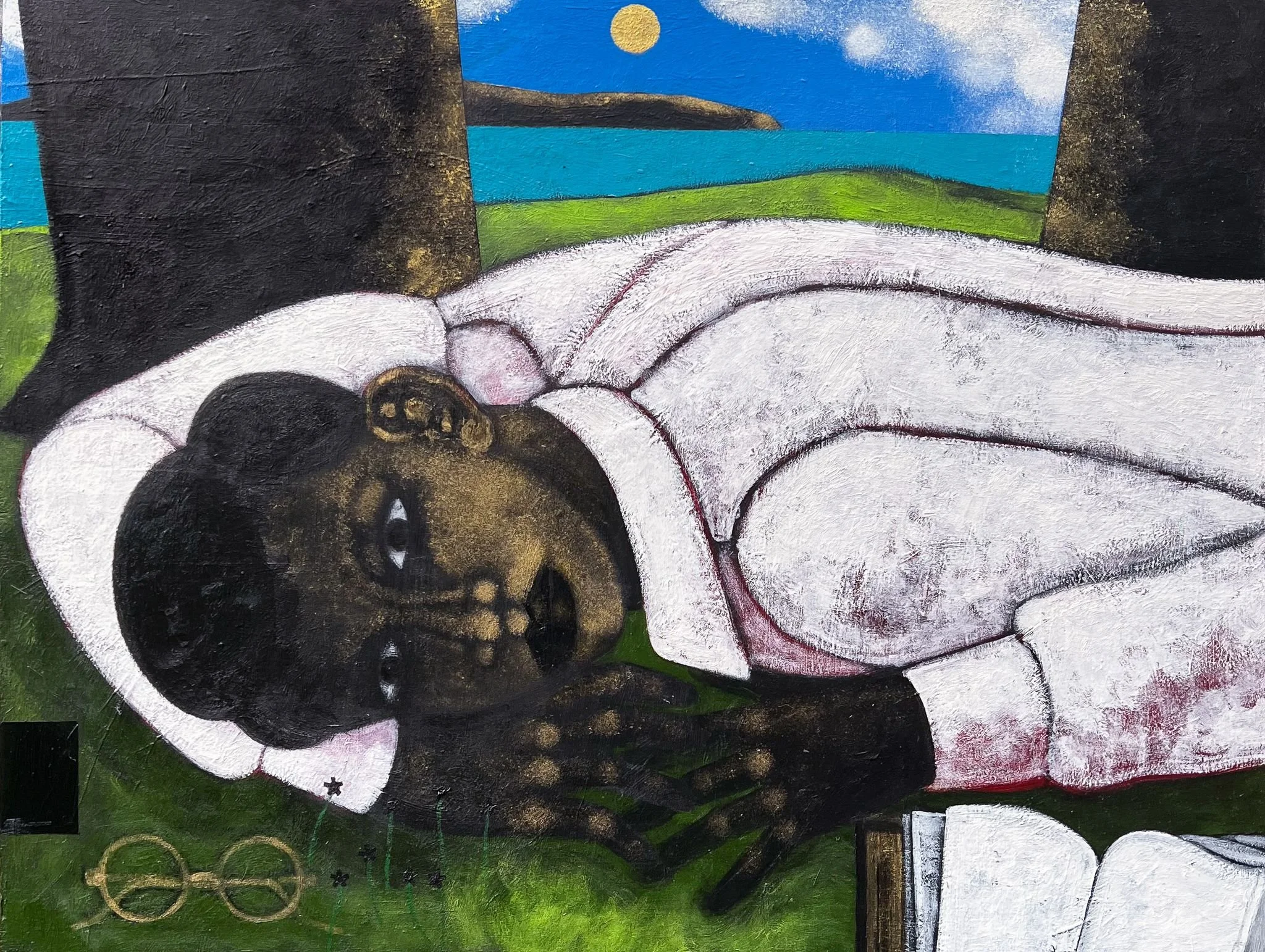
The architect turned painter Abe Odedina wants you to find the magical in the mundane, and the profound tucked away into those ordinary corners you thought you already knew. His plea as an artist is simple enough: take some time with his paintings and let them do what pictures sometimes do best, which is to make the fact of being alive feel urgent. His journey to the canvas is a curious one in terms of its timeline. He arrived at painting late enough to surprise the usual narrative about youthful prodigy, yet quickly enough to have his work inhabit rooms that really matter, such as the Royal Academy Summer Exhibition, the National Portrait Gallery (after a Portrait Award nod for The Adoration of Frida Kahlo), Somerset House, and Carnegie Hall – the kinds of institutions that provide acceleration to reputation.
His work is figurative and oddly mesmeric, not in the glossy, instantaneous way of attention-seeking images, but in a quiet way that asks you to return, re-engage and notice what you missed the first time. There is, perhaps unsurprisingly, an architect’s discipline in his composition, a sense that structure is not merely support but a frame for feeling, and his figures don’t so much pose as hold a temperature of sorts – when looked at long enough, they begin to blur the edges of perception.
As such, Odedina’s art insists on a kind of contemplative attention — not flashy, not doctrinaire, but persistent, as if someone had tinkered with the apparatus of your attention, so that ordinary things are seen in a new light. It’s a process of reconfiguration that effortlessly blends deities and contemporary cultural commentary to evoke the universality of the human experience. In this interview with FUTURISTIC DRAGON he discusses taking inspiration from the disparate likes of Haitian Voodoo practitioners, painters of the Sacred Heart, and his daily walks in Brixton, and tells us why he seeks to spark dynamic contemplation of lived experience.
Your work seems very much to be about celebrating the spiritual in the mundane, the ordinariness of things …
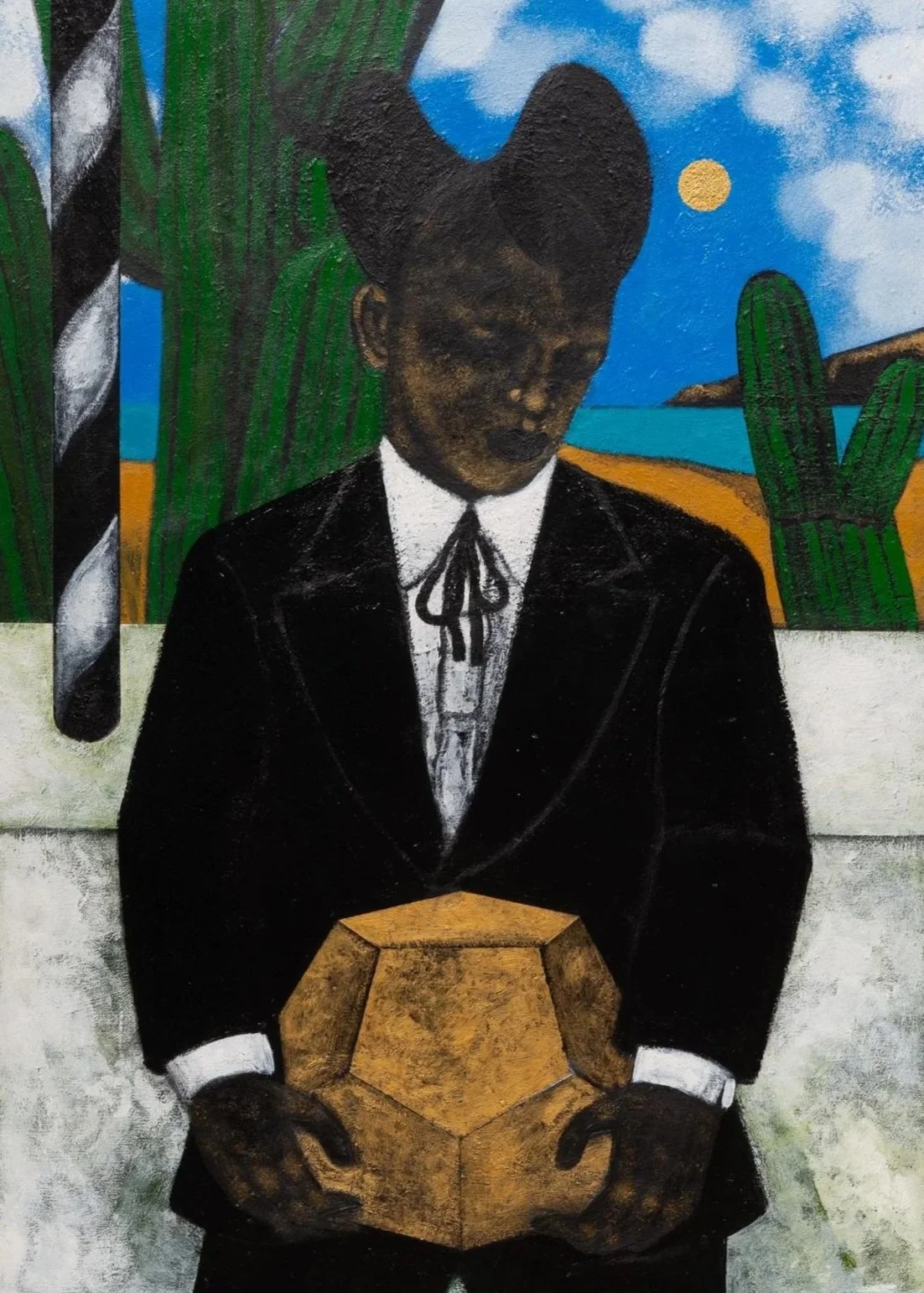
Yeah, it is that. What I'm saying as an artist is that everything is magical. It’s all about how you look at it. Every single life is worth exploring. You can see a guy walking across the road and think, oh, well, he's just coming back from work, and he does the same thing every day, and then some people might think, what's there to discover there? But everything is there. I find it very easy to imagine that all of life is going on within him potentially – it's all beautiful, tragic, heroic… it’s all going on within all of us, all at once. Whenever I'm painting in the studio, I'm not listening to music. I'm listening to Radio 4, because I like to know what's happening, and to get a sense of things to see what you can pull out from what is happening right now, what doorways it opens in thinking.
Where do the figures come from in your work, and what would you say you are seeking to transmit?
My figures are not drawn from nature. They're made up, so they're not burdened with biography, and I'm often placing my figures in very significant liminal spaces – such as a space behind a wall, or at a window. And that is because, if you think of contemplation, for example, somebody standing by a window begins to underpin that, doesn't it? Because, then it’s you in the painting – you are there by the window, and you're in that space between inside and outside. And, I just think those kind of spaces become very powerful. I like to put myself on the same side as the audience when I make paintings. I don't ever get that sense that, 'I'm an artist, and I have a privileged understanding.' No. I don't believe in that at all. I was an architect before being a painter, and drawing has always been core to what I do. I've just chosen to make this my job. I'm just a conduit. And I'm not that interested in introspection. I'd much rather look out the window than look in the mirror.
“You need to create a dialogue. You need to create something that's open”
Do you believe in any kind of faith or religion?
I guess I just like all of the Gods, all of them, in every religion. My understanding of them may be quite challenging to anyone who is traditionally religious, but I just think they are part of our supreme effort to understand what is going on. They're manifestations of our consciousness, across the board, and therefore, they are repositories of a huge amount of knowledge and beauty, and the beauty within religion still hits people on a daily basis. The first paintings I ever saw that really turned me on were baroque paintings made in churches and painted on wood, which is why I still paint on wood. There’s just such immediacy to those paintings for me, and there is the fact that it's art that is just steeped this sense of being very much a part of life, and an aspect of the everyday.
What would you say is ultimately the purpose of the artist?
You need to create a dialogue. You need to create something that's open. Everything in art comes in degrees of abstraction – even if you look at so-called realistic art closely, it's still a degree of abstraction. Between the interpretation of the viewer and my intention is the fertile ground where the work actually exists, because I then don't need to be there for the work to reveal itself. You will bring some hinterland; bring your own experiences to the painting. The more you as viewer bring something to the party, the more you get from it. I think of paintings as tools of enchantment. That sounds a bit grand, but it's not meant to be. I see them very much as tools of enchantment; as things that spark off questions.
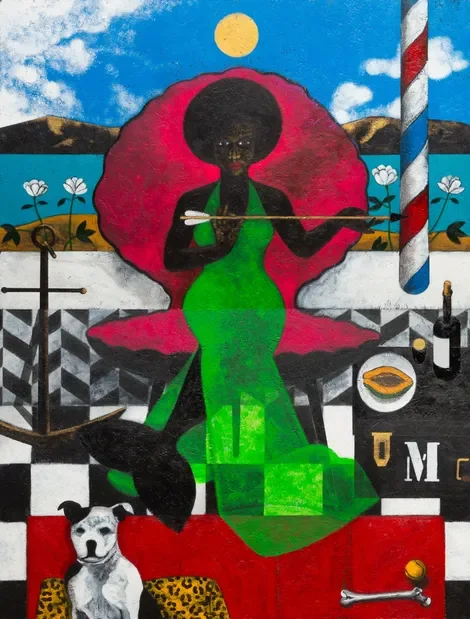
“Between the interpretation of the viewer and my intention is the fertile ground where the work exists”
How does your notion of art as a tool of enchantment play into Son of The Soil?
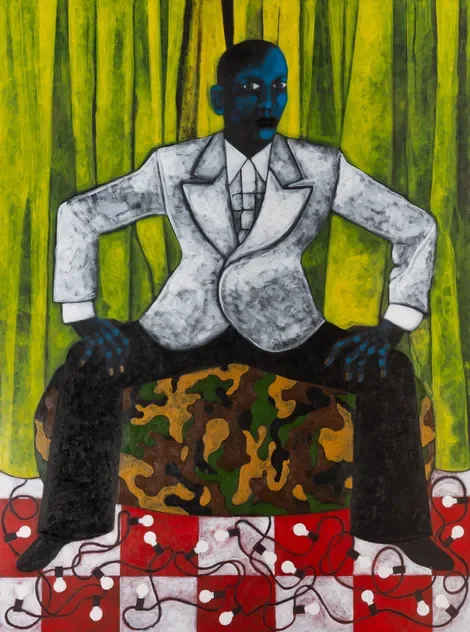
In The Son of the Soil, there is actually an ideology at play, which is about people who are born in any area having a natural stake in it. If you extend that idea, it can get to an uncomfortable area, which is that only people that have a stake are the people who are born in an area. But what I'm interested in is to say that anybody who finds himself or herself in any part of the world where they feel that they belong because they're contributing in some way, then they too have a stake. And the protagonists in all the various paintings are exercising precisely that right to be – not by doing hysterically dynamic things at all, but by demonstrating various simple aspects of life, and how they're engaging with it.
It sounds almost like they are figures evoking a sense of belonging ...
These are various ideas of belonging, but you can belong in very ambiguous ways. For me, it’s not about saying this and that dramatically. It has to be more like poetry. There has to be space. There has to be distance in order to allow the work to be infused with other ideas. You need gaps. You need something that's open. I hope there's openness in these figures that could suggest a number of things and a range of possible meanings, which allows you to invest something of your own spirit in the work
Introduction & Interview by by John-Paul Pryor
Find out more about the artist here.
All images courtesy of the artist.
Get up-close-and-personal with artists from all over the world and unlock the mysteries of the creative mind.
Read in-depth interviews with the most exciting cultural movers and shakers shaping the creative landscape.

Discover the actors, authors, designers, mavericks and entrepreneurs at the bleeding edge of cultural life.