ART & IMAGE: INTERVIEW
Declaration of Love: Anne von Freyburg
Abstraction, Consumerism And Reclaiming The Feminine
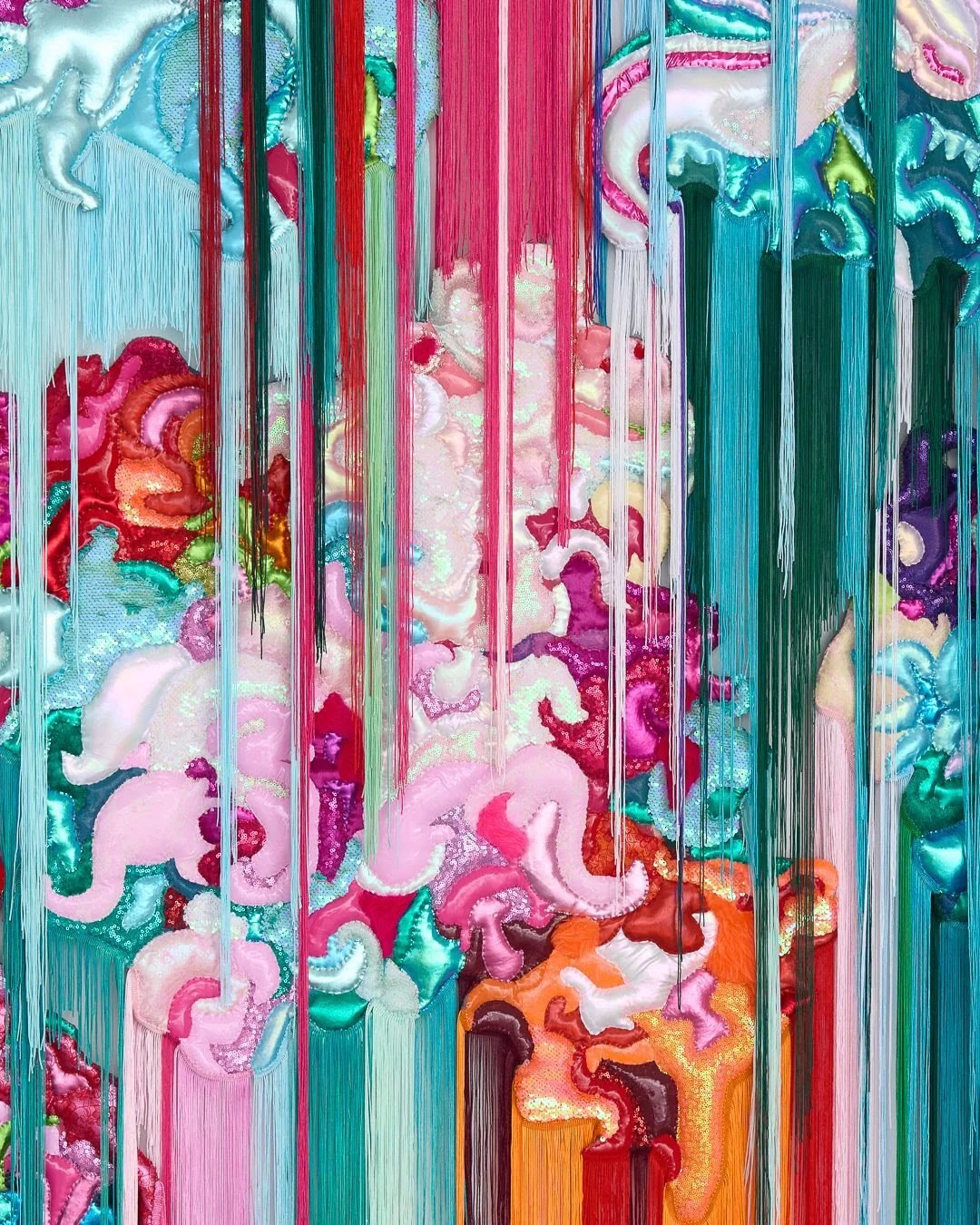
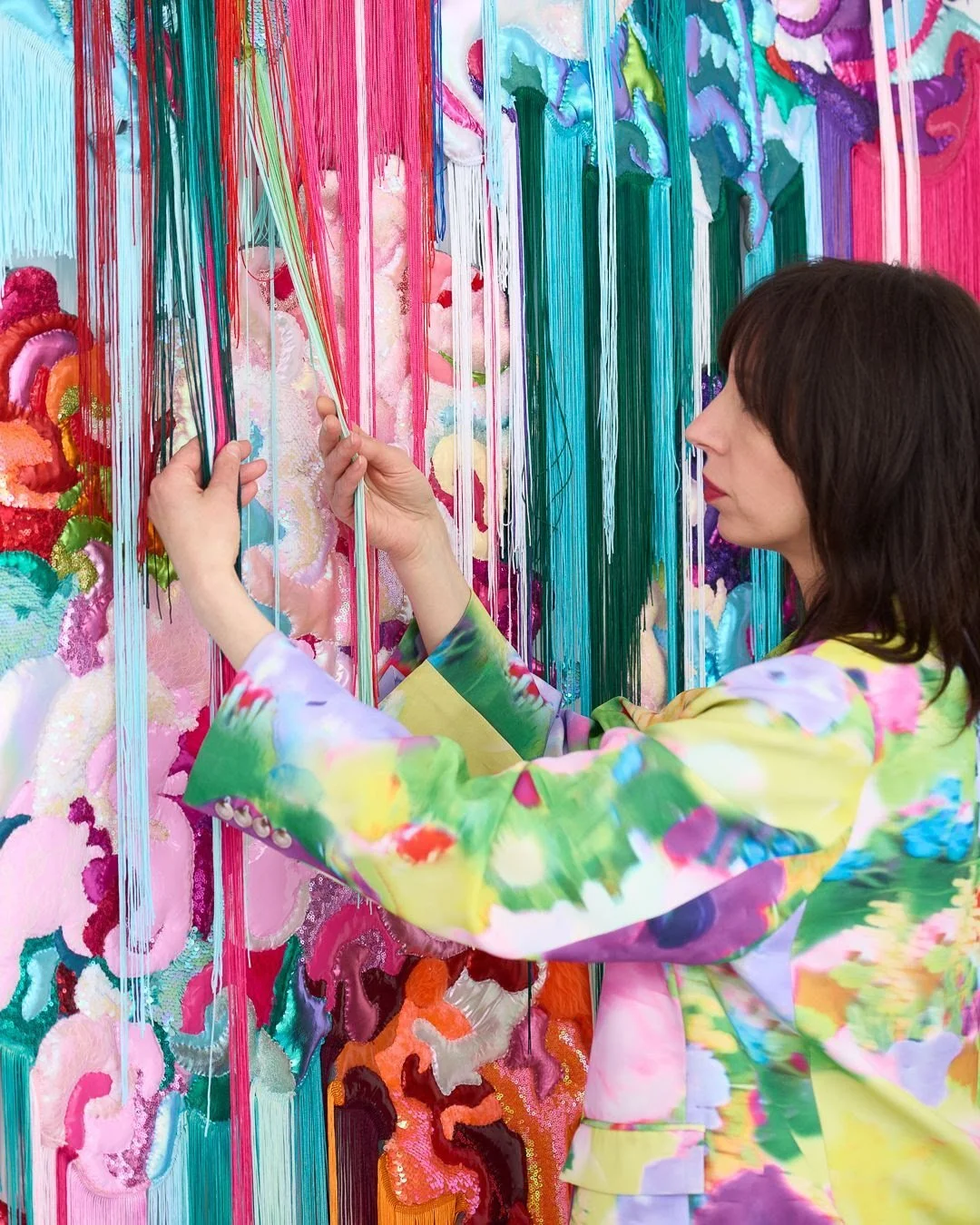
The London-based Dutch artist Anne von Freyburg brilliantly explores the interplay between textiles and decoration within the context of painting, critiquing traditional ideas surrounding the female gaze and femininity, while powerfully forwarding aesthetics all-too-often dismissed as secondary — challenging long-standing hierarchies in which crafts and decoration have been radically undervalued.
The increasingly celebrated artist is perhaps best known for her inventive reinterpretation of five of Jean-Honoré Fragonard’s extended series of Rococo paintings collectively entitled The Progress of Love, one of which was exhibited earlier this year in ‘Textile Art Redefined’ at Saatchi Gallery, curated by Helen Adams. In her woven reimagining of his classic works, von Freyburg deliberately utilised the love story depicted in the paintings to reflect on saccharine clichés of romantic love and unpick the theatrical staging of desire. This month, she exhibits at CAN ART Ibiza where Rademakers Gallery will be showing her latest large-scale deconstructed floral textile wall installation, a re-interpretation of a still-life by the Dutch master Jan van Huysum, which provides a wry comment upon consumer culture and contemporary globalisation.
These bold, colourfully woven creations reassert domains traditionally tied to the feminine sphere and usurp tropes of art history, inviting sustained contemplation on themes like taste, the porous boundaries between high and low art, and the social construction of female identity. As such, her visually compelling abstraction celebrates the sensuality, texture, and visual complexity of materials and ornamentation, while provoking thought on intersecting issues such as gender, overconsumption and self-indulgence in contemporary culture. In this interview with FUTURISTIC DRAGON the artist discusses her singular mission to reframe femininity, the craft-driven labor behind her practice, and tells us why, for her, great art must always seek to communicate honesty.
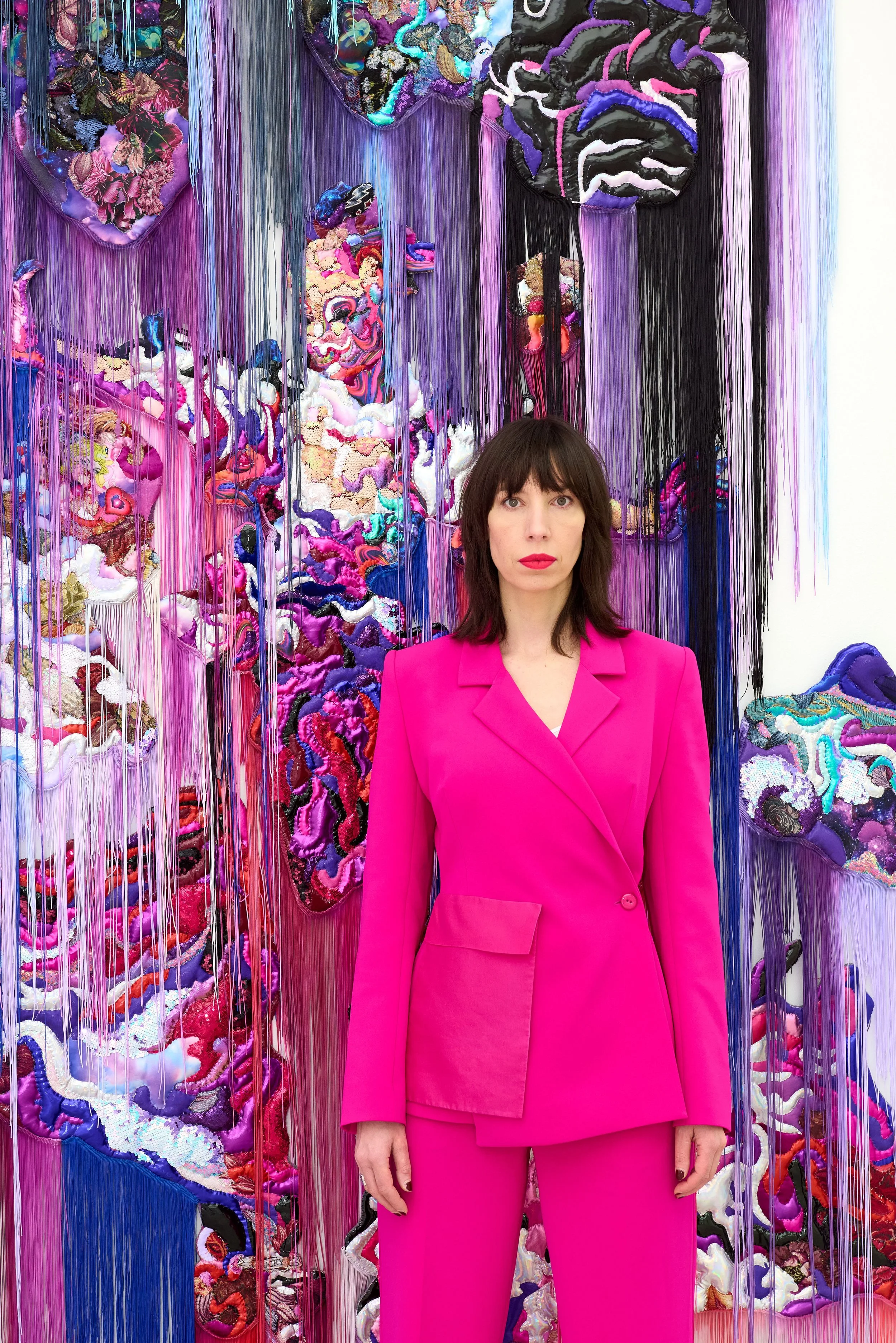
“To celebrate the feminine or what has been described and constructed as a feminine aesthetic is a way to reclaim it. That way it can be deconstructed and recreated, free from preconceptions”
What would you say drives you creatively? How would you describe yourself as an artist?
What interests me is where the hierarchy between fine art and craft comes from and why ornamentation and detail was seen as something inferior to modernism. One could see the banning of ornament and decoration in art and society as a patriarchal strategy to diminish femininity. While I was exploring the history of ornamentation and decoration I couldn’t miss the direct link it has with textiles. There has always existed a hierarchy between painting and tapestry. One can still see that in how tapestries are categorised as craft and design in museum collections. Tapestry has been seen as reproducible low art, made by women, while male painting was seen as significant and important. Painting still has the highest value on the art market. The marginalisation of textiles and everything that’s linked with the feminine is what drove me in blending these two disciplines. Choosing the Rococo, for example, an era that’s been categorised as frivolous and unserious, adds another layer of meaning to the work. I would say I’m a painter that uses fabrics as a medium to make extended hybrid works that sit between sculpture and painting.
Describe the ways in your work challenges and conversely celebrates notions of the feminine, and tell us why that is important to you …
In my practice I’m exploring the self through figurative and abstract painting, tapestry, textiles, craft and ornament. By making work that is overly feminine I’d like to open up the discussion around the construction of femininity, feminine heritage of ornaments and decoration. I would like to honour the feminine history of textiles and craft, because I think it is important to retain and reclaim its history and bring back the “feminine” decorative ornament in relation to abstract painting. To celebrate the feminine or what has been described and constructed as a feminine aesthetic is a way to reclaim it. That way it can be deconstructed and recreated, free from preconceptions. I want to celebrate sensuality, pleasure, joy, fierceness and intuition. Art should not only be viewed through the mind and consumed by the eyes but should also give space for the senses of touch and evoke pleasure and joy.
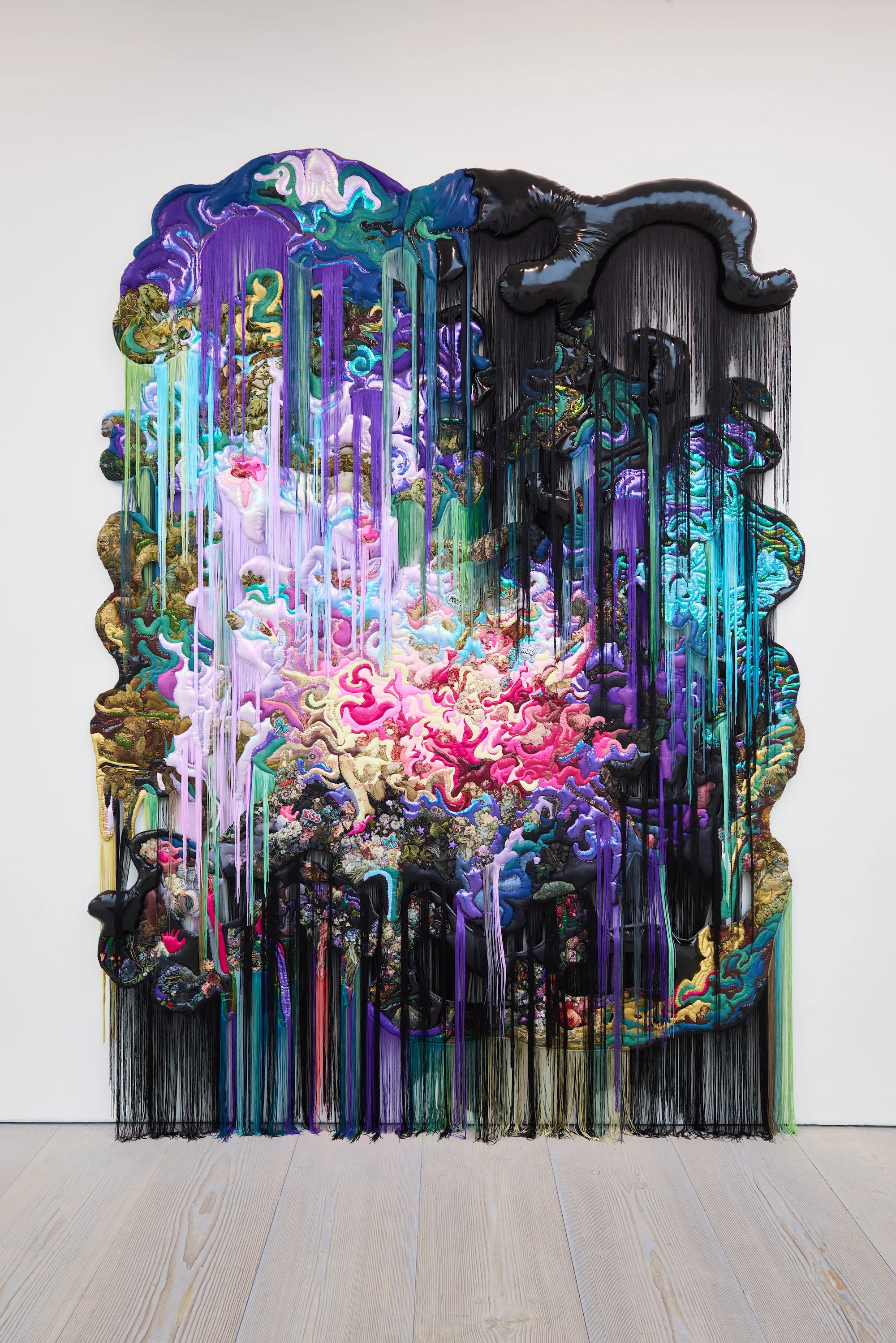
“Art should not only be viewed through the mind and consumed by the eyes but should also give space for the senses of touch and evoke pleasure and joy”
Your work has been described as a comment upon consumerism, can you unpack your thoughts about the capitalist consumer construct and how your work tackles notions of excess?
In my opinion female identity nowadays is created through the female gaze on social media platforms. We are overwhelmed by mass media that confronts us with ever changing beauty standards. Additionally we see that on social media women are capitalising on themselves and making lots of money. The objectification of ourselves has evolved, validation now is often achieved through material means such as through fashion and plastic surgery. Still consumers, especially women, are kept insecure about their bodies and their looks through advertising, which makes people keep on buying. I think this is all very complicated and concerning and I don’t think my work is going to change this, but as it is part of my reality as well I feel the need to react on and make work about it. By disrupting the image through the swirls, drips and overload of materials and visual information I want to subvert the clichés of gender and beauty and turn it on its head, like looking into a distorted mirror at a fun fair. My work is questioning when material pleasure turns into excess. On the other hand women are often being criticised and discriminated for being too much and too loud. In that sense, the work with all its vibrant colour and tacky materials is me being unapologetic about standing out and being loud.
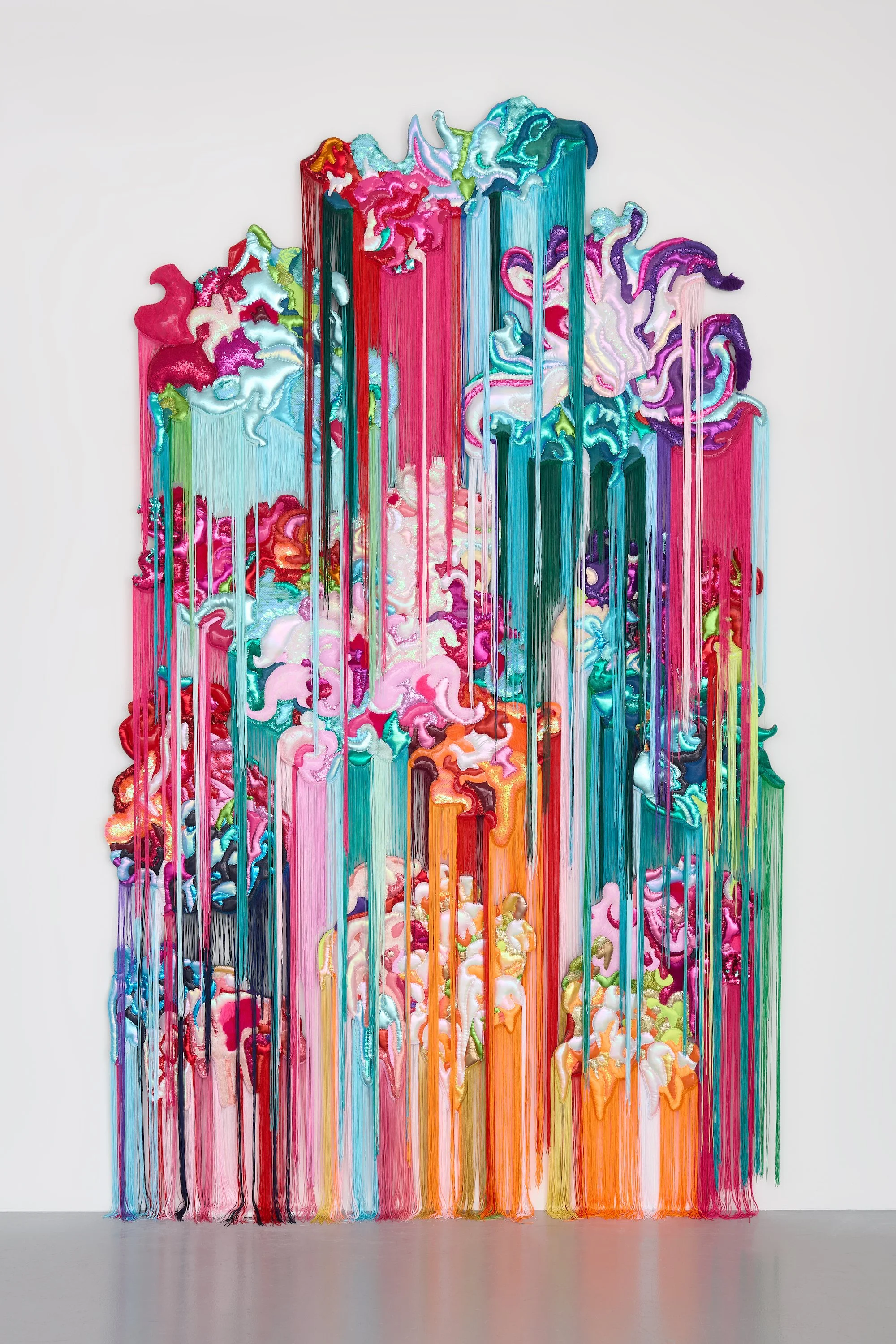
“I want to subvert the clichés of gender and beauty and turn it on its head, like looking into a distorted mirror at a fun fair”
Please describe your process and a typical day in the studio. How do you see an idea through from conception to completion?
My studio is in South London and commuting from where I live takes more or less an hour. In the early morning, I mostly do admin, like writing emails or write interviews. Since sewing takes up most of my time, which I can do from home on an embroidery frame, I spend 60 percent of the time at home, and the other time I work in the studio painting and collaging fabrics onto the painted canvas. When I arrive in the studio I immediately start working/collaging the fabrics on my painted canvas. If it’s a new painting, then I first gather all the fabrics that I need for that particular piece, which is mostly picked by colour, texture and print subject. The process of collaging is very intuitive and organic. I pick and choose, pin a piece and maybe later I see a better piece of cloth and replace it. It is really just trial and error. Interpreting painting into fabrics is the part of the process that is most creative and which I love doing the most.
Tell me about the installation that will be exhibiting in CAN Ibiza …
This artwork is a reinterpretation of a floral still-life painting by the 18th-century Dutch master, Jan van Huysum. As being Dutch myself I’m looking at the apex of my birthplace's floral paintings and questioning who these luxuries were painted for and at what expense. I am interested in them as fetishised commodities and through making I’m thinking about consumer culture, globalism, and the dark secrets behind exotic delicacies plucked from other places. The materials used to create the artwork have been repurposed, cut, and assembled from textile remnants. When stitched and quilted together, they weave a new narrative. Within this piece I aim to find new meanings surrounding traditions of ornamentation and decorative materials, based on aesthetic and political principles of inclusion.
What is at the conceptual core of your works?
Even though the reasons and topics behind my work are serious I try not to take the work and art too seriously. I find it important that the work can be enjoyed and be engaging for anyone and everyone. In general, I like art that is open and inviting – that it doesn’t ask too much time of a person, and gives space for interpretation. One has to think about the audience in my opinion, but not censor the message. Art should stay honest. In the works After Jean-Honoré Fragonard I was making a declaration of the love and care necessary for all of us to thrive. It was about being free and choosing your own path to happiness in relationships. No more fairy tales about men saving women; instead, it’s about women being the heroines in their own life stories. Overall, I hope the work brings joy and a feeling of empowerment to be your own weird self. While making I do think of the viewer and I hope they’ll engage long enough with the work to see my little jokes and hidden nuggets.
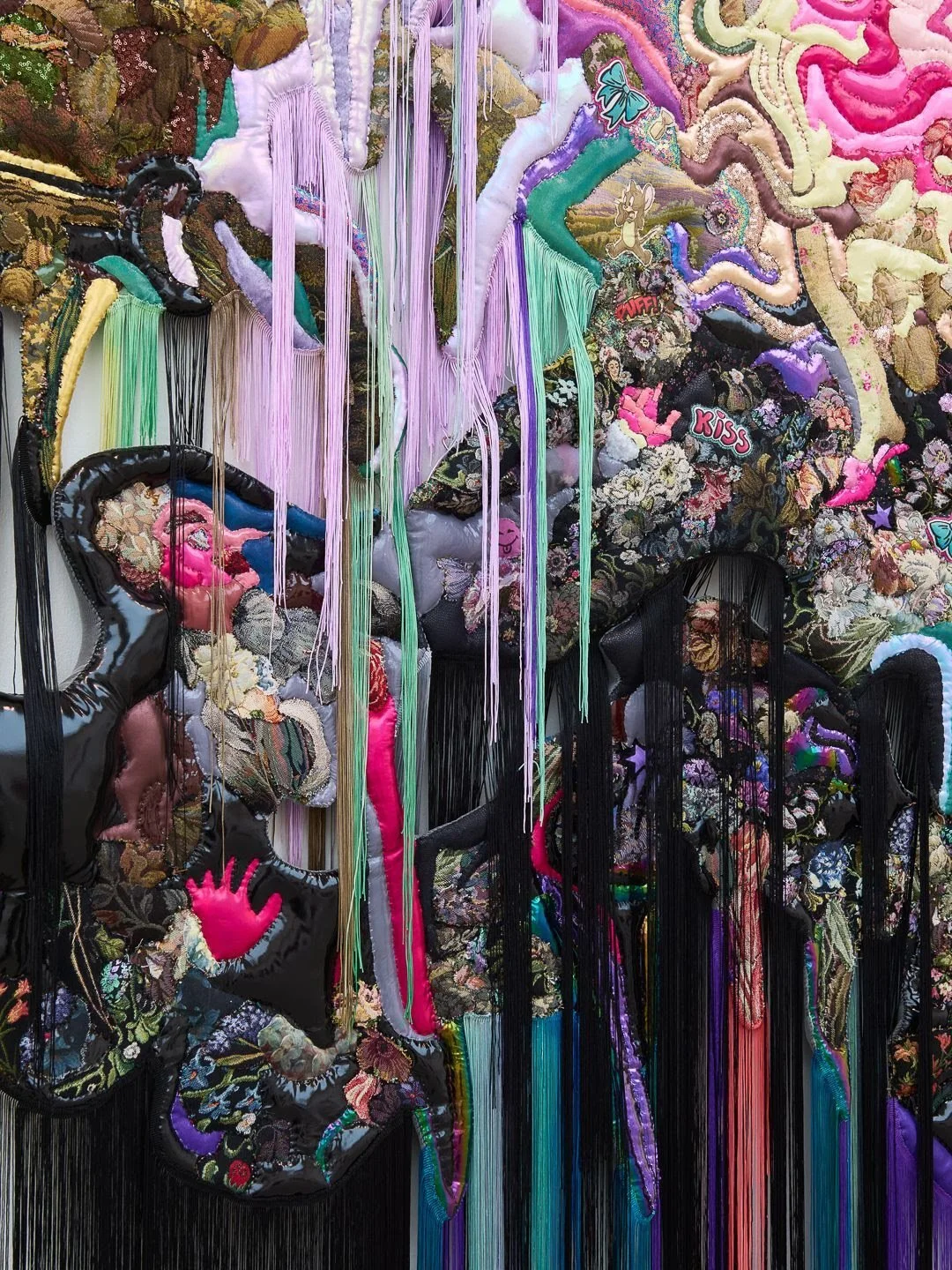
“My tapestry painting is dressed up in fabrics that refer to the erotic: shocking and hot plastic pinks, deep purples, flowers, chains, kinky black glossy plastics, and fake leather”
How does that play out in a work like Flight Mode (After Fragonard,‘The Swing’) which you showed at the Saatchi Gallery?
When you think of the Rococo, you think of The Swing by Jean-Honore Fragonard. It is one of the most appropriated paintings of this period by mainstream commercial culture. You see a young woman in a pale pink dress that billows around her with two men on each side. The one on the right is holding the rope that controls the swing while the other one has fallen over in the bushes and lurks under the woman’s skirt. One shoe is flying through the air while the other one is almost dropping. The work is full of sexual references. At the time, this painting was made for the male gaze and male sexual fantasy. The woman has no agency; it’s the man who’s swinging her who is in control. With In Flight Mode (After Fragonard,‘The Swing’), I wanted to take back female control by making a work that is loose and dynamic in gesture to unlock the previous objectification of the female form. By making this work extra-large in scale, the opposite of its original, I was able to emphasise movement and disorientation by obscuring the subjects in the original iconic image –for example, the woman’s dress that appears as if it’s going in and out of shape. For me the painting is also about looking - the two men who are looking at the woman and the viewer who is looking at the painting. Surrounding the central figure with fringes might give the idea that one is looking at a theatre stage where the woman is acting out her fantasy. My reinterpretation can be read as taking pleasure in being looked at, but only on one’s own terms and with total freedom of expression. My tapestry painting is dressed up in fabrics that refer to the erotic: shocking and hot plastic pinks (a fetish colour), deep purples, flowers, chains, kinky black glossy plastics, and fake leather. The sculptural bodily elements in the work could make it almost like an odd, fetishised object. Then there are small side jokes like the cartoon animals Tom and Jerry who are having fun dancing and jumping on the woman’s dress and in the foliage. On the one hand, the work is bedazzling with its seductive materials, while on the other it can appear wobbly, quirky, imperfect and grotesque.
“Beauty is as much a construct as femininity is. Beauty is made and decided by who’s in power”
How do you approach the colour spectrum and how much does the disruption of beauty inform your work?
Beauty is as much a construct as femininity is. Beauty is made and decided by who’s in power. Also historically beauty has been associated as male and something that only men can create and judge over, women can only make pretty things. In my work I play with those ideas and turn the pretty in large-scale masculine size works and use beauty more as a double-edged sword to destabilise rigid conventions and restrictive behavioural models. By making work that challenges western ideas of beauty, I’m indirectly disturbing identity, systems and order. Like ornament, colour has been seen as a cosmetic extra, feminine, artificial, dishonest and there to conceal. Colour is associated with irregularity or excess and therefore can promise liberty and threatens to disorder. Colour is also connected with our childhood - think of cartoons. Colour is connected with the unconscious - it doesn’t need words. When I use colour I think of the body. I think of colour as a way to resist order and normality. I use colourful fabrics rather than paint as they have more intensity and as my work talks indirectly about the body, it makes more sense to use fabrics as my colour palette than actual paint.
How has your art practice helped you evolve as a human being?
My practice helps me to grow as a person. It’s where I can be myself and also where I have to leave some perfectionistic tendencies at the door. I have to step in the unknown and allow myself to make something ugly, ridiculous and over the top. Making the work is more about challenging myself and allowing myself to go bonkers. When I read and write about the topics that interest me is when I learn about the world and my role in it. I do believe that reading, writing and self-development are equally important as making work. They feed off each other.
Introduction & Interview by John-Paul Pryor
Find out more about the artist here
Image Credits: Detail shot of Floral arrangement 2 (After Jan van Huysum, still-life with fruit)2026; Portrait by Pasquale Viglione; Floral arrangement 2 (After Jan van Huysum, still-life with fruit)2026; In Flight Mode (After Fragonard, The Swing) 2026. Portrait by Pasquale Viglione.. Detail shot of In Flight Mode (After Fragonard, The Swing), 2026. All photography Pasquale Viglione. All images courtesy of the artist.
Get up-close-and-personal with artists from all over the world and unlock the mysteries of the creative mind.
Read in-depth interviews with the most exciting cultural movers and shakers shaping the creative landscape.
Discover the actors, authors, designers, mavericks and entrepreneurs at the bleeding edge of cultural life.