ART & IMAGE: INTERVIEW
Across The Universe: Antony Daley
Abstraction, Cosmology and Forever Seeking Wonder
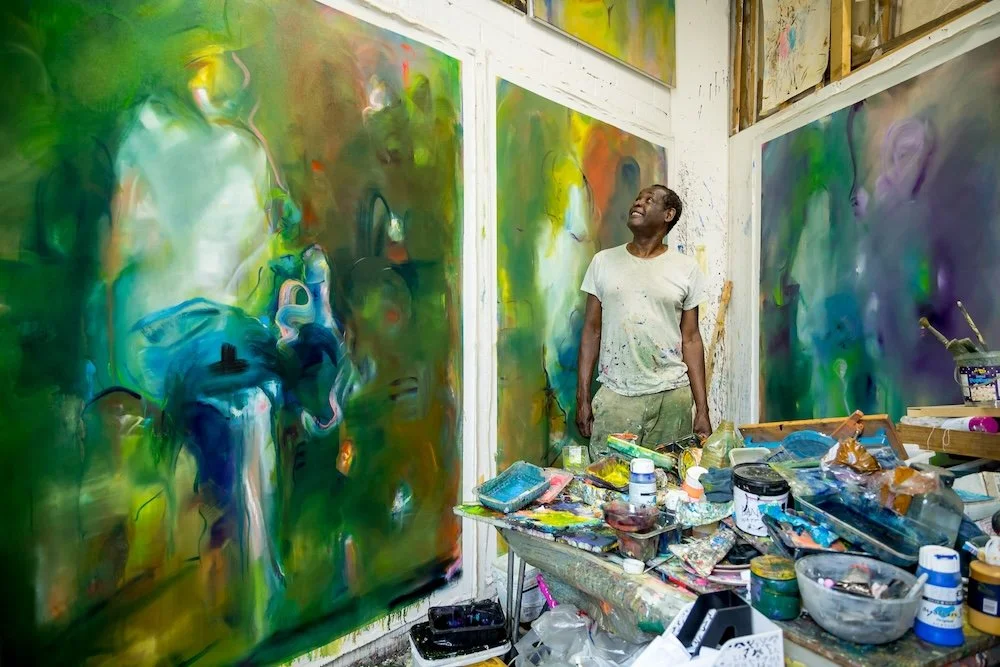
The Jamaican-born British artist Antony Daley migrated to the United Kingdom in early adolescence and studied painting at Chelsea College of Arts, emerging in the early 1980s with a strangely capacious technique that confirmed him as being in possession of rare painterly skill. Across a span of four decades, his increasingly celebrated oeuvre has grown outward from the hermetic laboratory of his studio into vast, immersive canvases that are now housed in prestigious public and private repositories across the UK, the Caribbean and Europe.
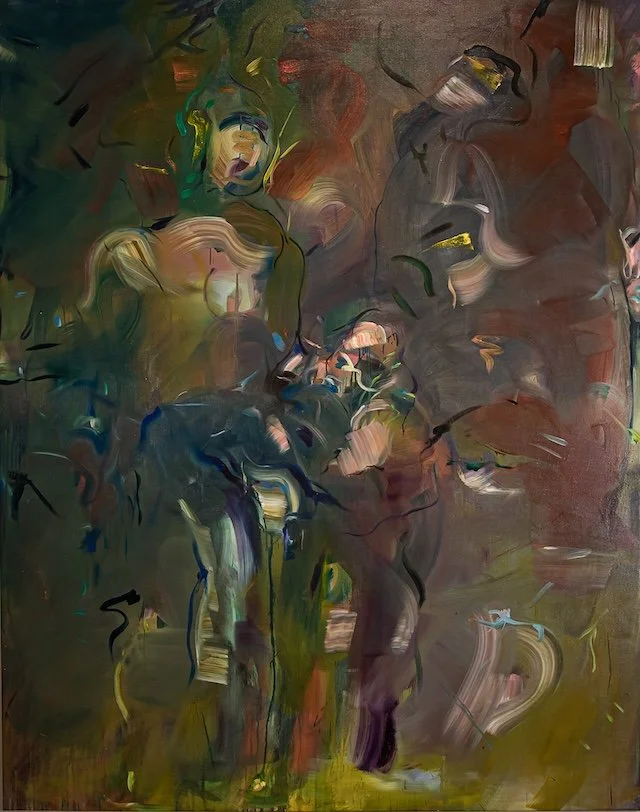
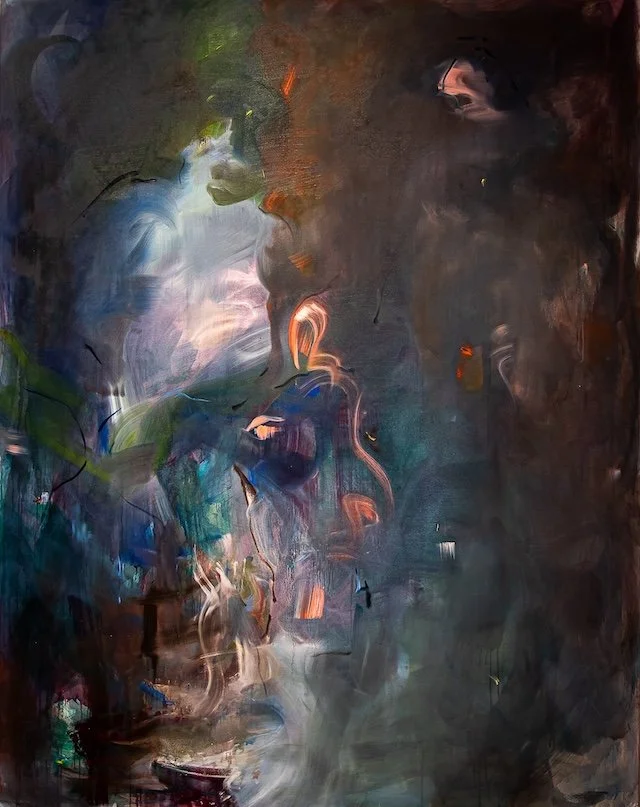
His visual idiom is arguably allied to the mastery of the old academies, but Baroque drama and Renaissance composure are not so much fetishised as utilised as scaffolding in his work – recasting chiaroscuro, layered glazing, and the measured architecture of composition to sustain an aspiration toward transcendence. Upon these vast and luminous canvases, the impulsive nature of abstract expressionism is negotiated through a painterly temperament that marries freewheeling calligraphic energy to a slow, almost reverential modulation of colour and tone.
There is also a deep love of mathematics and cosmology informing his unique visual lexicon – topographies that might be read equally as microscopic and astronomical constantly recur as motifs in the work, and he has often been included in thematic group shows that explore the overlapping intersection of science and art. In this rare interview with FUTURISTIC DRAGON, he discusses finding wonder in everything from a Newtonian equation to a falling leaf, and tells us why he believes play is the ultimate expression of individual freedom.
Where did your desire to create art initially stem from?
That’s a very big question with a lifetime of answers, isn’t it? I mean, I’ve made art of some kind from as early as I can remember. One of my earliest memories is one of my relatives coming to show my grandmother a carving of a bird they were very proud of. I thought it didn’t look anything like any of the birds I had ever seen, and I immediately ran off into the woods to go and find some wood to carve a better bird.
As a kid in Jamaica, I was always battling with all the artists in the community, as well as all the artists and thinkers in the books at my grandparents’ house, and trying to be better, or as good, as them. From a very young age, I had a fascination with all the geniuses in the world – not just painters, but philosophers and scientists – and the one that fascinated me more than anybody else was Isaac Newton. As a child, I was like a little Newton in my mind, and I was constantly making little experiments.
It’s interesting that you were initially drawn to science…
I was also always really interested in The Book of Genesis. I remember being in church one day, and the preacher talking about God and the origin of the galaxy, and trying to twist astronomy into religion. He was showing us a picture of a spiral galaxy, and trying to tell us that somehow God made it, and I just remember thinking, there’s a triangulation of thought here, and no real truth to what he is saying. I remember going to sleep that night and just thinking that it was nonsense, and that I didn’t want to believe in God any more. In the morning, I woke up and ran down to look at the spiral in our little river in the garden, and I was really interested in the connection between the two of them – the spiral galaxy and this little whirlpool.
“I suppose what still plays out in all my work is a kind of reverie and reverence of beauty”
It sounds like you were aware of a deeper reality at a very young age, or a sense of wonder …
I became obsessed with the origin of beauty very early on, and quite obsessed with the meaning of beauty. As a child, I used to go into the bushes and look up through the leaves at the gaps in the canopy, and the water falling through when it rained, and the little bowls of water, and tiny rainbows, and stuff like that. I used to go off by myself a lot, and I used to enjoy that. Where we lived in Jamaica until I was seven-and-a-half years old, we had a river in the back garden with great big boulders, so I used to go and sit on them and just imagine all sorts of things. It was a kind of reverie really, and I suppose what still plays out in all my work is a kind of reverie and reverence of beauty. It’s all basically to do with the origins of life.
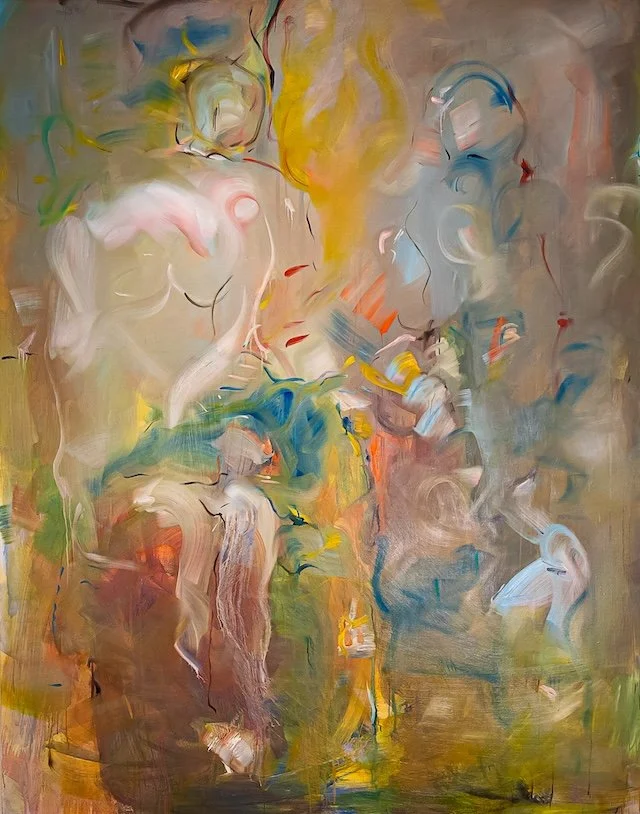
“There is a reality to a painting and it is the same reality that you get from looking into infinite space”
Are you drawn to that notion ‘truth is beauty, beauty is truth’ as espoused by John Keats?
I suppose I’m trying to understand truth. I knew there was no absolute truth early on, but I loved the idea of inventing truth, inventing reality – doing experiments and getting things right. In my painting, I think that’s always been the drive. By the time I was nine years old, I was obsessed with the idea of universal beauty, and I just wanted to try to pursue it – beauty and truth, but also the scientific truth of beauty, wherever, and whatever that was. By the time I started school in Jamaica, I was already too bright for school, quite frankly, because I had educated myself. I had also decided for some reason that I wasn’t going to get a Jamaican accent, and all those kinds of things. I don’t know how it happened, but I did make these decisions as a kid, and I just painted and read books all the time. I felt I had just found the truth in drawing.
How would you personally define beauty?
Well, for me, it’s about the beautiful minds of certain people – every so often individuals are born, and they just seem to have these great minds. And that is true across the board. Creativity has nothing to do with art, and it’s not just contained in art – it’s also about maths, physics, geometry, music. I love the beauty of Einstein’s equations, for example, and the way they’re connected with art. There’s always a time when there seems to almost be a surge of thinking across disciplines, and they seem to connect a collective consciousness and push things forward. I really love that.
And I love the way a painting you are making has its origins from nowhere, then, as it evolves, it becomes like a collective of consciousness – it’s extraordinary, like magic. By definition, you’re making a painting that is of nothing, particularly, because it’s an abstract painting that has a kind of personal language, and a connection with the history of painting. Then, when you stick it on the wall, and somebody comes along and understands it, or creates an understanding of it, it has become kind of a portal. I love that connection with the viewer trying to define and play with reality, because there is a reality to a painting and, for me, it is the same reality that you get from looking into infinite space, or trying to explain the origins of galaxies. An abstraction is not a painting of nothing. It’s everything and nothing, and I love that paradox and contradiction.
Words & Interview by John-Paul Pryor
Images courtesy of the artist. Find out more about the artist here:
Get up close and personal with artists from all over the world and unlock the mysteries of the creative mind.
Read in-depth interviews with the most exciting cultural movers and shakers shaping the creative landscape.
Discover the actors, authors, designers, mavericks and entrepreneurs at the bleeding edge of cultural life.