Sublime Intimacy: Agata Przyżycka
Mental Health, Eroticism And The Eternal Quest For Beauty
ART: INTERVIEW
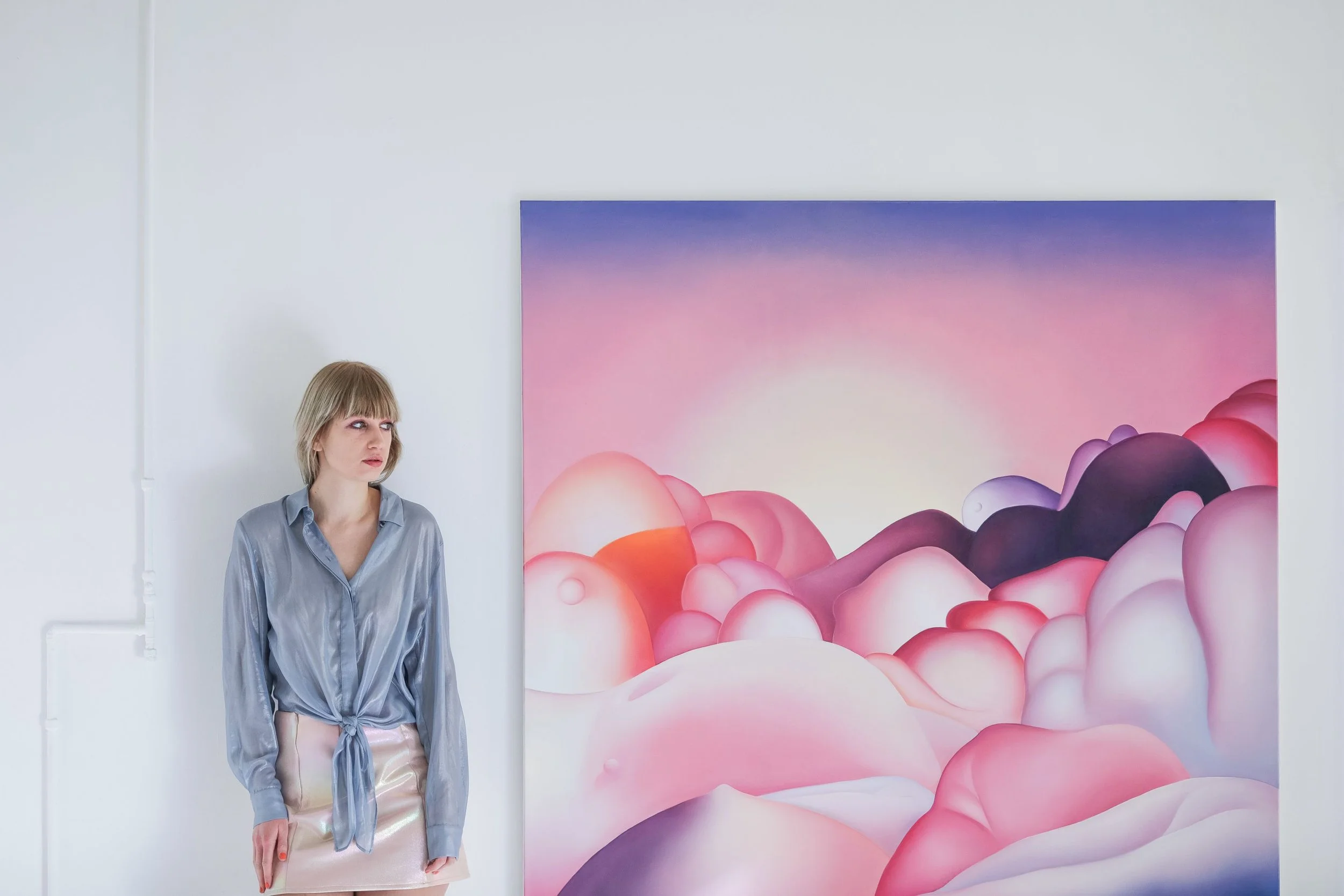
Agata Przyżycka is a young Polish painter whose work moves like a thought that has just become flesh. Her insistently sensual canvases treat the female body not as an object of display but as a field for experiments in perception, in which limbs and curves become topography – the body at once both organism and language, speaking to the viewer in gestures borrowed from landscape.
There are obvious parallels to Georgia O’Keefe in her work, and she describes her practice as a process that seeks to uncover sublime intimacy, with the starting point of each painting often being a photographic session with close friends or family members. These sessions provide an emotional jump-off point for the artist, who then radically alters the forms caught in the eye of her lens into sumptuous abstractions that are both dreamlike and imbued with subtle eroticism – inviting you to deep dive into unfettered reverie.
As such, her practice refuses simple allegory, preferring instead a poetics of relation — between what the eye recognises and what the eye must learn to read. In this interview with FUTURISTIC DRAGON, the artist—whose reputation grows quietly, like light through a shutter—speaks of art not as spectacle but as a means of attention and therapy, loosening the tightness of anxiety and opening a small room in which it becomes possible to breathe..
Talk to me about your childhood. Where does your interest in painting originally stem from?
I took painting classes from early childhood, and it has been very important for me my whole life. It was immediately a form of expression that I liked and understood. I remember that the first exhibition we had from our painting lesson made me really nervous, though, and I still get nervous showing other people my work. I also find it quite difficult to talk about my work. I think I am quite a reclusive person, really – I don’t like to talk with other people so much, and I love the solitude of painting. It’s almost a form of meditation for me, and I can happily spend a lot of time in my workshop alone. I think the first thing that really drew me to art was probably album artwork, because my parents absolutely loved music. I can also remember my parents taking me to Barcelona very young, and the Gaudi Park was just amazing to me – there was this very organic feeling I got from the sculptures. I suppose, even from a very young age, I knew that I wanted to go the academy of fine art, and the first really important thing I became interested in when studying was realist paintings and realist art.
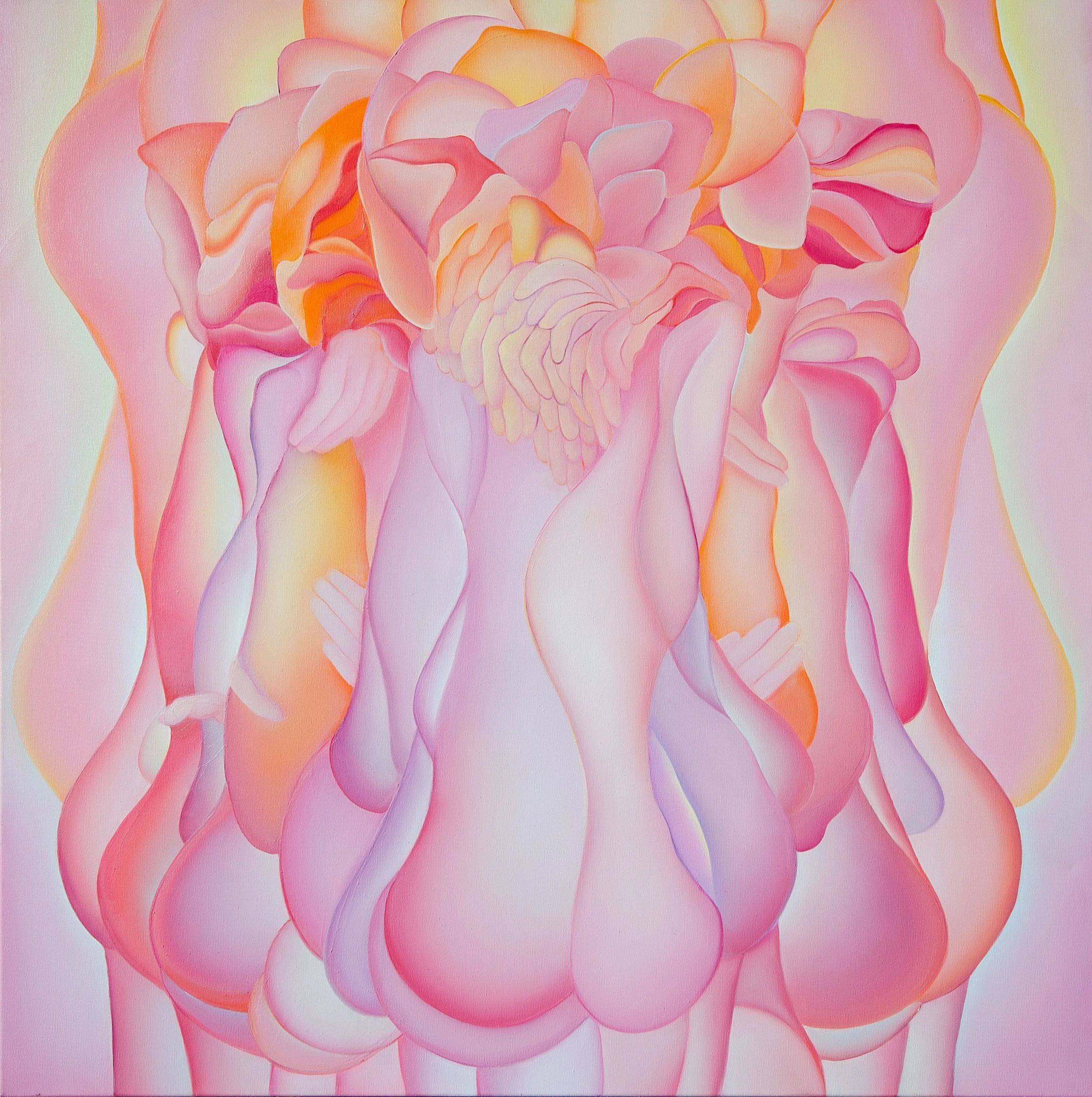
“Femininity is important to me. I consider woman as the source of creation, in a way – the bringer of life.”
Is that same organic feeling something you are seeking to communicate via your own art practice?
The first thing I wanted to do in my work was to show something that lies behind the everyday, and uncover a kind of erotic intimacy, but, lately, it hasn’t been so important to me. I think I have created my own aesthetic alphabet, and I use the female body as a sign. I do perceive my work as a process to look at nature, language, the body and femininity, and the main topic of my work is to capture the dynamics between those components. Working on a painting is an important and emotional process for me. Before I start, I will usually take a photograph of people I know from close friends and family, to kind of explore that notion of intimacy and the body, and I’m always seeking to go deeper into intimacy by taking the realistic form into abstraction and geometric shapes. I think abstraction has more value for me now than realism, because the viewer can kind of imagine something, without any pressure from me about how the painting should be received, or how they should feel.
How do you feel yourself when you view your work?
I paint a lot and always have a problem working out when to stop painting – it’s a long way for me to go conceptually and I am very much within the process.I actually think that the time I value most is that moment when I actually start the painting, and when I am thinking about it and am not sure what I will do. It’s good for me to have exhibition deadlines because it makes me stop painting when I need to. It also allows me to work on three or four paintings at once. I like doing that because it allows me to create the works as a series that correspond to each other.
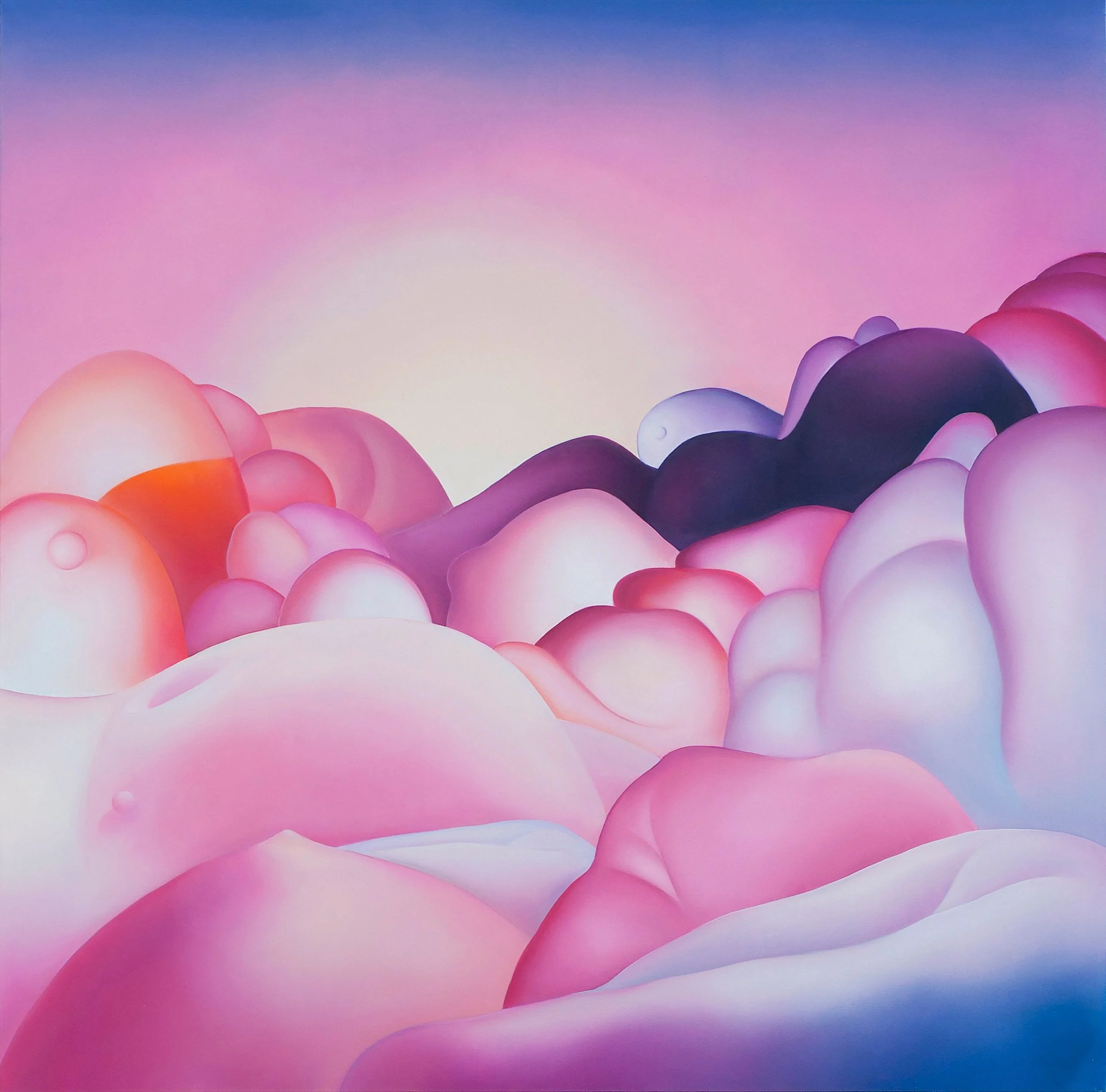
Why does it feel so essential to you to approach womanhood and femininity in your art practice?
It’s actually true that I’ve only been painting women’s bodies lately, but in the past I have painted men as well. I’m not sure why I was drawn to focus mainly on women but maybe it’s because the female body is more associated with biology, nature and the sense of a landscape to me. The palette that I use in my painting is generally inspired by the colours of sunsets, or flowers, which I know are pretty common topics. Femininity is just very important to me – I consider woman as the source of creation in a way, the bringer of life. All of my paintings are very close to my heart and play a big emotional part in my everyday life, but, ultimately, I can’t explain why I always come back to the female figure.
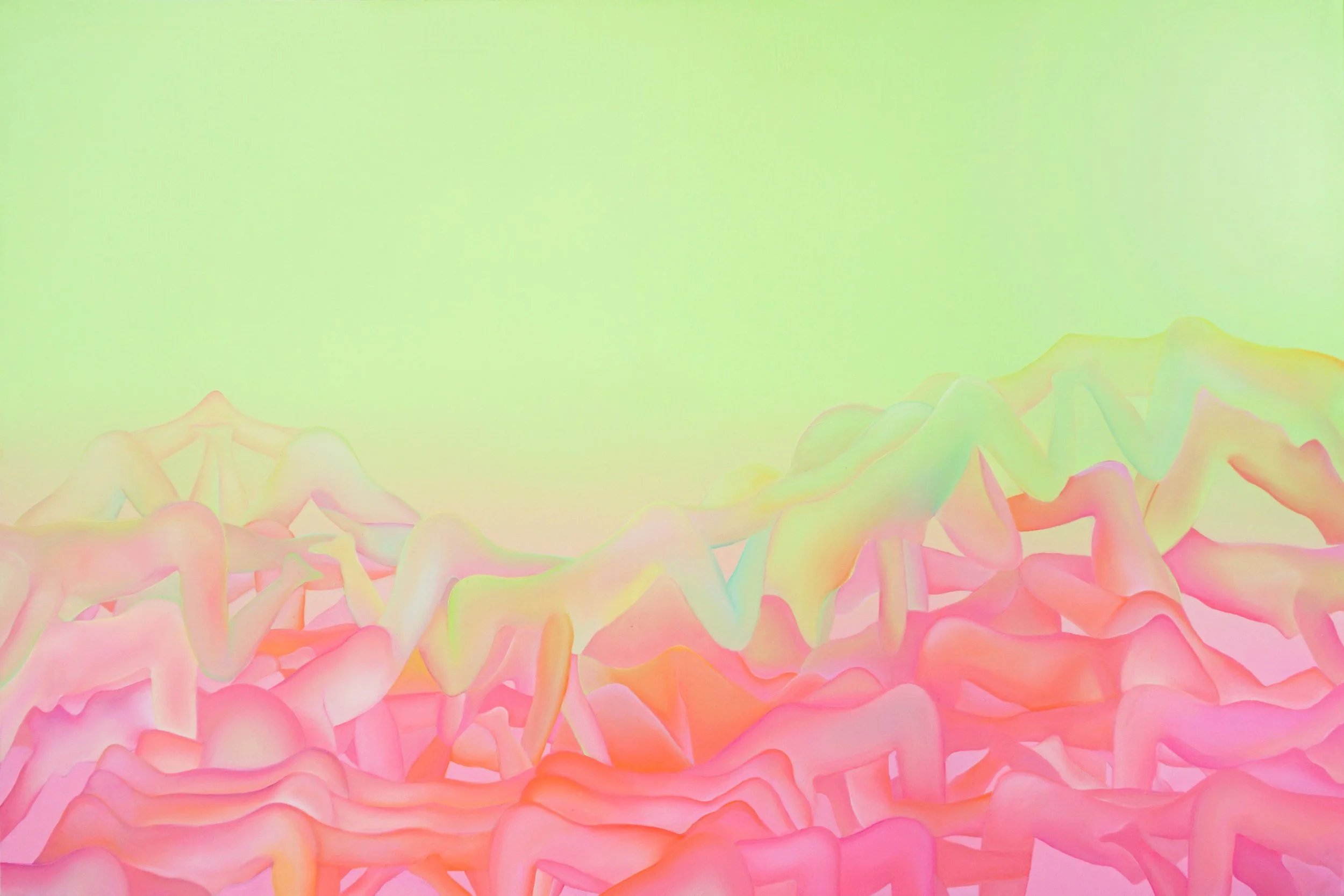
“Beauty is always there, every day in our lives, but we don’t look for it enough”
Does your art act as a kind of therapy for you?
Well, in a way, yoga and painting are very similar practices for me, and art has always been very important therapeutically for me. I can’t ever imagine stopping painting. I can find it difficult to go to work in the day-to-today, and I spend all of my free-time painting because it makes me feel better. I had therapy when I was younger, but my daily routine of painting is really the thing that makes me feel okay and calm, and makes me feel free. I don’t feel anxious or nervous when I paint; I feel that I can become anything on the canvas. I can’t really express why beauty is really so important for me, but I have always really been drawn to beauty, and I look for it every day in nature. Beauty is always there, every day in our lives, but we don’t look for it enough. I need that contact with nature, and my art is my connection to it. I like to spend time with other people, but I can’t ever predict what that will be like, but when I am alone, I am comfortable and I know that I can express myself freely.
Introduction & Interview by John-Paul Pryor
You can find out more about Agata Przyżycka here
Images (top to bottom): portrait of the artist at Kravitz Contemporary by Grzegorz Podsiadlik; Untitled, oil on canvas, 2021, Agata Przyżycka, courtesy of the artist; Trzymam świat Niepojęty, oil on canvas, 2021, Agata Przyżycka, courtesy of the artist; Untitled, oil on canvas, 2021, Agata Przyżycka, courtesy of the artist.
BARBARA KRUGER
Next month, Rizzoli publish Making It Up As We Go Along – a must-have visual archive celebrating the 20-year visual history of Dazed & Confused magazine, edited by Jefferson Hack and Jo-Ann Furniss. Unsurprisingly, it’s a veritable smorgasbord of stimuli featuring iconic, game-changing work from some of the world’s greatest photographers, stylists and artists. John-Paul Pryor is one of the additional editors who worked on the forthcoming publication, sourcing interviews with some of the in-house movers and shakers that defined the early years of the magazine, and some of those contributors whose specially commissioned works helped to push the form forward in unique and boundary-defying ways. One such artist was Barbara Kruger, who designed a limited-edition cover for The Freedom Issue and took over the inside pages with an intervention that wittily turned the culture of the style magazine firmly upon its head. In the first of a series of in-depth interviews previewing the publication of the book, AnOther presents an interview with the legendary image-maker – whose work has become an internationally recognised feminist touchstone in art history – in which she talks candidly about her process, the power of words and the place in her heart that will always be reserved for Dazed & Confused magazine.
Damien Hirst once remarked in the pages of Dazed & Confused that art and advertising share the same language – is that something you have also sought to explore over the years?
Well, I should say, I’ve never worked in advertising – my experience was as an editorial designer for magazines – but you could say, in the bigger picture, that magazines are vehicles for colour advertising. I think one of the things that art shares with what Damien Hirst would call advertising is that all art – especially poetry, for instance, or visual art – shares an economy with an advertising practice. It is a condensation of thoughts or feelings or moments, and that commentary is an encapsulation of what living might be or feel like. In the long run, my work really came out of my experience of doing serial page designing – it’s not about advertising per se.
What is interesting about employing that economy in art?
One thing I learned working at magazines was that if you couldn’t get people to look at a page or a cover, then you were fired. It was all about how you create arresting works, and by arresting I mean stop people, even for a nano-second. These days, short sentences and phrases are in many ways more vital than ever. The internet means we all have attention spans of kiddies riveted by mouse-like movements. The reason why bookstores are going out of business in The States is that people just can’t focus on longer narratives now – even narrative film is in crisis in many ways, unless it’s an adventure film. Things that require a short attention span are things that I’ve always been comfortable with because I have a short attention span, but my video work and my immersive work all demands a bit more time from the viewer. The videos and the more installations are really conflations of images and much longer texts – they’re scripts.
Where do you think the printed form is going, and is it still a more powerful way to disseminate art than the digital form?
Well, magazines are a powerful way of distributing pictures and words, of course, but we’re in a kind of crisis with the internet – it’s changed the whole trajectory. That doesn’t mean print doesn’t continue on a certain level. I do think people read totally differently online, though. For example, I have been sitting here reading a hard copy of the New York Times. And when I read a hard copy of a newspaper, I tend to read it very differently to how I would online. I tend to read a hard copy of the New York Times every day, and I read the LA Times and The Guardian and The Independent online. I think you read much more rigorously when you have a hard copy, you really do, because the distraction level is lessened – you’re forced to stay with narrative of the story and the story is more explicit, you stay with it. I don’t know… I think that magazines will survive this moment better than newspapers. I remember years ago, when I was at Condé Nast people were saying television would destroy the magazine market.
I think what’s really interesting is the question of where it goes next. How the language of advertising will still be channelled into our consciousness and define us. It could get quite William Gibson, even more subliminal…
I think that’s already there on a certain level. I don’t think it’s subliminal so much though – it doesn’t have to be anymore. As subjects, the readers and lookers are far more passive than they used to be, so it can be forthright and people will just do it. I think the big challenge is whether it’s possible for young people today, or even older people, to experience the world without looking through a lens or looking at a screen.
You have made some quite profound statements with your work over the years, not least in your Human Rights cover for Dazed. Do you believe art can make a difference in society?
I think things change incrementally, and I think art – whether it’s visual art, or music, or movies or any kind of cultural production is in some way a kind of commentary, what it means to be alive, about what it means to live another day, to take another breath. Not literally so, but any kind of notion of an examined life – as such to consider these moments and maybe promote the kind of doubt or questioning, it objectifies our experience on a certain level. So just in doing that, just in creating commentary as opposed to just being full on in the moment, proposes a kind of change or consideration… I think of things changing very incrementally, you know.
Is that what your longer scripts are about, and specifically your pages in Dazed– identity and what it means to be alive?
You know, I write a lot of scripts for my videos, and I listen to the way people speak. I’ve always been very tied to language. I always see my work as coming out of my experience in magazines, so coming back to the form and looking at the mechanisms at work when you look at a page or turn a page was thrilling, especially because it was Dazed. I remember when the magazine first came out – there was no equivalent in America and there probably still isn’t. Dazed added a whole different edge – it contemporised the magazine form to some degree, and that was something that could only have happened in London at that time. In many ways, the work I produced in Dazed is just a commentary about how certain cultures think and see, and like to be seen. I think what they foreground is my continued use of direct address and the use of humour in my work, because laughter is an important device that isn’t owned by either the left or the right... It can be sort of emancipatory.”
Making It Up As We Go Along, by Jefferson Hack and Jo-Ann Furniss, is published in October 2011 by Rizzoli.