ART & IMAGE: INTERVIEW
The Order of Things: Ike Quirk
Universality And The Poetic Nature of Random Connection
If existence is little more than a sequence of random events, then there is something quietly radical about the idea that a chance encounter can change the course of a life. A few words exchanged between strangers, an unexpected conversation, a message arriving at precisely the right moment. We tend to think of such things as incidental, yet occasionally they seem to possess such extraordinary synchronicity that they become the very events around which our understanding of ourselves begins to shift. For Irish artist Ike Quirk, the profundity of seemingly insignificant moments has provided the foundation of an intensely personal artistic language. What began during a journey along the Camino with his son David in the autumn of 2024 has evolved into an extraordinary period of creative exploration, captured in his new monograph, Hey, Ike, published by Constellations Press.
The title itself originates in a personal WhatsApp message thanking Quirk for his openness and vulnerability. Its emotional resonance set in motion a series of paintings rooted in the unpredictable nature of human connection, where fragments of conversation become starting points for vast, abstract compositions. In his work, words are often written directly onto the canvas, sometimes concealed beneath layers of pigment, sometimes left exposed, their original meanings gradually transformed through the physical act of painting. Beneath the apparent spontaneity of his gestural abstractions lies a deeper meditation on memory, responsibility and the passage of time. In one particularly affecting series, the words of his daughter become a reflection on the changing relationship between parent and child, while elsewhere Quirk explores the strange paradox of an increasingly ‘connected’ world in which genuine human encounters seem ever more elusive.
His paintings also reveal a growing preoccupation with the rhythms of the natural world, with the cycles of growth and decay offering a philosophical counterpoint to the fleeting nature of human experience. Perhaps most strikingly, his practice has evolved towards an almost instinctive restraint, discovering that the spaces left untouched can carry as much emotional weight as the marks themselves. In conversation with Futuristic Dragon, Quirk reflects on the beauty of accidental encounters, the vulnerability inherent in making art, and the possibility that our most private experiences might also be our most universal.
“I don't think anybody necessarily enters your life for a reason. I think you have a need, and you're subconsciously searching for something. In searching for that something, you might find a situation that just works for you, that resonates with you and transcends what you might normally think is possible”
Your paintings often begin with fleeting encounters that leave a lasting impression. Do you believe certain people enter our lives for a reason, or is meaning something we create from the accidents of existence?
Well, I suppose in my case these accidents of existence have been the genesis of the whole creative process I've been on since the autumn of 2024. From the very start, it's really been based around the randomness of meeting certain people and what they might write or say. I don't think anybody necessarily enters your life for a reason. I think you have a need, and you're subconsciously searching for something. In searching for that something, you might find a situation that just works for you, that resonates with you and transcends what you might normally think is possible. In my case, it goes right back to the Camino with David, my son. From then on, there was this creative idea of taking a line from somebody that really resonates with you and thinking about it. You're not thinking about the person so much. You're thinking about how that line resonates with you, and then using it as a bridging point to begin a painting or a piece of work, even a piece of video art. It comes down to that line, the need you have, and the belief that you can take something random that has resonated with you and make it into something quite large and interesting. Something that connects you emotionally to a particular situation in your life, but also, quite unexpectedly, reflects back onto the life of the person who said it.
Your monograph is called Hey, Ike, an unusually intimate title for an art book. Where did it originate, and does it reflect something about the conversations and encounters that have shaped your practice?
The very beginning of this was a WhatsApp message I received that said, "Hey Ike, thanks for your vulnerability and telling me these things." For whatever reason, that message just exploded all these ideas in my head about what I've been doing since. It brought in this whole idea of the power of random connection. It also made me realise that I might have been living almost in a silo of similar voices, similar opinions and similar people. When you take the risk to share, particularly when you're doing something like David and I were doing on the Camino, it becomes a sharing experience. It's not so much about anything else. You tend to have a better quality of conversation with people you might not regularly meet in everyday life. That line, "Hey Ike, thanks for your vulnerability and sharing these things with me," led to the idea around The Emotional Intensity of Random Human Connection, which was the first project I started with Flo in Berlin in the spring of 2025. It's an intimate title for the art book because it's the genesis of this whole thing. It's the beginning, and it started a series of totally unexpected events that followed from it.
“When you're lucky enough to show your work and other people come to see it, you don't particularly want to tell them exactly what it's about for you. But it's interesting to hear what other people take from the paintings. What they take is diverse, sometimes unexpected and definitely universal”
Your exhibition You Did Everything You Could for Me So Far takes its title from something your daughter said. How did those words change your understanding of love, responsibility and the passage of time?
Firstly, the exhibition You Did Everything You Could for Me So Far was an interesting challenge because there was a request to produce some watercolour works for LiTE-HAUS in Berlin. At that particular time, it was something of a watershed moment for me. I started thinking about what I was going to do and what was happening in my life, because my work is personal, always personal. Then Lucy, my daughter, said that line: "You did everything you could for me so far." I think what she was saying, in a sense, was that you've taken it this far, and now I'm of a certain age where I can take some of the weight off your shoulders. It's almost a passing of some sort of subconscious responsibility from a parent to a child. I produced one work based on that, but then, almost serendipitously, around the same time, Rose said something to me: "You always know what to do." That was almost the opposite. It was an empowering statement. One was relieving me of responsibility and a certain amount of influence and power in my life, while the other was giving it back. So I made these two large watercolours and placed them opposite each other in the gallery, facing one another. That created an interesting dynamic because one painting was saying one thing and the other was saying something completely different. Both statements were made out of love for me, but they were almost completely opposite in what they were expressing. Those watercolours are probably the most personal of all my paintings. Firstly, because the lines came from my family, and secondly, because even though they're saying completely different things, neither diminishes the love or feeling behind them. That's what makes them really important to me.
Memory is notoriously unreliable, yet it shapes almost everything we believe ourselves to be. Do you see your paintings as attempts to preserve particular moments, or to understand how those moments have changed within you?
I think the paintings, from the very start, from The Emotional Intensity of Random Human Connection through to We Were Meant to Meet, That's My Dilemma, You Always Know What to Do and the You Do Love So Much paintings, are all like snapshots of time. They're thumbnail sketches of a particular moment that I've captured. The instrument of capture is the line that somebody has said or messaged to me, or occasionally something that comes from myself. So I am capturing a memory in a way. I'm not sure I'm doing it because I think memory is unreliable. I don't remember ever feeling that memory was unreliable. I do feel there was a particular moment I needed to capture, and I needed to capture it within a painting. The process was to take the line, write it on the blank canvas, think about it and use the emotion of that line to create a painting that reflected that particular time and moment for me. When I look back at the paintings now, the interesting thing about memory is being able to look at something you've produced and see whether it accurately reflects your recollection of that time. And I think it does. Particularly in paintings like You Always Know What to Do, which really captures that moment. There's another painting called I Don't Know What to Say, which came from a particular conversation I had with somebody about something in my life. It really reflects that time and that conversation. Just looking at it now brings everything back. I can picture the moment, where I was, almost what I was wearing, who was there and the pace of that conversation. That's a really strong memory, and I think I've captured it accurately.
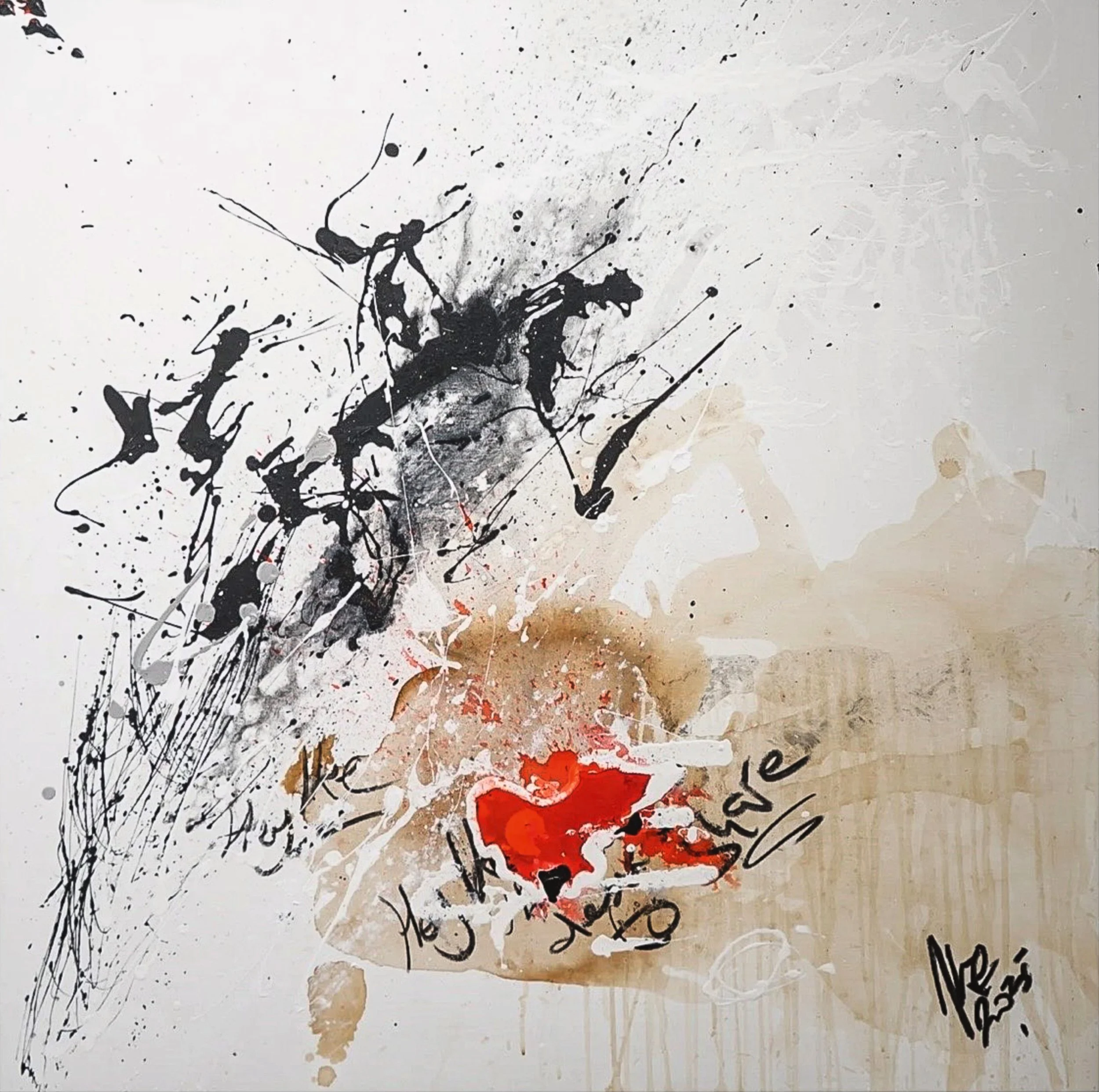
“When I first started, I would conceal what I was writing, either in paint or gesso, and then maybe sand down to it to reveal a little of its content. But more and more, because the lines and messages I picked up on were so interesting, I began to leave them visible”
Your practice moves between the deeply personal and the seemingly universal. Do you think our most private experiences are also those that reveal the greatest truths about the human condition?
Absolutely. As I would always say about my paintings, they're all deeply personal, but they do seem universal. When you're lucky enough to show your work and other people come to see it, you don't particularly want to tell them exactly what it's about for you. But it's interesting to hear what other people take from the paintings. What they take is diverse, sometimes unexpected and definitely universal. Sometimes the personal feeling you take from a painting is shared by someone else, but sometimes it can be something completely different. And it's the truth. It's their truth in their condition, and it's also my truth. So I would say my most private experiences are probably shared by most people. Everybody, in their own way, is connected by the experiences of their lives, and our experiences aren't always that totally different anyway.
Hey, Ike concentrates on just eighteen months of your practice. Looking back across that period, what changed most profoundly in your relationship with painting, and what did the work reveal to you that you hadn't previously understood?
How the work evolved over that period is interesting to me for a couple of reasons. . When I went to Valencia to paint the large canvases on the floor for the first time, the two lines I'd taken with me were "The struggle is still beautiful" and "It's impossible to be an impostor in your truest skin." They're just amazing lines, you know? And they made the process easy. I thought that when something is that interesting to me, you presume it's going to be interesting to a viewer too. So you leave it out there to be seen. The process changed in that the lines became clearer. I also ended up using new materials, like tea and gesso, which I hadn't used so much before, and a lot more charcoal on the paintings, which was really interesting. But towards the end, going back into the You Do Love So Much paintings and some of the paintings I'm doing now, in a series called Don't Ever Change, what has changed most of all is the space in the canvas. It's the confidence to leave space in the canvas that I really feel happy about. Through this process, I realised that sometimes what you leave out is as interesting as what you put in. When you put something intensely in the centre of a canvas, the colour works better, it's more interesting, and it seems more courageous to do that. That's what I'm happiest about. I've got to the point where I can say a lot more by doing a lot less.
Your life has encompassed both the physical world of the land and the more intangible world of artistic expression. Do you see a philosophical connection between cultivating something in nature and bringing a painting into existence?
That's really current for me at the moment because I'm working on an installation idea that connects those two things: the cycle of nature and artistic expression. At the moment I'm kind of obsessed with time. When you work on the land, as I do, the whole idea of time is defined by the seasons. Nature never stops. It just turns and turns every year, and it gives you a really interesting insight into how the world works at its natural best. I've been looking at an installation where, if you take a barley seed and plant it in March, it takes about five months to grow. The idea is to place five large trays in a gallery, plant the seeds, and have those five trays represent the five growing months of the year. Then there would be five large canvases on the walls around them, and I'd work on those canvases during the growing period of the crop. As the crop grows and changes, I'd be working through the paintings alongside that natural process of the plant growing and reaching maturity. And with plants, when they reach the point where they have the most energy, when they've produced their seed and the seed has matured, that's the point at which they begin to die and deteriorate. At that stage, the idea is to spray the barley and the trays a really striking red colour and let them crumble and deteriorate, while at the same time finishing the paintings on the wall. The whole thing comes together as one united installation, where nature and artistic expression exist in the same space, representing the same thing with the same sort of emotion.
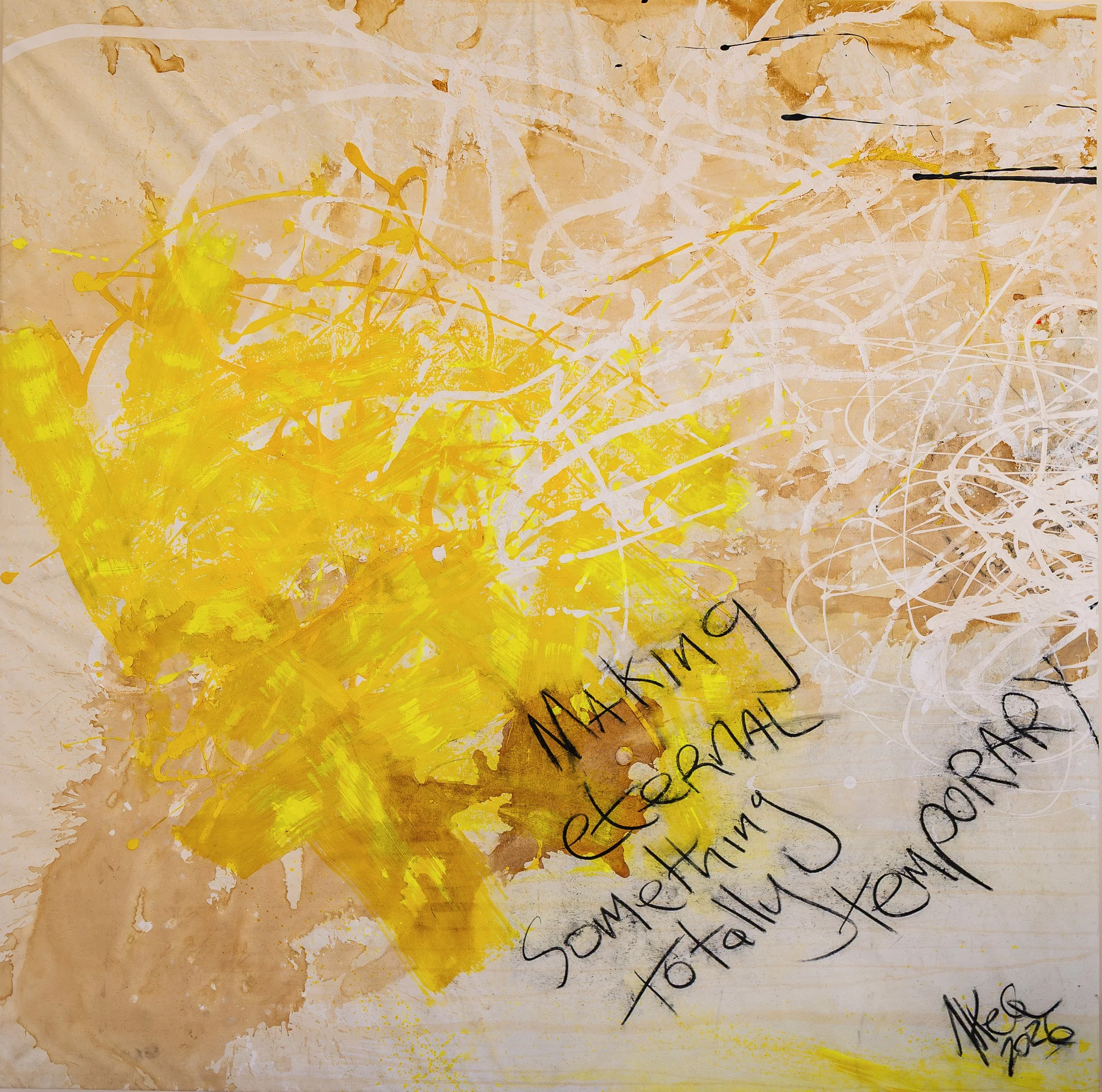
“The paintings always connect me to the place I've been and the people I've met. I'm not sure you can ever recover that feeling, but you can rekindle it in your mind and bring back the experiences you had in that place”
We live in an increasingly connected world, yet loneliness and emotional disconnection seem ever more prevalent. What do you think we have forgotten about the art of truly encountering another human being?
That's been the starting point of all this. What struck me most about the original idea of The Emotional Intensity of Random Human Connection was that, in my own life, I'd lost this ability just to meet people. Fear had taken over a lot in life. There was this fundamental fear of one human being towards another that seemed to dominate the whole social landscape. That was really the driving idea of the original project, and it was something Flo was attracted to as well. She's a bit younger than me, and she could see it more profoundly in her own life. We'd taken the personal out of human encounters and put a medium, normally an electronic medium, between people before they initially meet. What I was trying to reflect on originally was whether we could get back to the uniqueness and special nature of direct human encounters. And how could I produce paintings that connect me, in my life, to that thought and that idea?
The publication of Hey, Ike gives a relatively brief period of your life a sense of permanence. Does seeing your paintings gathered together in a book change your understanding of them, or do you feel that each work belongs to a particular moment that can never truly be recovered?
The publication of Hey, Ike was an unexpected development, really. It came from Jill and Claire coming to Berlin, being brave enough to come and see the paintings I was exhibiting there at the time, and then us getting into a dialogue about reflecting this particular period, which has been about art, human connection and Berlin. When I look at the paintings now, it doesn't really matter where I see them. They remind me of the time and place where I painted them. What I really like to do is go somewhere I haven't been before and work there. The paintings always connect me to the place I've been and the people I've met. I'm not sure you can ever recover that feeling, but you can rekindle it in your mind and bring back the experiences you had in that place. And because, as I said earlier, I'm kind of obsessed with time at the moment, the book covers a period of time and gives an almost eternal feeling to that period. I hope anybody who has the book, sees it or reads it can sense that there's a progression through the timeline.
Introduction & Interview by John-Paul Pryor
Find out more about the artist here.
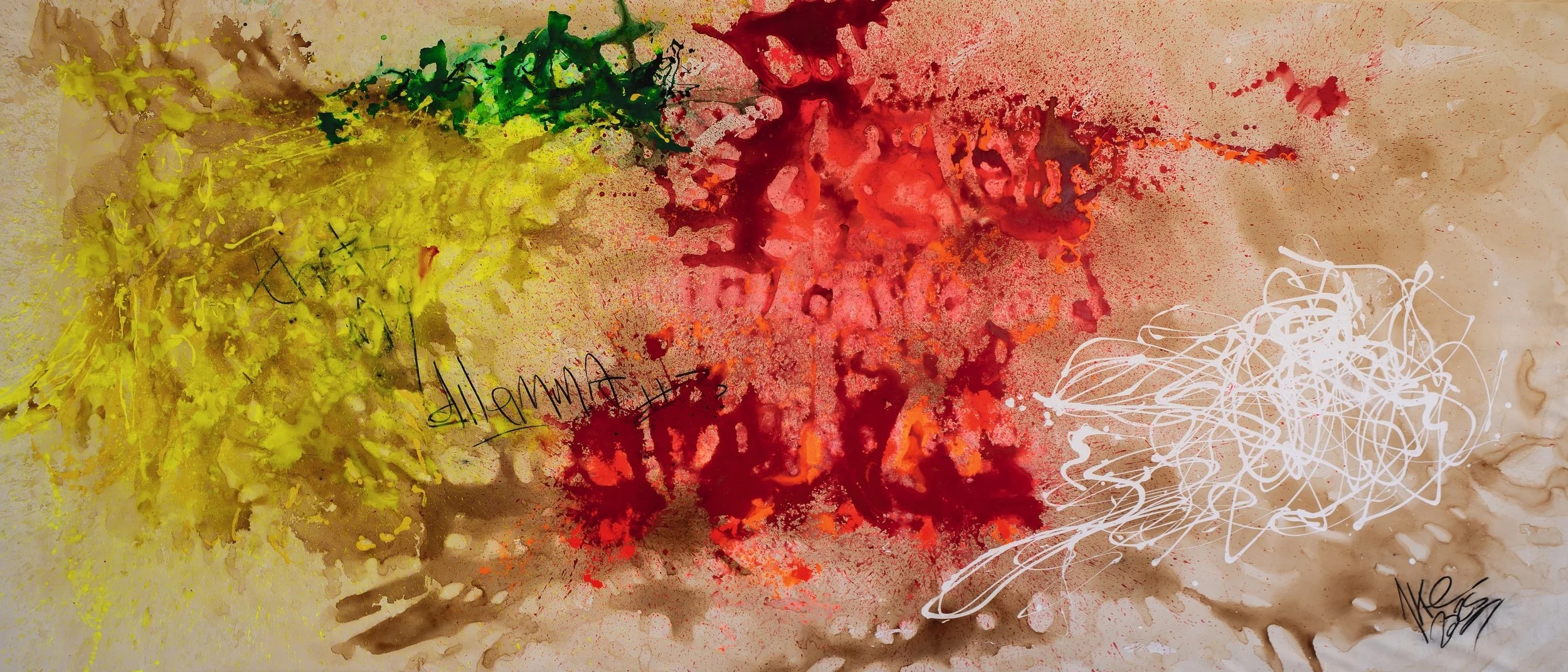
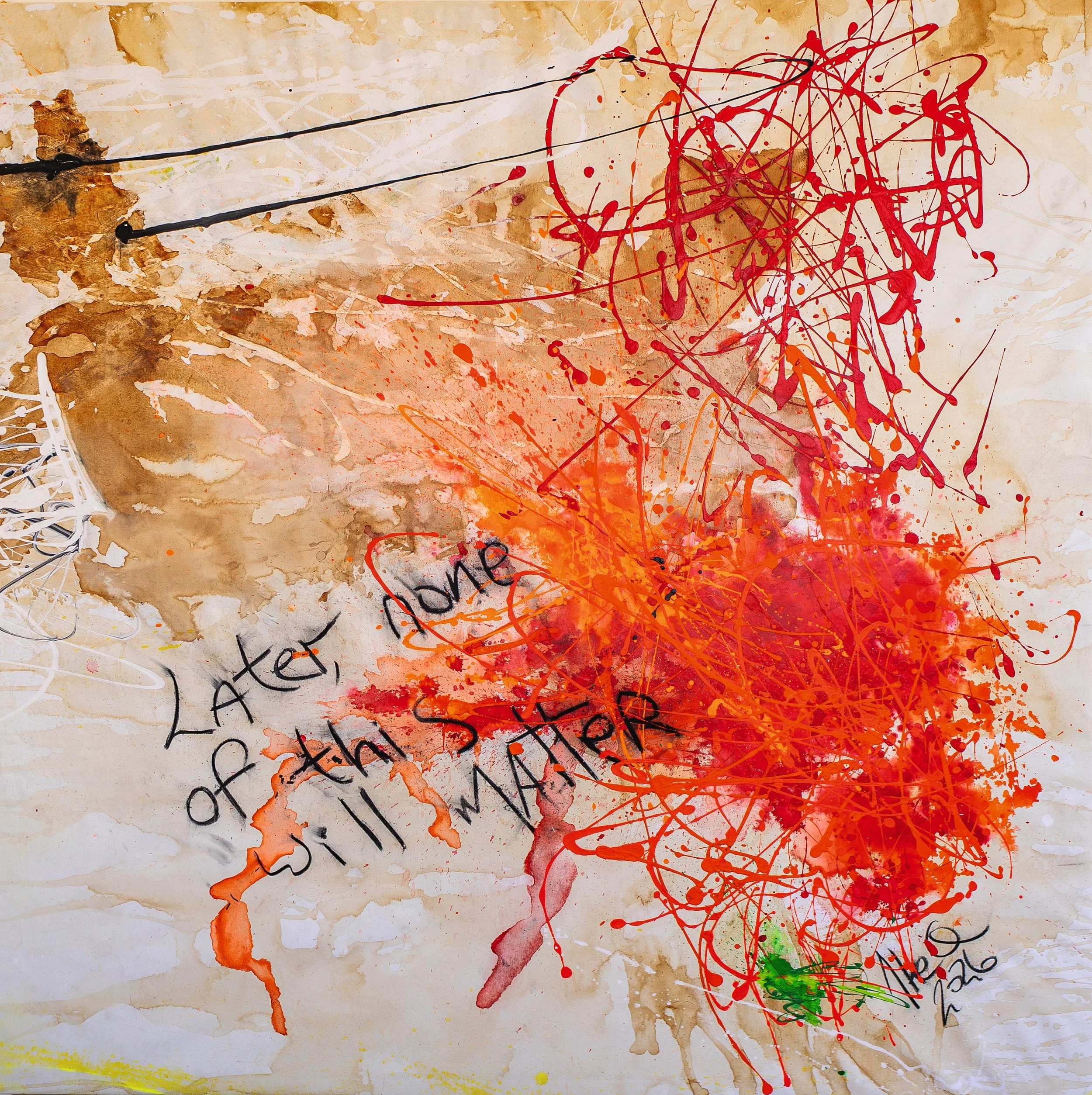
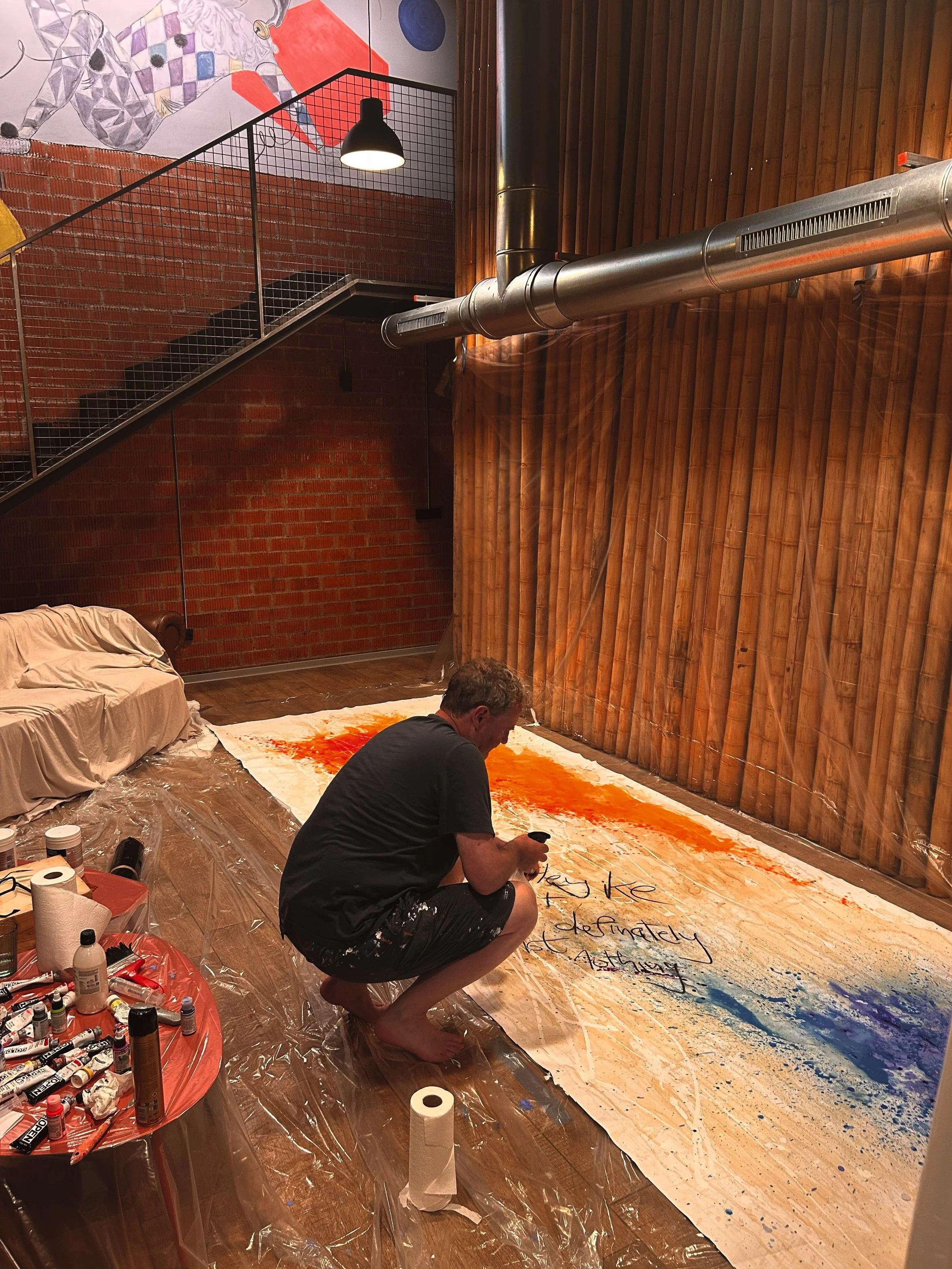
Image Credits: And That’s My Dilemma #1, 2026, 408x175cm, watercolour, tea, gesso and charcoal on canvas, ; Later, None of This Will Matter, 2026, 170x170cm, acrylic, tea, gesso and charcoal on canvas; .Portrait of Ike in the studio; The Human Desire to Share (part of the We Were Meant to Meet series), 2025, 100x100cm, acrylic, tea, gesso and charcoal on canvas; Making Eternal Something Totally Temporary, 2026, 170x170cm, acrylic, tea, gesso and charcoal on canvas. All images from the monograph Hey Ike by Constellation Press, supplied courtesy of the artist.
Get up-close-and-personal with artists from all over the world and unlock the mysteries of the creative mind.
Read in-depth interviews with the most exciting cultural movers and shakers shaping the creative landscape.
Discover the actors, authors, designers, mavericks and entrepreneurs at the bleeding edge of cultural life.