ART & IMAGE INTERVIEW
Reality Is Not What It Seems:
José Parlá
The Cuban artist on consciousness, engrams and coming back from the brink of death
By John-Paul Pryor
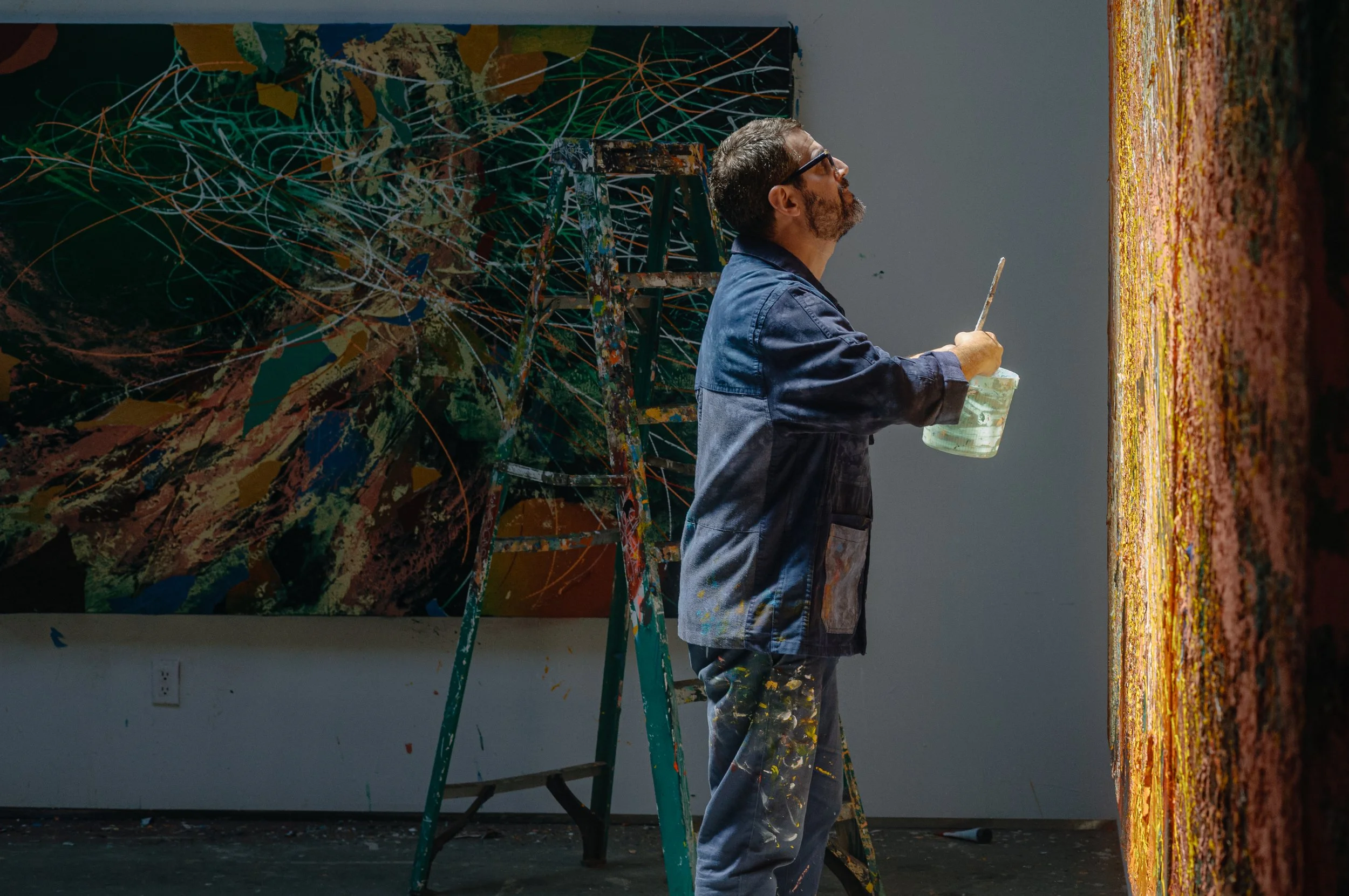
The acclaimed New York-based Cuban artist José Parlá creates works that explore the fascinating neurological processes that underpin our perception and experience of being-in-the-world. His most recent series of works Engrams sought to translate the fluid winding pathways of our brain’s neural networks, while his preceding Phosphene series was inspired by the sensation we experience when we close our eyes and witness a swirling dance of colourful shapes on the inside of our eyelids. To Parlá the commonality of these physiological processes represent a kind of universal language – being born of phenomenological sensations everyone living unconsciously experiences. Interestingly, the large abstract paintings the artist has created inspired by such phenomena actually found their conceptual genesis in his own near-death experience five years ago with Covid-19, which initiated a four-month coma from which no one was sure he would awaken.
His recent works are then both profound and exhilarating, exploring collective experience, memory and, in a sense, the fundamental atomic energy that keeps us alive. These deeply philosophical concerns emerged while the artist was recovering from his coma in Miami, Florida, where he began painting outdoors in the sun kissed beauty of nature, as opposed to his urban studio in Brooklyn. He became obsessed with conveying the abstract visual language forming in his mind due to the sensation of the sun penetrating his retina, and in translating that experience directly to the canvas – the result being a psychedelic interplay of form that blends the strange calligraphy of optic nerve stimulation with painterly abstraction. This then evolved into a deeper fascination with the physiological processes of the mind, resulting in his Engrams series. Here, the artist speaks to FUTURISTIC DRAGON about the experience of returning to the world from the brink of death, and tells us why his works are intended to represent the fluid neurological residue of experience .
Are the paintings you have been producing over the last five years reflective of an awakening in you after the experience of your coma – a sense of light and life flooding back in, or a second coming, if you like?
Awakening is actually a really interesting choice of word, because in 2020, I actually did an exhibition titled The Awakening, which obviously predated me being sick. And that was about me and a group of friends who are artists who felt a really deep urgency to come together and do work in the community and educate people about what had been happening since the murder of George Floyd. We formed a group called The Wide Awakes. The Wide Awakes has a deep history that goes back to the abolitionist movement that emerged after the Civil War in the United States, and we sort of wanted to revive a lot of the ideas from back in those days, because a lot of us had experienced police brutality first-hand. So, there was already this notion of societal awakening in my mind, but little did I know that just a year later, I would get sick and wind up in a coma for four months. And, of course, there was then a very literal awakening into the next phase of my life. It's definitely work that is reflective of a rebirth.
“My experience with illness changed the way I think about time, memory, and the body's capacity to rebuild itself”
What was it like to come out of such an extended coma, how did it affect your perception of reality?
I had a stroke, so it was very serious, and they really didn't think I was going to make it. There were a lot of difficulties. When I woke up, I had absolutely no idea I had been in a coma, and no idea what had even happened to me. I wasn't even what I could call fully awake – it was more like I just had an instinct to wake up. So, upon waking, I went back into emergency and they put me back under. When I woke up a second time, the reality that I was registering was the one that I had been dreaming about for four months. But, just to be clear, I wasn't aware I was dreaming when I was in the coma – I only started to process that about two weeks after waking up. I ‘woke up’ believing all sorts of things – I had been kidnapped by the mafia, I was living in hotels all over the world. I had survived a tsunami ... When I was trying to communicate with the doctor and my brother, I believed all of this was absolutely real. They were not allowed to tell me I had been in a coma because that can produce too much anxiety – you actually work with a psychologist to slowly kind of ease you back into reality.
Did you view the physical canvas as a site of cognitive rehabilitation?
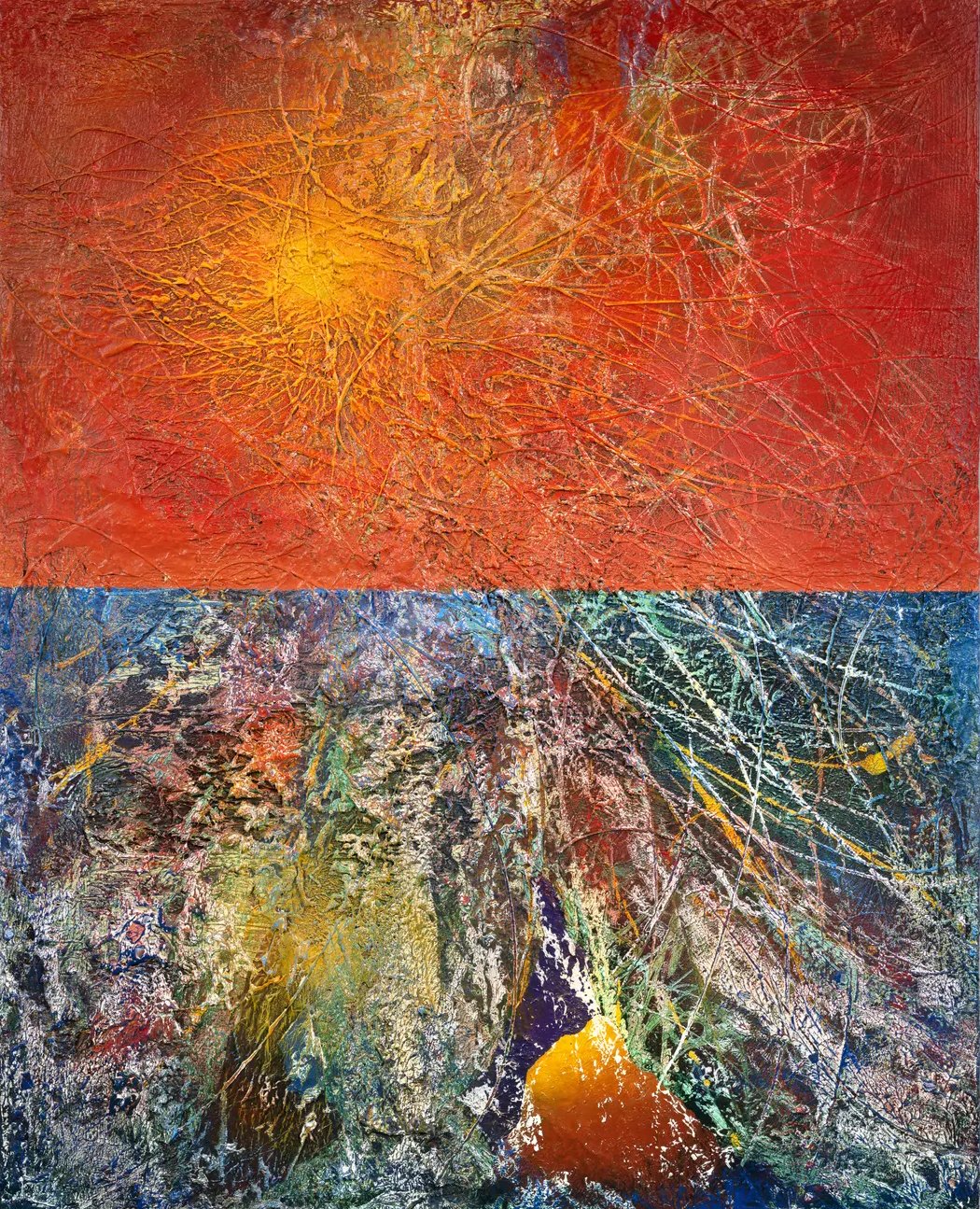
My experience with illness changed the way I think about time, memory, and the body's capacity to rebuild itself. Recovery wasn't a return to who I had been; it was the formation of new pathways, physically and emotionally. That process feels deeply connected to the way I paint. The surface evolves through accumulation, interruption, removal, and revision. Nothing disappears completely. Every gesture leaves a residue that influences what follows, much like experience shapes the architecture of memory. The painting becomes a record of adaptation rather than perfection. I call this painting process, Adaptation/Translation. Whether painting physically alters the engrams in my brain is a question better answered by neuroscience. What I can say is that the act of painting changes me. Each work reorganises my relationship to memory, to perception, and to lived experience. In that sense, the canvas becomes less a place where memories are illustrated than a place where they continue to form. The painting and the painter are engaged in the same act of becoming.
“An engram suggests that experience is never stored as a fixed image but as a living trace, something rewritten every time it's is recalled”
Neuroscience seeks to understand the mind by mapping the material brain - the firing of synapses and the formation of physical engrams. Your recent work translates these electrical storms into highly tactile calligraphic paintings. In making the microscopic architecture of thought macroscopic, do you feel your art bridges the gap between the material brain and the spiritual mind?
It is interesting to imagine that by painting I may be resolving the relationship between the biological and the spiritual, but occupying the space where those distinctions begin to dissolve is what the language of art can achieve. A gesture may originate in the body, but by the time it reaches the surface it also carries intuition, memory, emotion, culture, and lived experience. Those things resist easy separation. The paintings don't attempt to visualise the brain scientifically. They acknowledge that much of what shapes us remains invisible, yet leaves physical evidence. The physical is the storytelling role of art and creation. A mark can be understood as pigment on canvas, but it can also function as language, rhythm, breath, or memory. Like an engram, it exists simultaneously as a material trace and as something that exceeds its material form. If the work bridges anything, it is perhaps the recognition that consciousness and matter are not opposing conditions, but different expressions of the same continuous process. The creative part is always a display of culture which is interpreted differently by people of different nations, because our lens for cultural translations comes from the places we are from.
Neuroscience tells us that an engram is a living, shifting pattern that changes every single time it is recalled. How do you capture something that is inherently un-fixable?
I've always thought of the archive as something alive rather than fixed. Walls, cities, and even our own bodies carry traces of what has happened to them, but those traces are constantly being altered by time, weather, new experiences, and our changing relationship to them. Neuroscience gives us another way of thinking about this or that memory itself isn't retrieved intact but reconstructed each time it's recalled. In that sense, the painting isn't an archive of a memory so much as another moment in its transformation and in a personal way a translation of feeling. What appears fixed in paint is actually part of an ongoing process. Every viewing becomes another act of remembering, another rewriting. The work doesn't preserve a memory; it continues it and expands it. I hope that the viewer's perception becomes part of the engram itself, allowing meaning to remain in motion rather than settling into a single interpretation.
When you map the subterranean energy of New York, or a Havana sunset through your signature calligraphic layers, are you mapping the geography of those places, or are you mapping the physical architecture of your own consciousness?
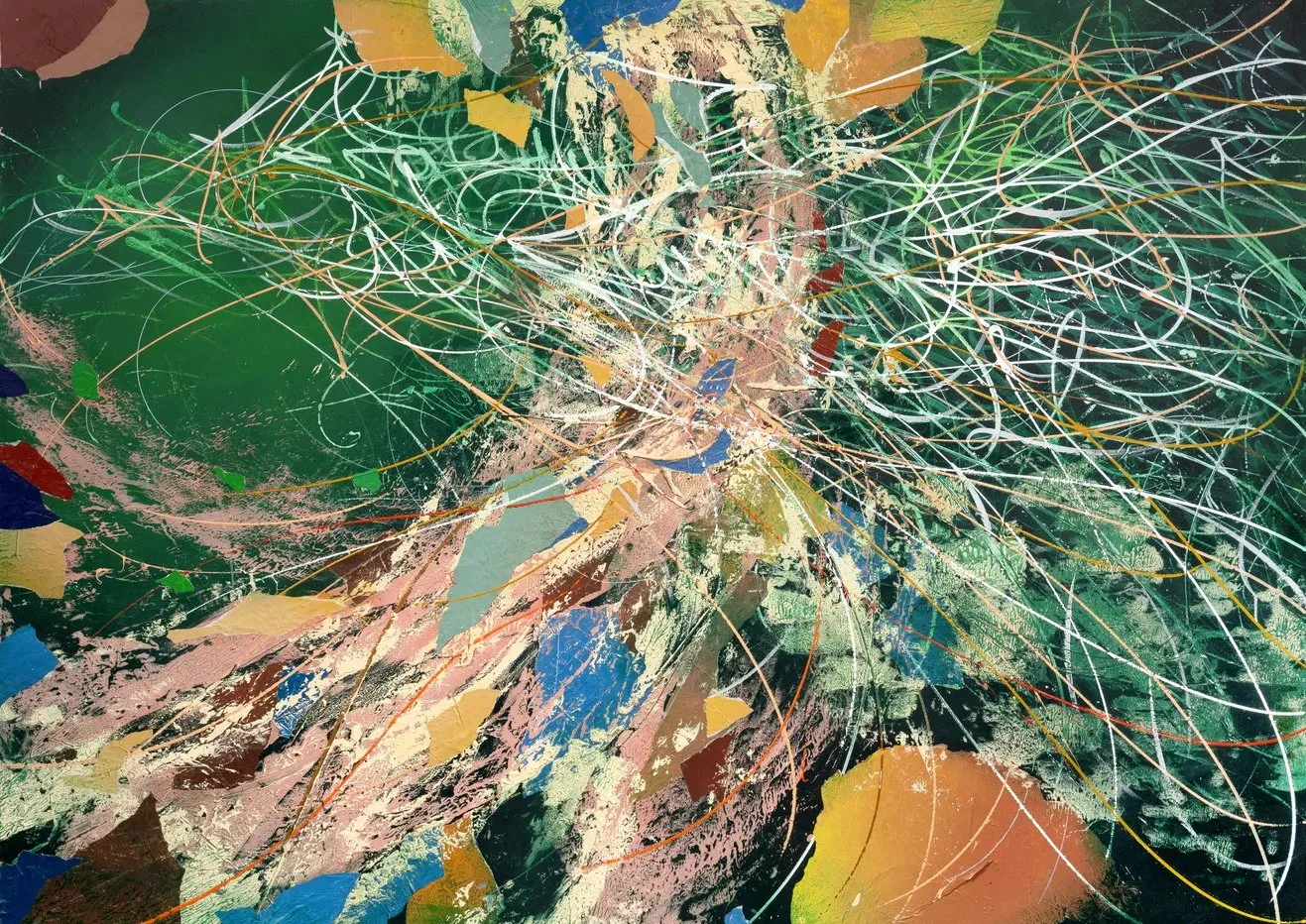
I don't think there's a clear boundary between those things. An engram suggests that experience is never stored as a fixed image but as a living trace, something rewritten every time it's is recalled. The places I paint aren't landscapes in the traditional sense; they're accumulations of sensation, movement, conversation, light, sound, and time. By the time they emerge in the work, they've already become inseparable from memory. The calligraphic forms aren't intended as a language to be decoded. They're closer to the neurological residue of experience, a visual equivalent of thought before it becomes words. Whether a viewer sees a city, a horizon, a fragment of writing, or an emotional state depends on the traces their own memories activate. So I'm less interested in describing a place than in revealing the space where the external world and the internal world continuously rewrite one another. The painting becomes its own engram: a record of experience that isn't complete until another consciousness encounters it and begins to reconstruct its meaning.
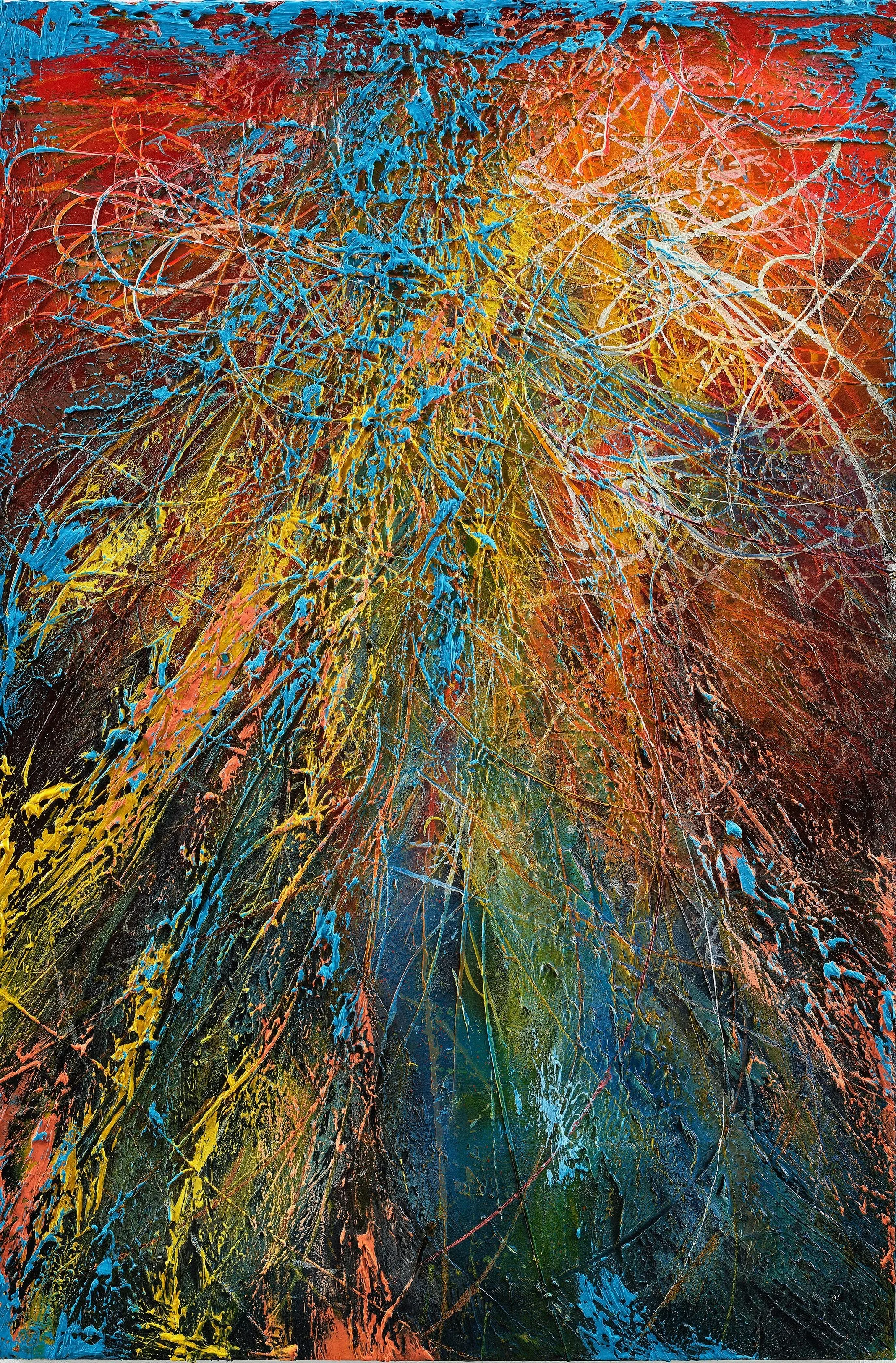
“The painting becomes its own engram: a record of experience that isn't complete until another consciousness encounters it and begins to reconstruct its meaning”
Your first show after your coma was a series of paintings based on the phenomena of phosphene. Did your interest in the phenomenon of phosphene come directly from that experience?
The phenomenology of phosphene has always fascinated me. It’s kind of a universal language and I was interested in exploring it as a unifying thread for humanity – even a blind person experiences phosphene. It’s not a language that is legible, of course – it doesn't need to be read. It's more like a feeling, and it's very abstract, and that abstraction has so much power because it allows us to use our imagination. There's no particular form or shape, or landscape, in these works, but there is a language that maybe that reminds you of calligraphy, and shapes that maybe remind you of light. And I kept thinking while making the work that if phosphene enters the skin through your mind's imagination, then does that light continue to travel through your arteries, your blood and your inner landscape, so there are shapes and forms of light in the paintings that look like arteries and veins. It’s all very abstract but, at the same time, it connects you back to a reality that we can all perceive – you can see the textures of walls, textures of mountains, textures of places, and perhaps even strange topographical locations.
Is there a sense of trying to bring people together in your work, in celebrating universal phenomena?
One of the techniques that I use in this work is to weave the colour, and imagine that I'm working with thread. I'm thinking about the fabric of society when I am weaving the forms in the paint, and thinking, metaphorically, about bringing people together. The purpose of that, for me, is that we've all experienced the toughest times since 2020, and ever since the pandemic, things have drastically changed. It really feels like something we've never seen before. They say over 20 million people died in the pandemic, but the number is so abstract, no one really knows. And life just continues to get tougher – politically, socially, economically … Things are getting more and more dangerous. And against that backdrop, I believe the role of the artist has always been to imagine a better world. If you look at these works, they're all about a surge of light producing beams of energy, and that is something that might sound whimsical, but we can't function without energy – the sun, the light; it's the energy that we have in our body.
Do you feel your work has become more purpose-driven since you survived the coma?
It was always purpose driven. But, yeah, I've never been so close to dying. And going through the struggle of learning how to eat again, learning how to use my hands again, learning how to walk again, learning to swallow – I mean, that really changes your outlook. Because then you realise so absolutely that there is very limited time. The question for me now is how does my work help others? How can it connect to people's inner questions? And how can it be universal enough that it's literally open for anybody from all walks of life? I've always wanted for people to transcend to another place through my work, and the choice of where they're going becomes their own story. I transcend myself while I'm painting these works, because they are really labour intensive – you're exhausted making them, and go into this state of almost synesthesia. I just hope that viewers find their own way to transcend through these. And on a larger scale, I always hope that one day there will be a major transcendent evolution for humanity.
Find out more about the artist here.
Images (top to bottom): Portrait of the artist in his studio by Brian Pollock; Kinesthetic Memory Field, 2026, acrylic paint and collage on canvas; Gestural Engram, 2026, acrylic paint and collage on canvas; Universal Meditation, acrylic paint and collage on canvas2023. All images courtesy the artist and Ben Brown Fine Arts.
Get up-close-and-personal with artists from all over the world and unlock the mysteries of the creative mind.
Read in-depth interviews with the most exciting cultural movers and shakers shaping the creative landscape.
Discover the actors, authors, designers, mavericks and entrepreneurs at the bleeding edge of cultural life