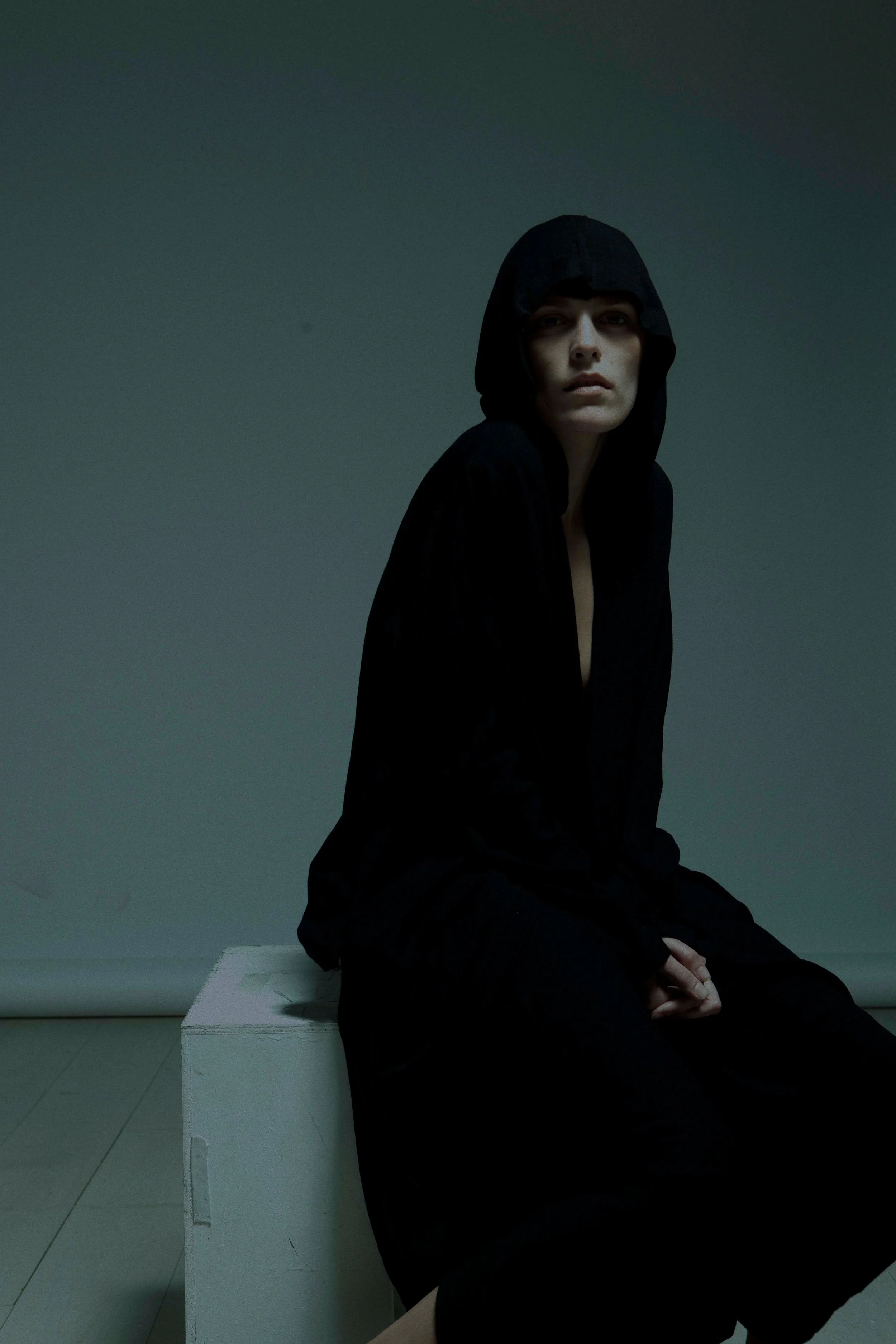
STYLE & CULTURE: INTERVIEW
Laxmi Hussain: Word To The Mother
Matrescence, Autonomy And The Flux of Identity
A body does not need to be complete to be understood. In Laxmi Hussain’s work, a single line can suggest the curve of a back, the weight of a breast or the intimacy between mother and child. Upon her canvases bodies disappear, figures overlap and the negative space becomes almost as expressive as the marks surrounding it – the eye instinctively completing what Hussain leaves unfinished. But thus economy of line belies emotional complexity. Hussain’s practice is an intensely personal investigation into the female body, motherhood, memory and the shifting nature of identity. Drawing became particularly important to her during her experience of matrescence – the profound physical and psychological transformation of becoming a mother – and offered a way to understand the person she was becoming, while holding onto something of the person she had been. She recalls entering labour known by her own name and waking the following morning to find herself referred to simply as ‘mummy’ – a small linguistic shift that contains something much larger: one identity becoming absorbed by another.
That tension between presence and disappearance runs throughout her work. Mother and child occupy and interrupt one another’s forms, raising questions about giving, care, autonomy and how much of the self can be surrendered through motherhood. Loss has brought another transformation. Following the death of her mother – the woman Hussain describes as the principal witness to who she had been – ultramarine blue became a recurring presence in her work: part memorial, part continuation of the love between them. Yet, for all its intimacy, Hussain’s practice is resolutely outward-looking. From her monumental Landscapes of Women at Wembley to her role as a patron of Create, she believes art should exist beyond the traditional boundaries of the art world and be accessible to everyone. That belief informs her current involvement with Winsor & Newton’s Art Mail, an open-call project inviting artists around the world – established or otherwise – to contribute their work to a collective artistic exchange across borders. In this interview with FUTURISTIC DRAGON, Hussain speaks about matrescence, her architectural training, and her enduring belief that art belongs to all of us.
As I understand it, you transitioned into your professional art career during the profound transition of matrescence (becoming a mother) to reclaim your own identity. In a patriarchal society that all too often expects mothers to dissolve into their role, how does the act of deconstructing and rendering the female form allow you to explore motherhood, identity and autonomy?
My art helped me to channel a way to understand my new identity as a mother. Matrescence, as we now know, alters a mother so dramatically that we're often left with very little understanding of all the things that impact us during this transitional period. Despite being proud of becoming a mother, I felt like I was catapulted into this new role with no space for the past me, and the only way I could navigate this was, and has been, through art. Even just the simple act of documenting who I have become and who I continue to become on paper or canvas has been life altering for me, and has brought a real acceptance of the normalcy of this transition. I very much create my work to understand and see myself through a more realistic lens. I kept wondering if the person I was before was someone I would ever be again, both physically and mentally. Personally, I know a lot of women struggle with the physicality of how much our bodies alter, and even though I sometimes still do, my work pushes me to share the beauty of what our bodies go through. It’s a reminder of how much we are capable of. I'm really able to hold the softness of the moments my body goes through because I'm able to share this through my work and see its changes as something else, something worthy of being depicted in art, as it should be.
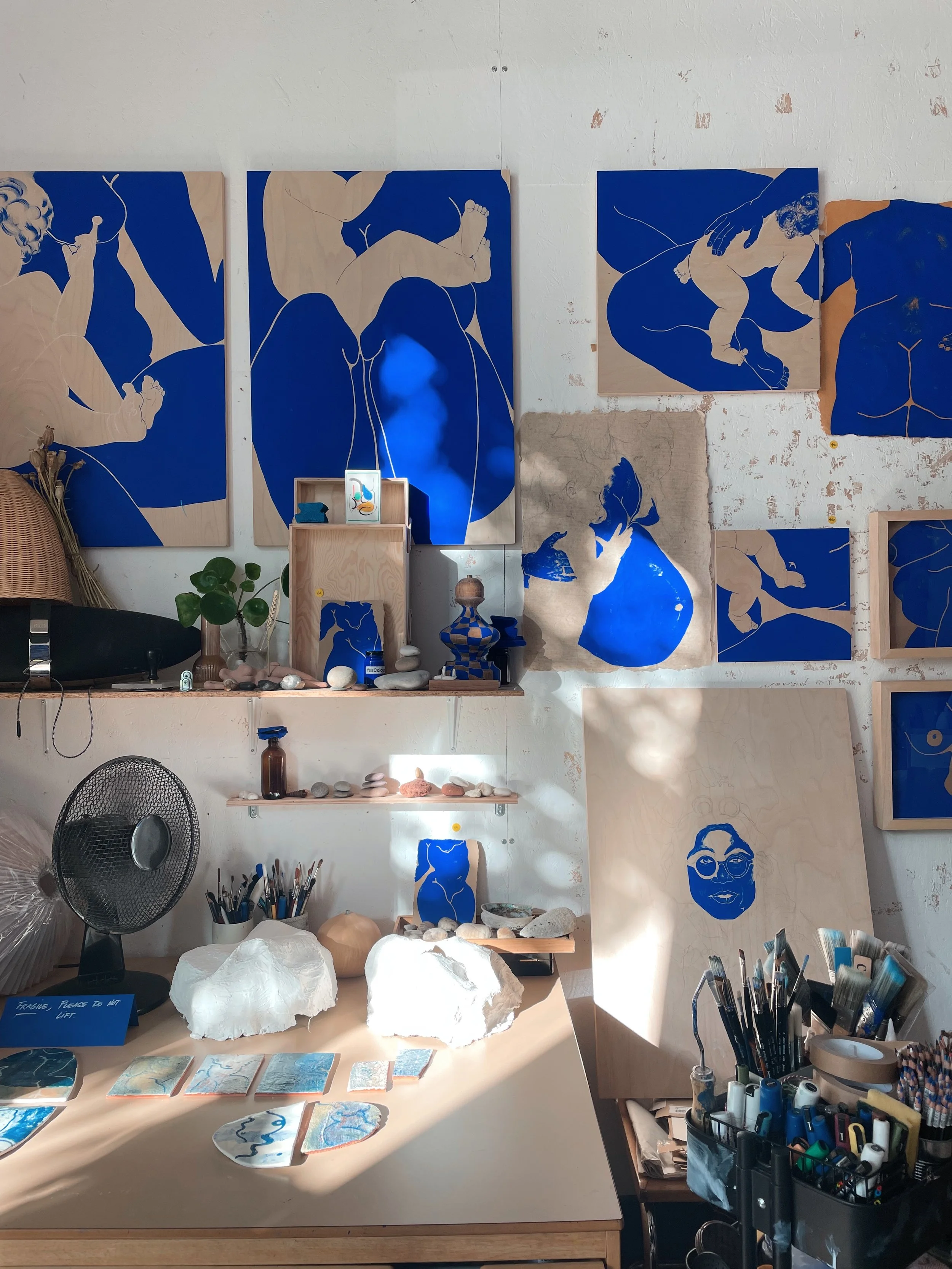
“Most of these moments are from my life, laid bare. Motherhood is just that: learning to be vulnerable, to be open, stretched to capacity and then stretched even more”
Your work appears to be both intensely intimate yet universally resonant. When you translate highly personal experiences of your own body and motherhood onto a canvas for public consumption, where do you draw the line between public vulnerability and private sanctity?
I'm not sure there is always a line; I've never known anything quite as difficult yet, at the same time, so rewarding. Often, I've felt there is a stigma around sharing openly how beautiful and challenging this role can be; my work is meant to be an open reminder of that. I often depict the tender moments of mothering, because a moment ago I could have been covered in some bodily fluid I barely wiped off, but you stop for that one fleeting moment of stillness – one you barely get to revel in – and, for some reason, you are in another world.
Many of your pieces appear to leave hinted at forms incomplete, prompting the eye to ‘finish’ the silhouette. Do you view your art as a co-creation with the observer, and what does this engagement with the viewer's imagination tell us about the collective human experience?
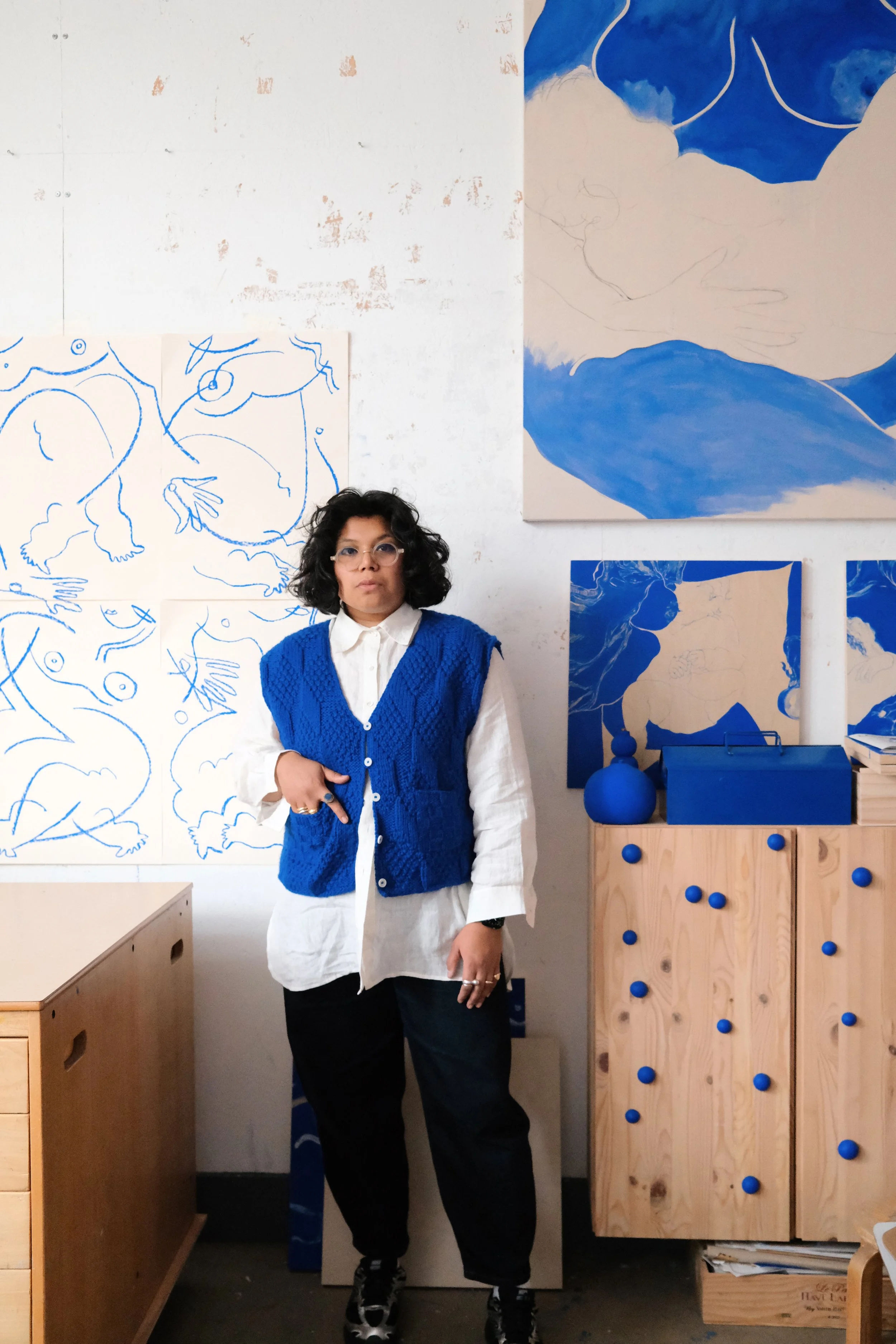
My drawings depict this viewer/artist interaction in a more intriguing way. The way I draw doesn't allow much time for me to think. I often work in a continuous line, which means both the movement of my arm and hand dictate the speed and the flow, and my mind reminds them of my past movements. The resulting forms can be drawings which are abstract, but the viewer can see where a leg or an arm might sit, even if the defining lines are not there. I've always been obsessed with what the mind fills in, and therefore sometimes I do not need to say it (with my pencil), but you can see it. This flows through into my painted works, but it is much more intentional. The baby is often in the space taken from the mother, and perhaps I'm trying to explore the connection between how much of herself the mother gives to the child and how much of the child takes of the mother.
When I first started painting this way, I often thought about how much the child was held in early motherhood and not the mother, and so often the mother was less distinct. When I had my first child, I went into labour being called by my name, and when we woke up the next morning I was just referred to as 'mummy'. As my paintings have evolved, the mother's features are much more detailed. I often share her hands, which are always my own, handed down from my own mother (we have identical hands). So, while the mother is often from my own experience, she is more loosely interpreted from memory and instinct. My focus now is how much giving there is within the landscape of motherhood, and how a body can represent this in my paintings. For many years, I felt that mothering was something we just did and not an identity, and now I feel really open about sharing how much of a transformative part of my life it is, but also all the acts of giving which go above and beyond just being a mum, socially, politically, and more.
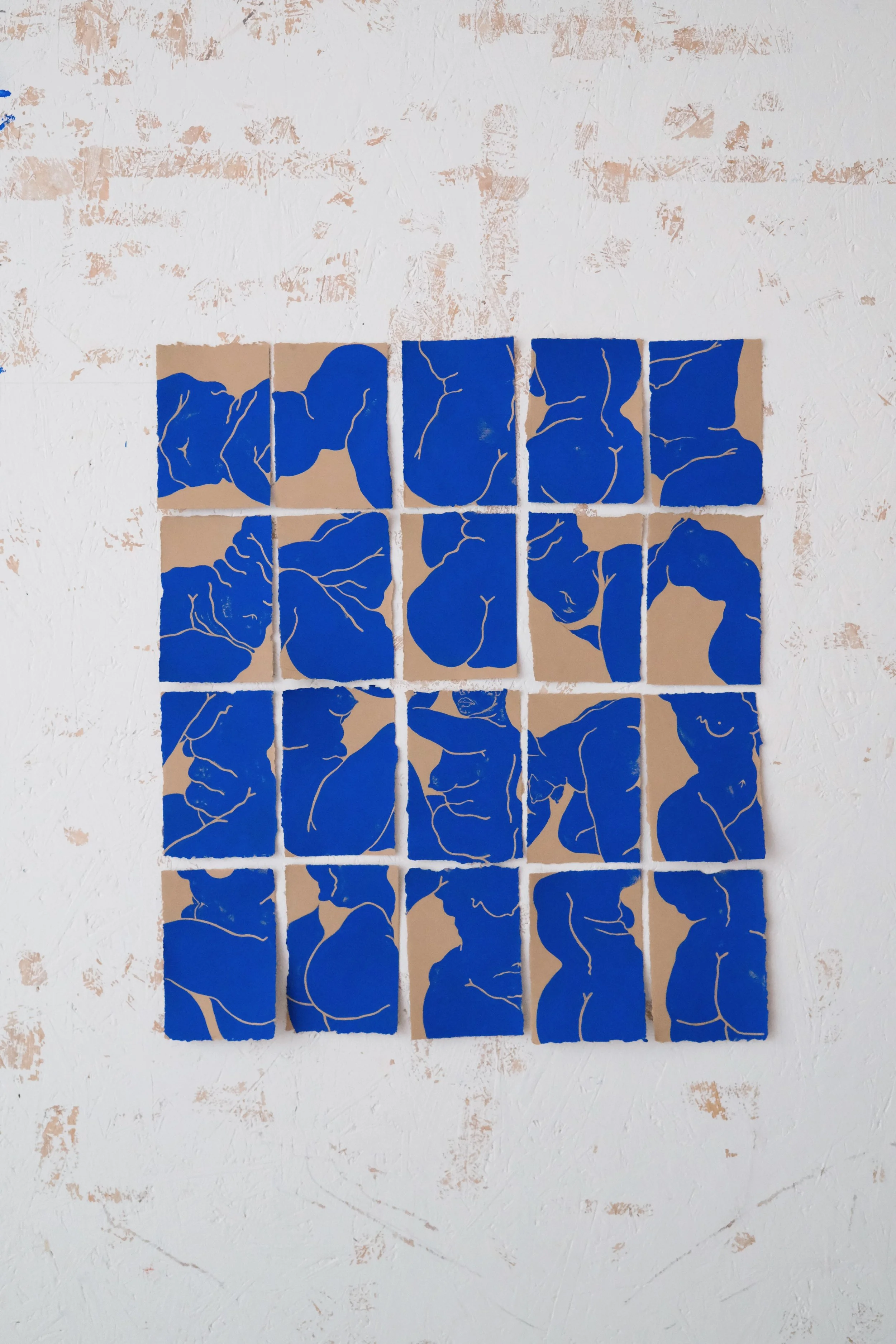
“My focus now is how much giving there is within the landscape of motherhood, and how a body can represent this in my paintings”
Your architectural background lends a structural logic to otherwise fluid, organic lines. How has your architectural training shaped you as an artist and how do you navigate the tension between the rigid, calculated order of architecture and, if you like, more emotional flux of the human form?
Whilst I called it quits once I graduated from my degree, I know that the drawing aspect of my course heavily influenced the way I see. My forms are very proportional, even when I am being abstract. The line plays a strong influence in my work, and when I look back on how I depict forms, I definitely feel there is synergy between what I was taught at university and how I work. That being said, I love to learn new things and I think all learning influences how our work alters as we move through life. The way I approach things, how technical I am with things behind the scenes, like the practical aspect of making art – these are all definitely informed by my background in architecture.
I have read that your use of ultramarine blue is a personal tribute to your late mother. How does restricting or focusing your palette to this specific hue transform grief from an internal ache into a monument of love?
My mum was the main witness to who I was up until the point that she died; what she remembered, she remembered through an adult lens. I'm lucky to have siblings, but childhood is blurry, and one of us might remember one thing and the other not so much. Then she left, and, like motherhood, I didn't know who I was again. I am never going to be the person I was before the moment she left. And, as I always do, I pour myself into my work – the blue reminds me she is still a part of me. Yes, it’s become a tribute to her, but my work is all ultimately about love and being human, and in keeping her a part of the work, I hope I can share a bit of the love she had for me in all my pieces.
“My forms are very proportional, even when I am being abstract. The line plays a strong influence in my work”
You have spoken about drawing on the counters of your father's North West London corner shop as a child. Looking back, how did that bustling environment of everyday human interaction shape your early understanding of what art can do? What did art mean to you as a child?
I don't remember too much of this time; a lot of it is blurry because I was so young, but I do remember the ice cream fridges butted up to the windows. The counter with the register met the fridges at a T, and just between the counter and the fridges was a tall stand that had the bags for packing groceries on them. Because I was little, it could bear my weight and I would sit on top of the bags, and draw at the end of the counter or while leaning on the fridges. Our school was really close by, so we'd have to come to the shop after school and wait for our mum to finish before going home. I just remember the customers always mentioning that I would be drawing; sometimes those that would linger for a chat with my parents would draw with me. I've always been able to escape into drawing and, as a child, I think it was really important to me because it's just what I would always be doing.
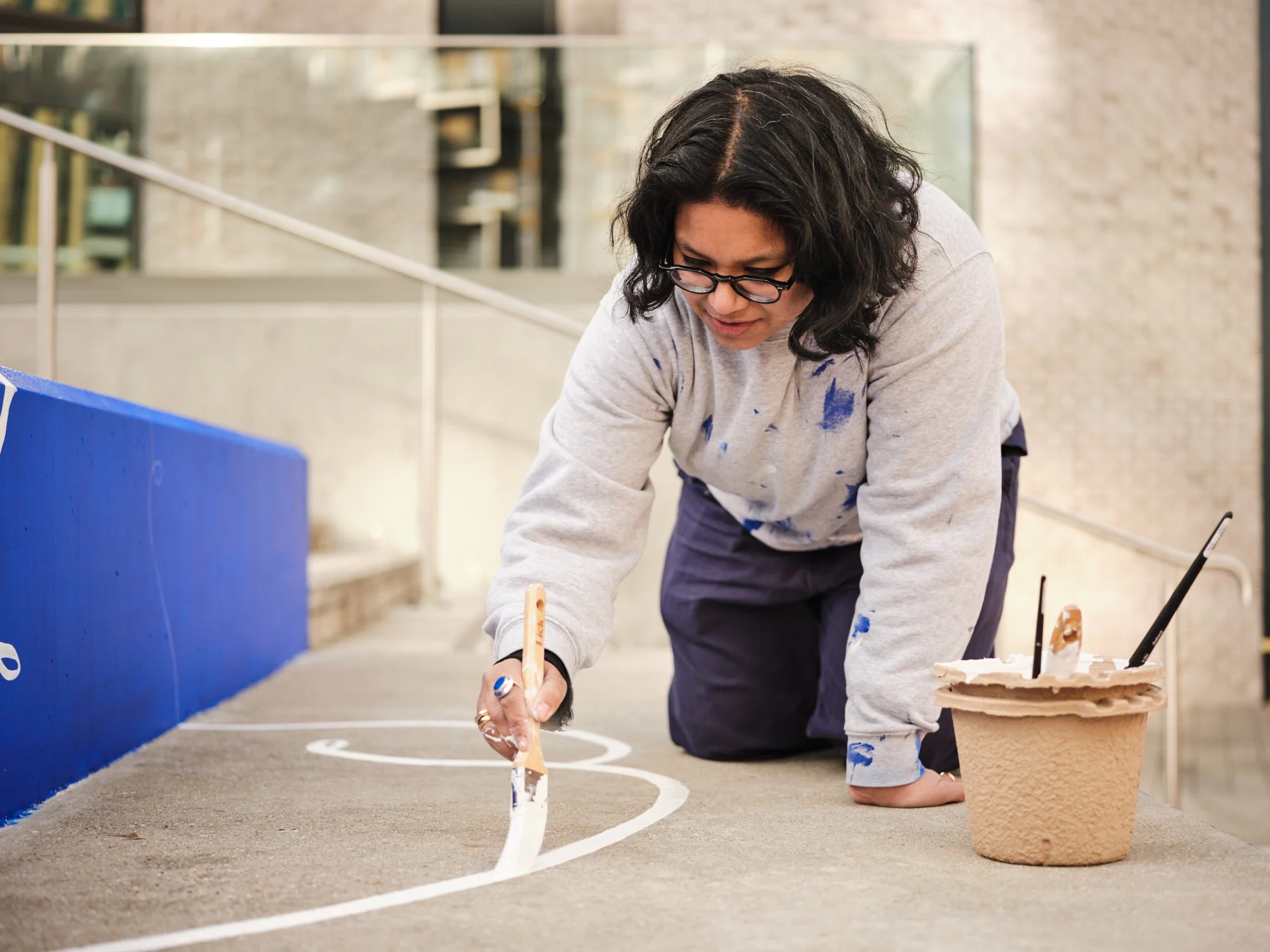
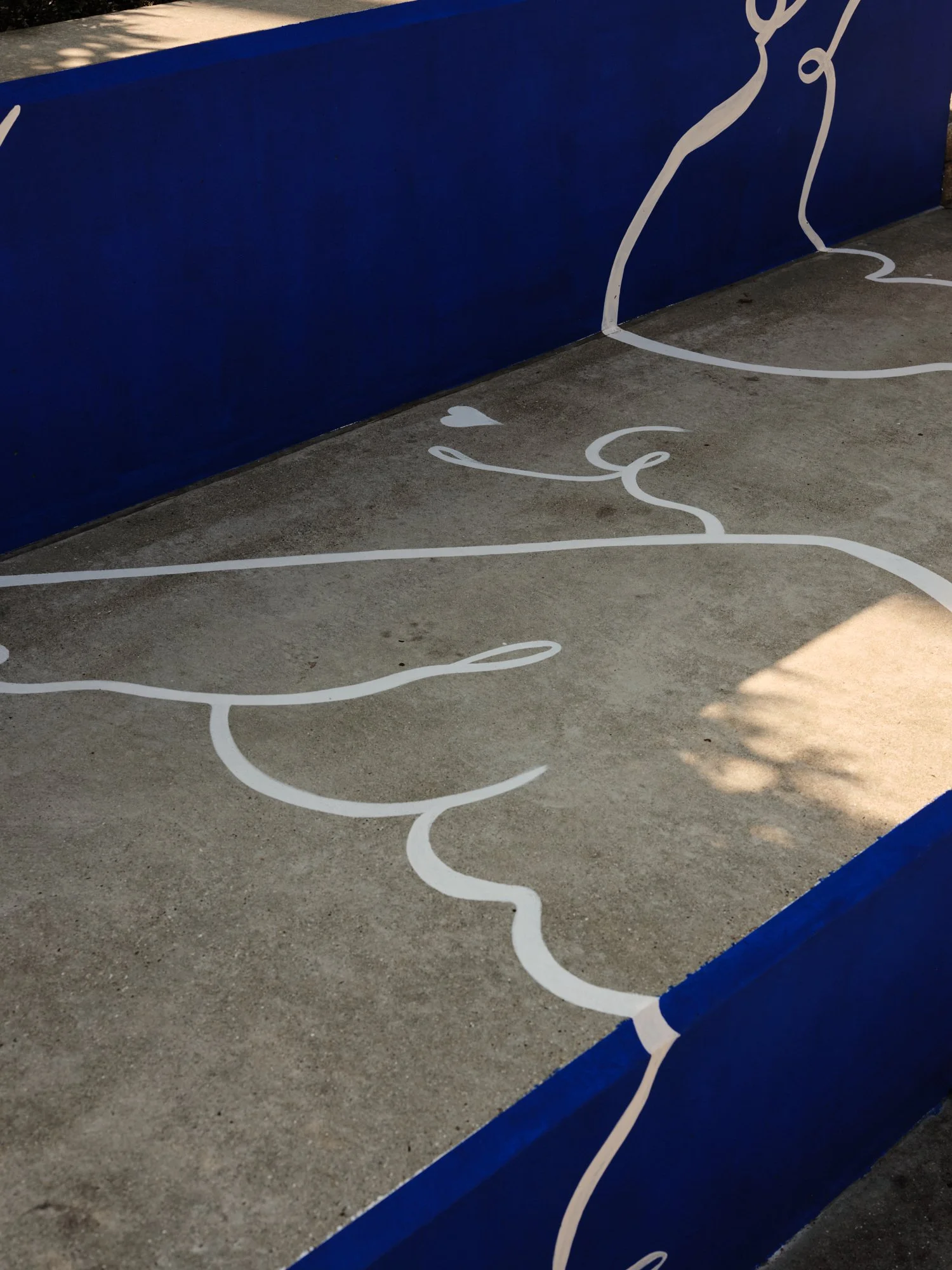
Your Landscapes of Women mural on the concrete Wembley steps was praised for injecting an organic softness into a traditionally rigid and concrete urban space. How do you see the introduction of the fluid female form reshaping how everyday commuters subconsciously experience a quite brutal architectural environment?
I'm always so happy to see this piece being used, walked on, climbed on, and am so grateful for that opportunity. It feels a little surreal that I was able to do that sometimes. It was really important to me that the steps added that fluidity back into a newly developed space where everything looks so swish and brand new. I'm really lucky to be able to walk past it quite often, as it's only a short walk from my studio, and I love that over time it has worn, but has maintained its striking vibrancy from a distance. I'm very proud of this piece and love that so many people use it every day; that makes me so happy.
“I definitely think public art spaces are important. They can sometimes bridge the gap between how inaccessible or fragile gallery spaces can seem, especially with children”
Public art exists in the elements - it is subject to weathering and eventual erasure, whereas canvas art is often preserved in controlled spaces. Do you find a unique beauty in the vulnerability and temporary life of outdoor art? Do you think it is more profound to experience art in public spaces?
I definitely think public art spaces are important. They can sometimes bridge the gap between how inaccessible or fragile gallery spaces can seem, especially with children. That's not to say, as an artist who has exhibited public art, that it's not heartbreaking when a piece is damaged, but even so, it's the nature of public art - it will forever be altered by its surroundings. I do feel that allowing space for interaction, even if it's as mundane as a space that people just sit on for lunch, can take away our feelings about how precious some art needs to be. I also feel more open to visiting galleries with my children when I understand how enriching art can be through exposure to public art.
Talk to me a little about the Art Mail exhibition. How did you get involved and what does participation mean to you?
I've known the Winsor and Newton team for quite some years now and was invited to contribute to Art Mail and work on the campaign to encourage artists around the world to submit their work. I think that my work can lend itself well to removing the pressure and the feeling that, in order to submit to an art campaign, you need to be an established artist, or a professional. This campaign has been really inviting to all artists, new or established, all over the world, and it's really exciting to see it all come together. I love that my work can sit alongside someone who might have just picked up painting for this campaign and thought, “Let me give it a go,” as well as someone who might have been painting for years more than I have. I think that is the beauty of an open call: everyone getting involved in an artistic journey where we will be able to see hundreds of people's thoughts from all over the world.
As a patron for Create, you advocate for making art accessible to marginalized communities. Does your work seek to democratise art and aim to dismantle the traditional, elitist barriers of the art world?
Absolutely. Enjoying art is such a powerful tool and so many of us think we can't participate because we're not artists. You don't need to be an artist to enjoy or experience how powerful art is. It's there for all of us to use and experience, and it can be life changing for so many. I'm so honoured to have become a patron for Create. Their work in supporting people through life's challenges through art makes me proud to be an artist - if I can help them share how important art can be to all our lives, it would be a pleasure.
Introduction & Interview by John-Paul Pryor
Find out more about the artist here:
The Winsor & Newton Art Mail Exhibition runs at the Saatchi Gallery in London from October 1 to October 11, 2026.
All images courtesy of the artist. Portraits of Laxmi Hussain and Wembley Splay Steps piece by Liz Seabrook.
Get up-close-and-personal with artists from all over the world and unlock the mysteries of the creative mind.
Read in-depth interviews with the most exciting cultural movers and shakers shaping the creative landscape.
Discover the actors, authors, designers, mavericks and entrepreneurs at the bleeding edge of cultural life.