ART & IMAGE: INTERVIEW
Nostalgic Reverie: Mehdi Ghadyanloo
Darkness, Light And The Ephemera
of Childhood
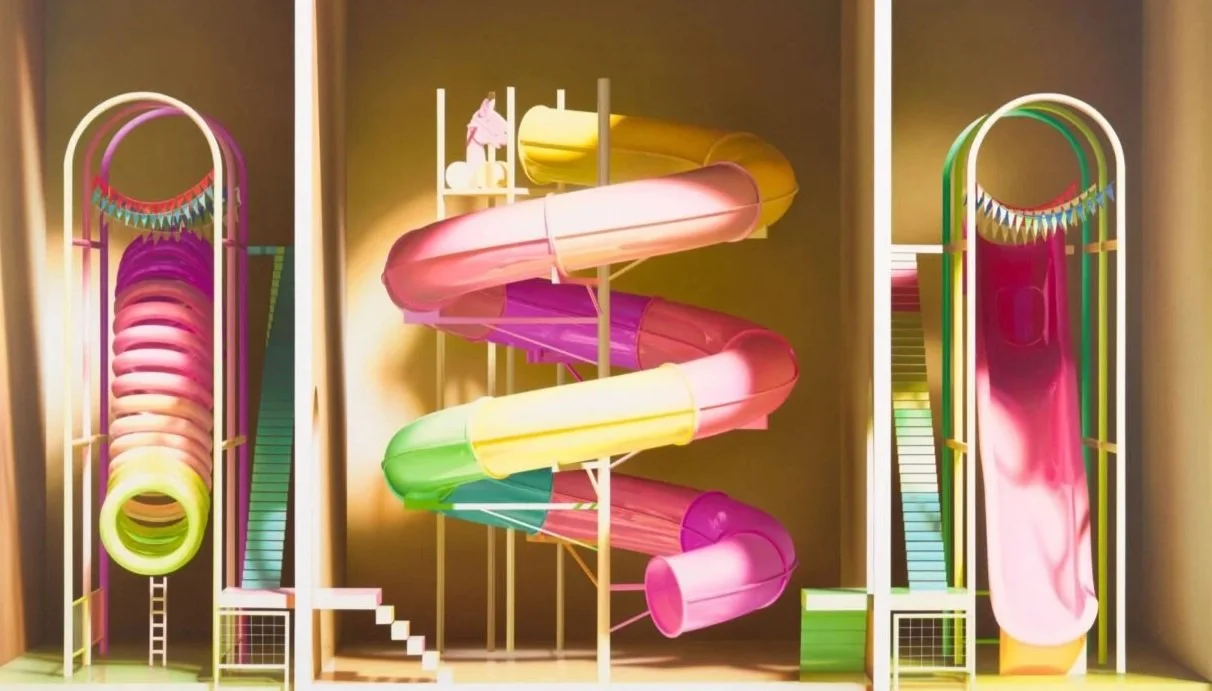
The Iranian artist Mehdi Ghadyanloo’s paintings do not so much present themselves as stage a gentle dislocation, coaxing you into an awareness of your own coordinates. They insinuate a past-tense geography — as if space were something you had once occupied and can now only recollect — a remembered topology that reasserts itself on the retina with the calm implacability of a fact. The masterful artist arranges form and light with the simplicity that a child might arrange toys, yet the result is less play than testimony.
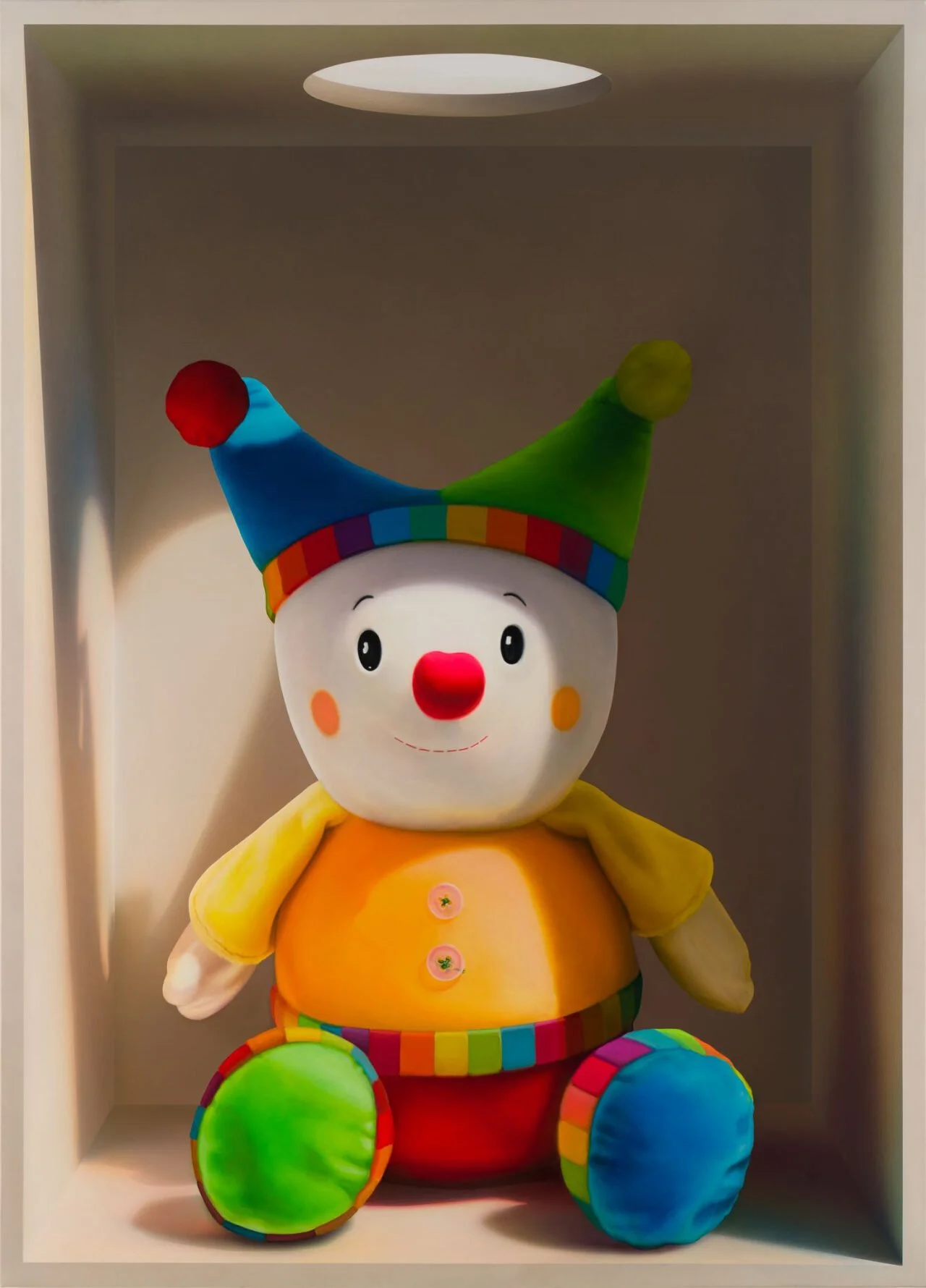
His employment of trompe l’œil invites us to step into interiors where manufactured childhood objects – slides, hobbyhorses, small plastic figures – sit as if waiting to be acknowledged. This colourful ephemera is rendered with a clarity that imitates reality and with a displacement that is uncanny – each object carrying both the weight of industrial mass production and the delicate biography of use and abandonment. The boxes become rooms of remembrance, and the light that falls across them is the light of recollection – hard, selective, and often cold.
The nostalgic sadness in these canvases is not then sentimental. Rather, it is a sadness that arrives from recognition: the recognition that collective memory is built from identical manufactured fragments, from the same melded plastics and painted wood, and that these fragments hold, within their design, the traces of play, and countless small lives. In the midst of this melancholia Ghadyanloo presents us with hope – asking us to recall a simpler sense, when an object as plain as a plastic horse could bring unbridled joy.
In this interview with FUTURISTIC DRAGON the artist discusses why he refuses to lose faith in a world of uncertainty, and explains why he will always be drawn to explore the ways in which beauty can overcome despair.
“I want to create something to bring hope, even if it’s for a short time”
Why have you been drawn to place childhood objects in boxes in many of your recent paintings?
I was always interested in architecture when I was young, so in my painting there is always this idea of conceptual and formal space being explored, and I love how the clean minimal cubes in this work represent a virtual three-dimensional space that doesn’t actually exist, except in your mind. That was the initial thought behind painting the boxes, but then I found that when you put something inside the box, it creates even more layers, and these paradoxical feelings of both light and shadow, and claustrophobia and openness – which, maybe in a more representative way, is reflective of the lives each one of us actually lives. At the same time, for me, the paintings became both joyful and sad – because these objects from childhood really are trapped in the boxes. I mean, some people enjoy the colours, and find these very happy paintings, but, for me, they represent life with all of its up and downs.
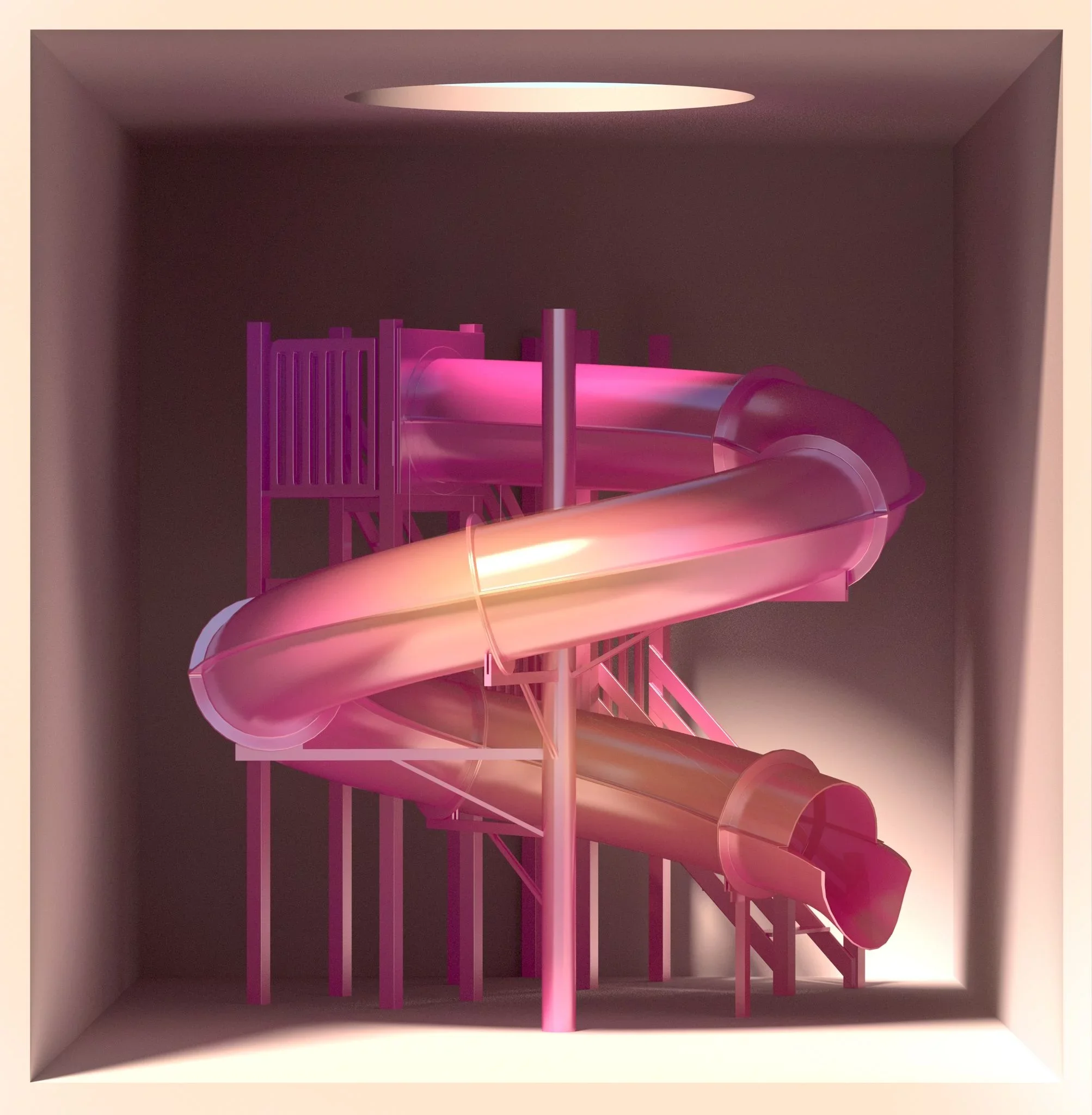
“I love how the clean minimal cubes in this work represent a virtual three-dimensional space that doesn’t actually exist, except in your mind.”
The boxed nature feels very sad, because it talks to me of childhood passing, or of the forgotten ephemera of simple joys…
There is a painful kind of nostalgia. I mean, when looking at these objects, you can see that they are made for humans, but you cannot see any figures. This kind of absence for me is sad, but paying attention to the detail of the beauty of the subject, makes the sadness paradox even more complicated. I was at The World Economic forum a few years ago, and listening to different talks about the plastic pollution in the oceans, and, you know, afterwards, I really hated plastic. But, conversely, when I was watching how much kids are enjoying and laughing and screaming from happiness playing on these elements that I have painted here, I found myself thinking that you can make some people truly happy with this material.
There is certainly a paradox in portraying industrially manufactured objects in a way that is so beautiful…
Yes. The material used to make these kinds of objects is certainly cheap manufactured plastic, and all over the world, there are these cheap playgrounds. But children don’t care at all about the aesthetic and the design at all – they only love the colour and function of these beautiful monsters. Actually, when I was studying these objects, I found that while, yes, plastic is ugly and creates pollution, it also creates incredibly joyful moments – the end almost justifies the means. The biggest challenge for me, as a painter, was to study the beauty inherent in the way that light travels through the plastic, and how it can have this kind of translucent quality – especially in the golden hour, because usually when you go to park with your children in the late afternoon, it’s that golden hour of the day. I love the combination of metal and transparency in plastic too, because it’s also some kind of yin and yang. There is a quality in there that reflects the symmetry in Persian culture, and it’s very interesting for me how, after four or five years of painting these playgrounds, I still have a lot to discover in terms of form and shape with these elements.
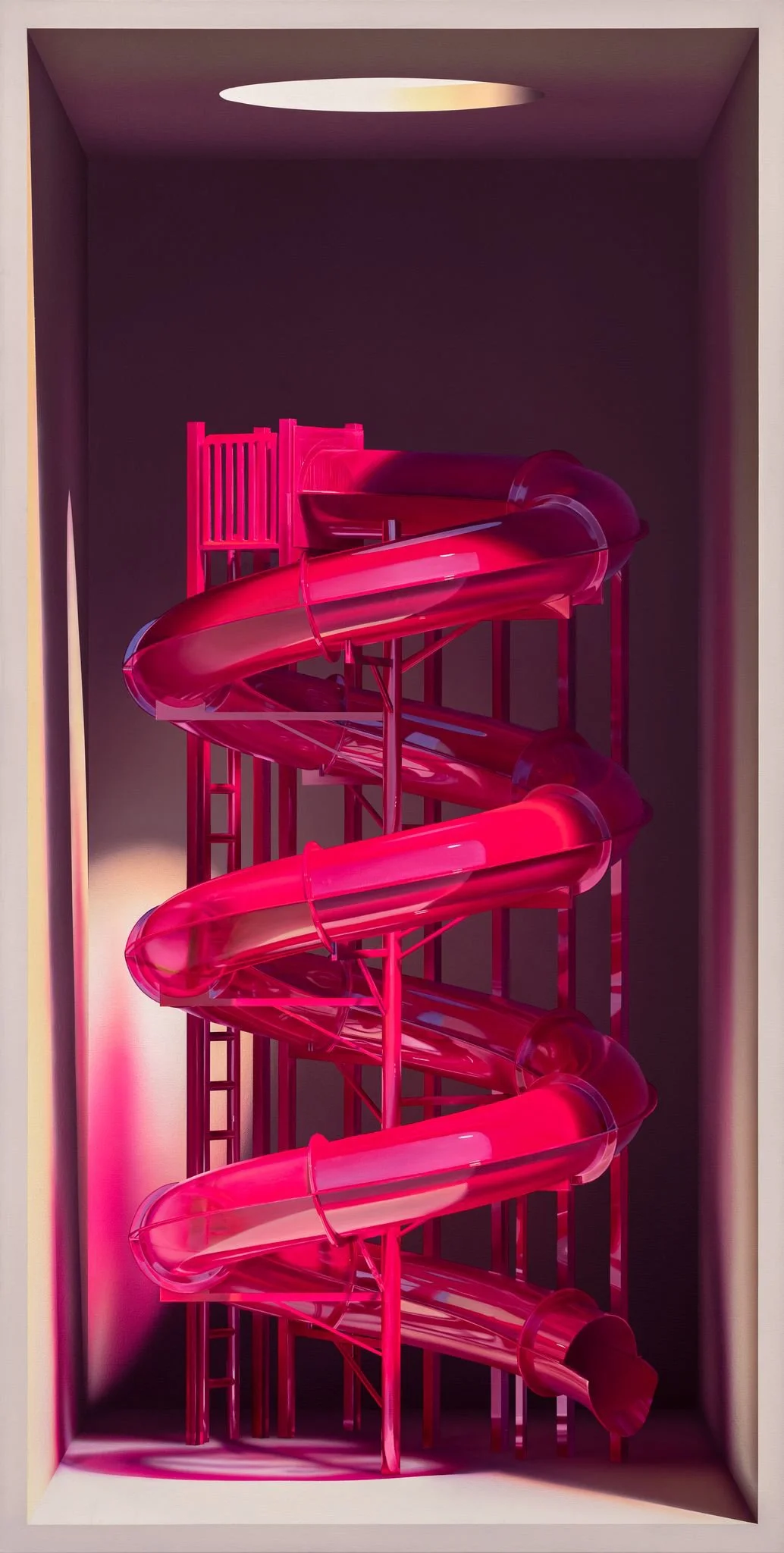
“I like the combination of boxes and toys or slides because they are kind of like existential anxiety questions for me”
The boxed nature feels very sad, because it speaks of childhood passing, or of the forgotten ephemera of simple joys…
There is a painful kind of nostalgia. I mean, when looking at these objects, you can see that they are made for humans, but you cannot see any figures. This kind of absence for me is sad, but paying attention to the detail of the beauty of the subject, makes the sadness paradox even more complicated. I was at The World Economic forum a few years ago, and listening to different talks about the plastic pollution in the oceans, and, you know, afterwards, I really hated plastic. But, conversely, when I was watching how much kids are enjoying and laughing and screaming from happiness playing on these elements that I have painted here, I found myself thinking that you can make some people truly happy with this material.
There is a deeper sense of loss apparent to me in them being packaged away for a predominantly digital age…
I can’t help thinking also that with this kind of rapid expansion and invention of new games for kids in the meta-verse that maybe my works will become a reference for playgrounds that will no longer actually exist – maybe in the future we won’t even have these kind of playgrounds. And really, playgrounds are just so important. When I was researching the history of playgrounds after WII, I found some amazing facts – such as the way in which they first made playgrounds in Switzerland and Spain in areas refugees had been sent to. It was a very strange feeling for me, because you knew that these kids had lost everything – their parents and families, but they’re laughing and having fun because in the playground they can even forget these serious things, you know? The playground can be a therapeutic forgiveness mechanism– it can bring short joy when there’s no guarantee for longer joy.
What is your definition of beauty and how does this notion of joy and balance play into it?
In a way, people talk very carefully about beauty now, because they feel that with the problems of the world maybe it’s almost cheap to approach beauty in an artwork. I think beauty has different meanings, but I truly think anything that can disconnect you from the problems of existential anxiety and create joy has beauty. I had this same approach or feeling even when making my murals in Iran almost 20 years ago. I wasn’t originally from Tehran. I came from a rural part of Iran, and when I entered Tehran to register my name in the university, I found it to be a very grey, ugly and boring city. And I wanted to be able to change, at least, the facades of the buildings – the joyful murals were intended as painkillers for the city. I’m continuing this approach in my painting. Whenever life becomes bitter, I became more play playful, to create this sense of balance. I’m one hundred per cent against this idea that if you paint something joyful, it means you are a shallow person, or you don’t feel the real pain in life. My work is a balancing mechanism. I am trying to balance the darkness with joy. I don’t want to add to the bitterness of life. I want to create something to bring hope, even if it’s for a short time, and that drive is sort of fundamental to Sufi philosophy.
Introduction & Interview by John-Paul Pryor
Find out more about the artist here.
All images courtesy of the artist and Almine Rech.
Get up-close-and-personal with artists from all over the world and unlock the mysteries of the creative mind.
Read in-depth interviews with the most exciting cultural movers and shakers shaping the creative landscape.
Discover the actors, authors, designers, mavericks and entrepreneurs at the bleeding edge of cultural life.