ART & IMAGE: INTERVIEW
Purdey Fitzherbert: Material Girl
Exploring The Strange Beauty of Impermanence
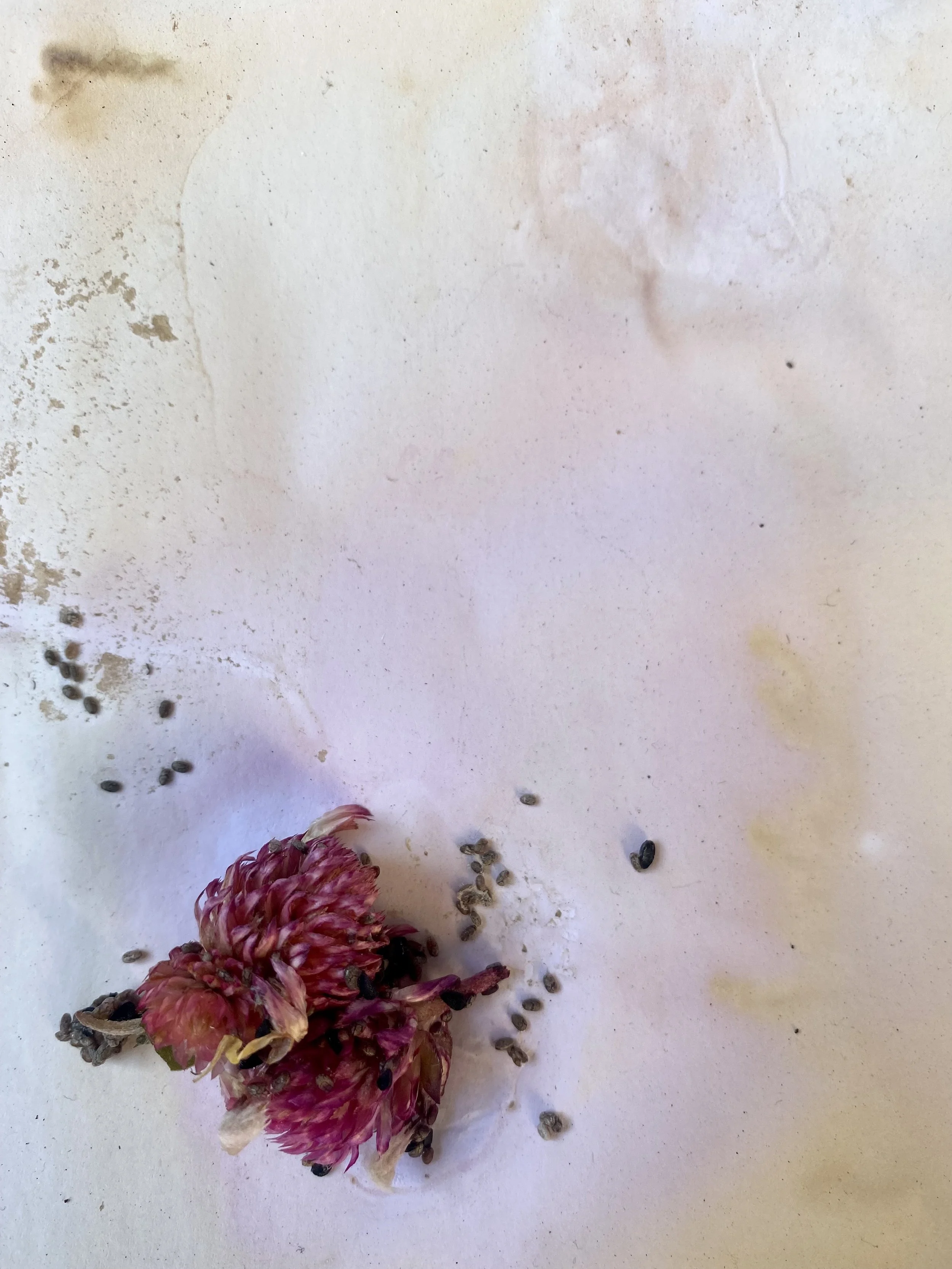
The Parisian uprisings of May 1968 gave enduring cultural currency to the slogan “Under the Paving Stones, the Beach!”, and there is something profoundly revealing about the cracked and worn surfaces of a city, particularly in those corners where the vagaries of time and meteorology have unravelled the illusion of permanence. Beneath relentless cycles of urban renewal lie the accumulated traces of countless forgotten lives – torn fragments of old advertisements, crumbling plaster, the remnants of vanished buildings, and hard concrete giving way to the stubborn emergence of vegetation. These are the incidental archives of human existence, material records of a world continually dismantling and reconstructing itself, and for the London-based artist Purdey Fitzherbert, they offer a glimpse into the strange beauty of impermanence.
Fitzherbert's practice inhabits a fascinating territory between artistic intention and the unpredictable metabolising agency of the natural world. Working with delicate Japanese paper, mineral pigments, rust, salts and discarded materials, she creates intricate, often ethereal compositions in which chemical reactions, atmospheric conditions and the passage of time become active participants in the creative process. Her approach is informed by a longstanding fascination with the instability of perception – the elusive boundaries between conscious and unconscious experience, and the possibility that matter itself might retain something of the histories through which it has passed. There is an alchemical sensibility to her works, which appear simultaneously ancient and embryonic, as though revealing the hidden architecture of processes ordinarily beyond our awareness.
Her participation in What Holds Us Together, a group exhibition emerging from an artist residency in London's Fitzrovia, has brought these investigations into compelling focus. Collecting fragments from the surrounding streets and exploring the relationship between architecture, memory and material transformation, Fitzherbert has incorporated bookbinders' muslin into her work, bringing into view a substance traditionally concealed within the structure of a book. It is a poetic gesture, exposing the fragile mechanisms through which things are preserved and connected, even as they remain vulnerable to change. At a moment when contemporary culture seems increasingly preoccupied with control, perfection and the preservation of appearances, Fitzherbert's work suggests a more generous and nuanced relationship with uncertainty. There is beauty in erosion, possibility in surrender, and perhaps an unexpected form of continuity in the knowledge that nothing remains entirely as it was. Here, the artist talks to FUTURISTIC DRAGON about the intelligence of materials, the unreliable nature of perception, and why the very impermanence of our existence might ultimately be what holds us together.
You deliberately relinquish a degree of control in your work to water, weather and chemical reactions. At what point does something cease to be an artwork you have made and become something nature has created?
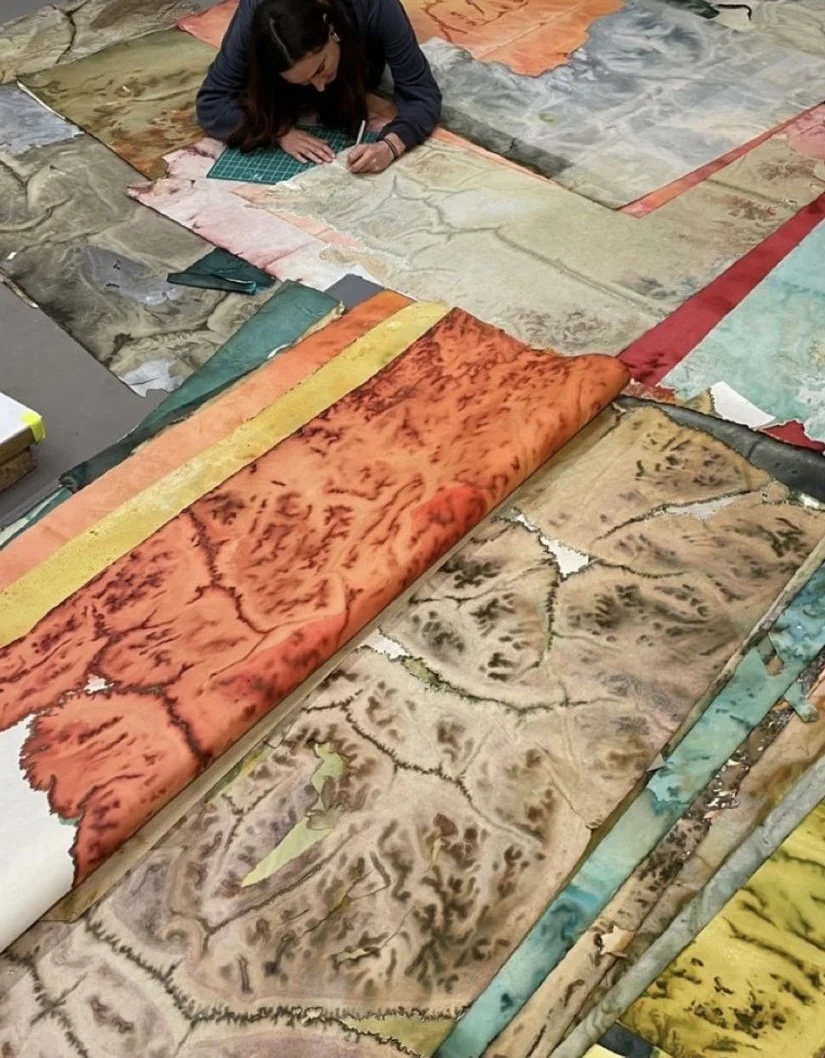
I’m not sure there is a precise point at which the work stops being mine and becomes something nature has made. It is more of a gradual surrender, a negotiation between my intentions and the behaviour of the materials. I might begin with a very clear idea of what I want to achieve, but as soon as the pigments, water, salts, heat and paper begin to interact, the work takes on a life of its own. I find myself responding to what is happening rather than simply executing a predetermined plan. I think of myself as providing the conditions for something to emerge. I introduce the materials, create certain situations and make decisions along the way, but I cannot entirely dictate the outcome. The paper might warp, a pigment might separate, a colour might bleed into another, or a chemical reaction might produce a pattern I could never have anticipated. Sometimes the most beautiful things happen when I stop trying to control them.
I see it as a collaboration, although not necessarily one between equal partners in the conventional sense. Nature has its own intelligence, rhythms and ways of organising matter, which I am trying to make space for. I have described my process as nature trying to sort out chaos. There is something extraordinary about watching patterns emerge without conscious planning, as though the materials are finding their own equilibrium. But I am still present in that process. I decide when to intervene, when to add something, when to leave it alone and when the work feels complete enough to stop. Perhaps my role is less that of an author imposing an image and more that of a participant, tending to something whose ultimate growth I cannot control. The mystery lies in that balance: I have a hand in making the work, but I am never entirely responsible for everything it becomes.
“I have always been drawn to things that exist on the edge of something, particularly when they seem to be in a state of transition. A wall where the plaster is falling away, a tiny flower growing through a crack in the pavement”
It would seem that your work occupies thresholds – between waking and sleeping, creation and destruction, the human and natural worlds. What draws you towards the edge between states?
I have always been drawn to things that exist on the edge of something, particularly when they seem to be in a state of transition. A wall where the plaster is falling away, a tiny flower growing through a crack in the pavement, a surface that is simultaneously beautiful and damaged. These things seem to contain several states of being at once. They are in the process of becoming something else, but they have not quite arrived there. I think my early experiences of chronic insomnia contributed to this sensitivity. Being awake when the rest of the world is asleep can alter your perception of things. Walking through the city when I was exhausted, I became very aware of small, fleeting details that might otherwise have gone unnoticed: a sliver of light, a stain on a wall, the texture of a surface, or a strange encounter between two colours. I was interested in the space between what I could actually see and what I felt I was seeing.
That interest extended into meditation and experiences in which ordinary perception seemed to shift. I became fascinated by the possibility that there are aspects of the world that we do not usually notice, or that cannot easily be described in words. In my work, these thresholds often appear through the tension between opposing qualities: strength and fragility, permanence and disappearance, concealment and revelation. I am particularly interested in moments when something seems close to falling apart but is still holding together, or when something damaged reveals an unexpected beauty. Perhaps these edges are compelling because they resist certainty. They allow several possibilities to coexist. I am less interested in describing a fixed state than in exploring the moment when one state begins to transform into another. There is a kind of heightened awareness in that moment, an intensity that comes from knowing that what you are looking at will not remain as it is.
Your earliest investigations into light seemed to be concerned with the unreliability of perception: the difference between what exists and what we believe ourselves to have seen. Has making art made you trust your perception of reality more, or less? Is reality merely consensus?
Making art has probably made me less certain about my perception of reality, but more curious about it. I have become increasingly aware that what we see is not necessarily the same as what exists. Our perception is influenced by our surroundings, our memories, our emotional state and the context in which we encounter something. My early interest in light and colour came partly from this fascination with the human eye and the way colours change in relation to one another. A colour can appear luminous in one setting and dull in another. Something can seem to have a particular form until the light shifts, or until we approach it from a different angle. I find it fascinating that something we experience as so immediate and convincing can be so unstable. Working with materials has reinforced this for me. When I combine pigments, minerals, salts and different surfaces, unexpected colours and patterns emerge. Sometimes the result seems familiar, almost recognisable, although I cannot quite identify what I am looking at. It might evoke a landscape, a microscopic structure, a map or something entirely imagined. I am interested in that moment when recognition occurs without a clear explanation.
I think reality is partly shaped by shared agreements about what things are and how we understand them. Those agreements can be cultural, historical and political, and they influence what we notice, what we value and what we overlook. But I would not say that reality is merely consensus. The physical world has its own forces and conditions that exist beyond our interpretations of them. A material will react according to its properties, whether or not I understand why it is doing so. For me, art offers a way of staying with that uncertainty rather than resolving it. It allows me to question what I think I know and to acknowledge that there may be more than one way of experiencing the same thing. I don't necessarily want my work to provide an answer. I would rather it create a space in which perception can become a little less fixed, and in which we can become more attentive to the things we do not yet understand.
“ I don't claim that materials possess consciousness in the same way that we do. But I am interested in how matter responds, changes and interacts within systems much larger than ourselves.”
Do you believe matter can hold memory? How does your work approach ideas about consciousness?
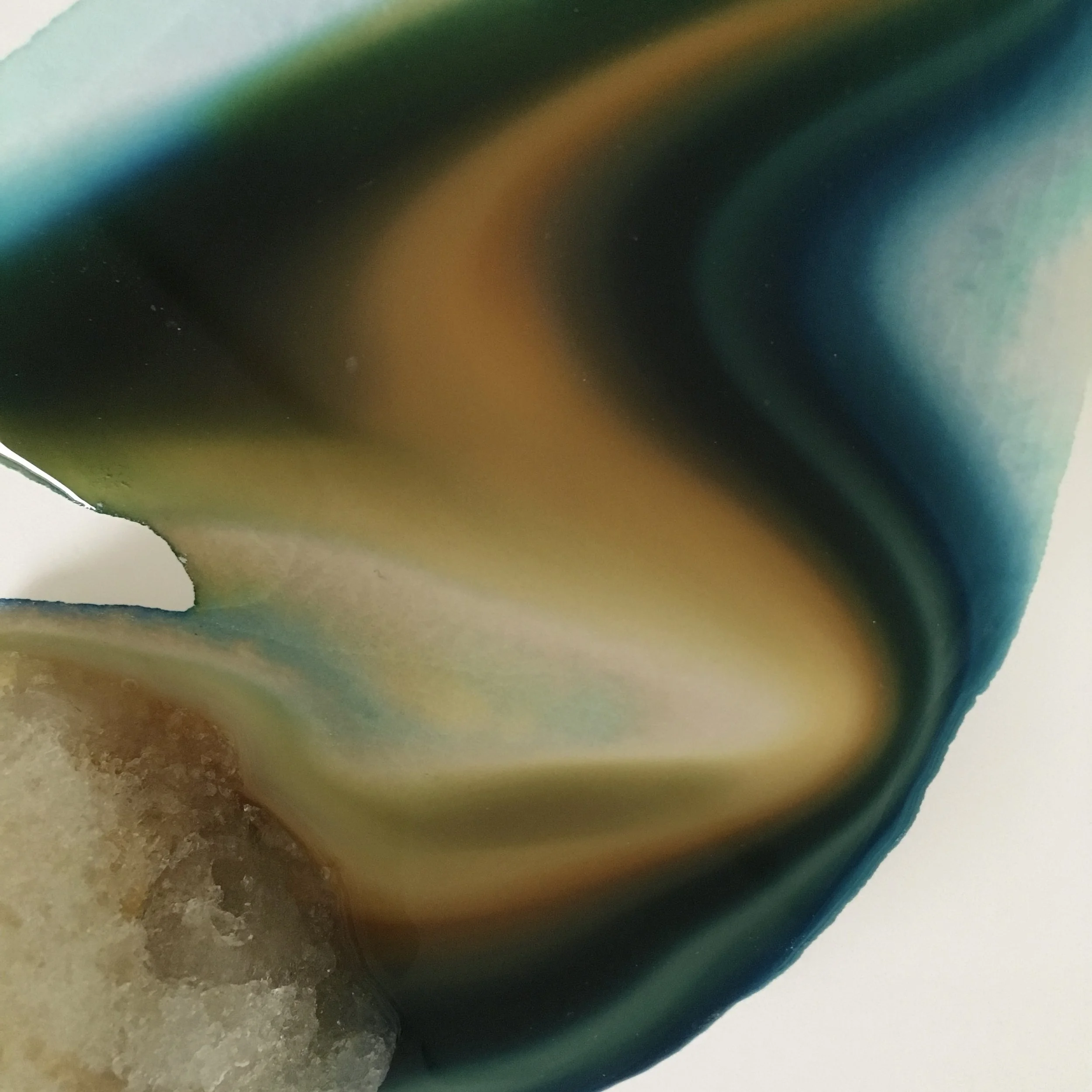
I do believe that matter can hold memory, although I think of memory here in a broader sense than the conscious recollection of an event. Materials retain traces of what has happened to them. A piece of paper can carry the marks of heat, water, pressure, friction, oxidation or exposure to the elements. These changes become part of its physical history, even if we cannot reconstruct every detail of how they occurred. I am drawn to handmade Japanese paper partly because it seems to possess a character of its own. It is delicate, but it is also surprisingly resilient. It absorbs pigments differently, responds to moisture, changes shape and reveals or conceals marks as the surface develops. I often feel that I am working with something living, something that has its own presence rather than simply providing a neutral ground for an image. In my recent work, I have also been interested in the memory held by urban surfaces. The layers of paint, old advertisements, exposed plaster, rust and repairs found on the streets of Fitzrovia reveal traces of different periods of activity. A wall becomes a kind of archive, although an incomplete one. Some histories are visible, others are buried, and some have disappeared almost entirely. Consciousness is a more mysterious question for me. My interest in meditation, alternative approaches to healing and the subtle relationships between our inner and outer worlds has made me curious about how we experience connections that are difficult to measure or explain. I am fascinated by the patterns that recur throughout nature, from the branching structures of plants to the formations created by water, minerals and weather. I don't claim that materials possess consciousness in the same way that we do. But I am interested in how matter responds, changes and interacts within systems much larger than ourselves. When I paint, I sometimes feel that I am participating in something I cannot fully comprehend. The work becomes a record of that encounter: my decisions, the behaviour of the materials, the conditions in which they met, and the traces that remain. Perhaps what interests me most is the possibility that there is always more held within a surface than we can see.
We tend to associate artistic authorship with intention, yet your process depends upon surrender. Is relinquishing control simply a method of making, or has it changed the way you understand being in the world?
It began as a way of making work, but I think it has gradually become a way of understanding the world. I have always struggled with the tension between wanting to control an outcome and recognising that the most interesting things often happen when I allow something unexpected to take place. In the studio, I might begin with a clear intention, but the materials rarely behave exactly as I anticipate. I can try to force them into a particular shape or composition, but there is often a point at which that intervention becomes counterproductive. The paper begins to resist, the surface becomes awkward, or something that was initially beautiful loses its vitality. I have learnt to recognise when I am pushing too hard. That doesn't mean abandoning intention altogether. I am still making decisions and developing a visual language. The process requires attention, patience and a willingness to respond. There is a difference between surrendering control and simply leaving everything to chance. I have to remain engaged enough to recognise when something unexpected is worth following.
Outside the studio, I think this has made me more conscious of how much energy we spend trying to hold things in place. We want to preserve relationships, identities, places and versions of ourselves, even though everything is constantly changing. I am interested in the idea that our attempts to prevent change can sometimes become a source of tension in themselves. My work doesn't offer a simple solution to that, because I still find the desire for control compelling. I am continually negotiating with it. But making art has taught me that uncertainty can be productive. It can create space for discoveries that would not have been possible if I had insisted on knowing the outcome from the beginning. I sometimes think of the process as tending a garden. You can prepare the ground, introduce certain elements and nurture what begins to grow, but you cannot dictate every aspect of its development. You have to participate without imagining that you are in complete command. That balance between care and surrender is something I am still learning, both in my work and in life.
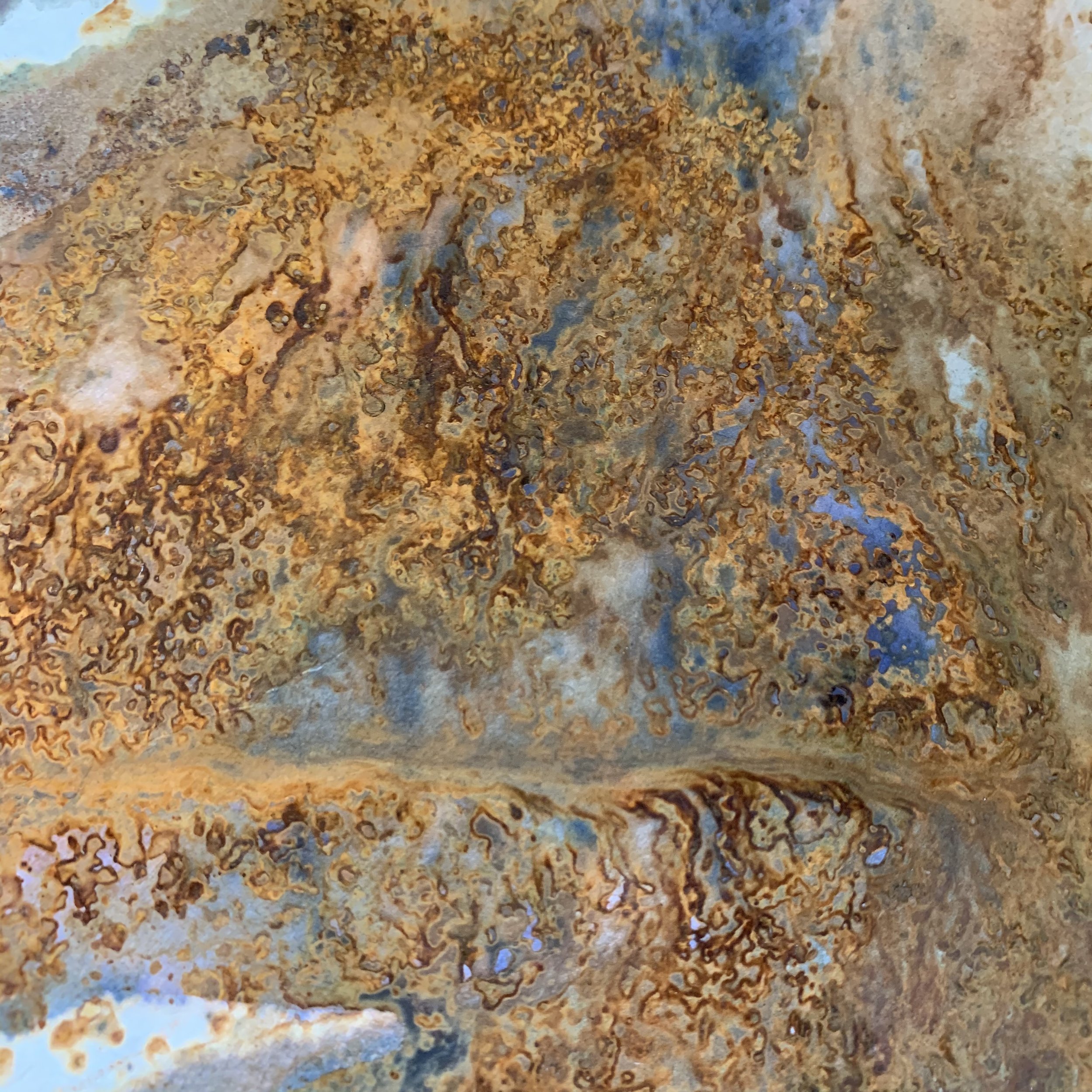
“The Japanese aesthetic of wabi-sabi has been important to my thinking because it encourages an appreciation of simplicity, imperfection and transience. I am also influenced by ideas of impermanence in Buddhist thought.”
There is something almost alchemical in your transformation of rust, discarded objects, fragments of buildings and natural substances into artworks. Is transformation more interesting to you than creation, the idea that perhaps nothing is ever really created from nothing?
I have always been fascinated by the possibility of transforming something ordinary or overlooked into something unexpected. As a child, I was drawn to collecting discarded objects and turning them into sculptures or artworks. I think that early interest in salvaging materials has stayed with me. I am often more interested in something that already has a history than in a material that feels entirely new or untouched. I collect things such as rust, pulverised brick, chalk, earth, ash and fragments of paper from the urban environment. These materials have already been shaped by events and processes before they arrive in my studio. Rust speaks of oxidation and time; a piece of old wallpaper might carry traces of a building that has been altered or demolished; a fragment of an advertisement might have lost its original purpose but continue to bear the marks of its former life.
When I grind these materials into pigments or incorporate them into paper, I am changing their form and context, but I am not erasing everything that came before. Their previous existence becomes part of the work. I am interested in that continuity, in the way something can be transformed without entirely losing its history. The process feels alchemical because it involves experimentation, transformation and a degree of mystery. I combine materials and introduce heat, water, salts or other elements, sometimes producing results I could never have predicted. There is a point at which the process becomes less about making something from nothing and more about revealing possibilities that were already latent within the materials. I don't think creation and transformation are entirely separate. There is certainly an act of creation in what I do, but it is one that depends upon existing matter, previous histories and interactions that extend beyond me. Even the paper I use comes from a long tradition of making, and the pigments carry the properties and histories of their sources. Perhaps what interests me is the idea that nothing exists in complete isolation. Things are continually being broken down, absorbed, altered and given new forms. I want my work to make that process visible, to show that destruction is not necessarily an ending, but can also be the beginning of something else.
What do damaged, ageing or disappearing things tell us about beauty that perfect things cannot? How do you define beauty?
I am very drawn to things that are worn, cracked, faded or on the verge of disappearing. There is often a sensitivity to them that I don't find in something entirely new or pristine. A damaged surface can reveal the passage of time in a way that a perfect one cannot. It carries evidence of having existed, of having been exposed to the world and changed by it. When I walk through London, I am often drawn to the small details that other people might overlook: a crusted wall, a flower emerging from a crack in the pavement, the remains of an old advertisement or a patch of plaster where several layers have been exposed. These things can contain an extraordinary mixture of neglect and beauty. They remind me that something does not need to be preserved in its original condition to have value.
The Japanese aesthetic of wabi-sabi has been important to my thinking because it encourages an appreciation of simplicity, imperfection and transience. I am also influenced by ideas of impermanence in Buddhist thought. Everything is in a constant state of change, and there is something liberating in acknowledging that rather than trying to deny it. I think contemporary culture can encourage us to treat ageing and deterioration as problems to be corrected, as though beauty depends upon maintaining an unchanging surface. But I am interested in what happens when we allow things to reveal their age. A surface becomes more complex; different layers emerge; what was once concealed becomes visible. There is a kind of richness that comes from this accumulation of experience. For me, beauty is not necessarily about harmony or perfection. It often emerges through contradiction: something can be delicate and resilient, sad and hopeful, damaged and full of life. I am interested in beauty that makes you feel something rather than simply admire an object. Sometimes it is a fleeting moment, a colour interaction or an unexpected pattern that holds me. I don't think decay is always beautiful, and I don't want to romanticise loss. There can be something deeply unsettling about watching things disappear. But I think there is value in looking closely at that process, because it reminds us of our own vulnerability and of the preciousness of what exists now. Beauty, for me, is often found in that fragile interval between presence and disappearance.
“Spending several months in Fitzrovia made me think about a place as something much more complex than its architecture. Walking through the area repeatedly, I became increasingly aware of the layers of history embedded in its surfaces.”
Your work for What Holds Us Together emerged from several months spent in Fitzrovia, an environment where buildings, people, histories and materials are continually replacing one another. What did you discover actually holds a place together – its architecture, its memories, its people, or something less tangible?
Spending several months in Fitzrovia made me think about a place as something much more complex than its architecture. Walking through the area repeatedly, I became increasingly aware of the layers of history embedded in its surfaces: old advertisements, exposed plaster, worn stonework, layers of paint and buildings in different stages of repair or renovation. These details revealed how much a place changes while still retaining traces of what it was before. I am interested in the idea that a city is an evolving archive. Its history is not always preserved in monuments or official records. It also exists in fragments, stains, textures and residues left behind by ordinary life. Something as seemingly insignificant as a torn poster or a patch of rust can suggest a previous moment of activity, a building's former appearance or the presence of people who are no longer there. During the residency, I began collecting materials from the surrounding streets and incorporating them into my work. I also became interested in the relationship between textiles and architecture, particularly after seeing the Miró silks hanging in a shop window. Their delicate, rippling appearance contrasted with the rough, weathered walls outside. I was struck by how something apparently fragile could hold its own structure, and how materials could protect or reinforce something without necessarily concealing its condition. This led me to use bookbinders' muslin, a material normally hidden within a book's binding, as a visible part of my work. I liked the idea of making a supporting structure visible, of showing the thing that holds something else together. I think a place is held together by all these different elements, but also by the less tangible relationships between them. Its buildings provide a physical structure, its materials retain traces of the past, and its people continually change its character. Memory connects these things, even when the original circumstances have disappeared. Perhaps what holds a place together is not its ability to remain unchanged, but its capacity to absorb change. Fitzrovia felt compelling because different periods of time seemed to coexist within the same surfaces. Nothing was entirely resolved or finished. For me, that layering became a way of thinking about how a place can retain a sense of itself while continually becoming something else.
The title What Holds Us Together implies that connection requires some kind of binding force. Yet your own work suggests that everything is continually changing, eroding and disappearing. Can impermanence itself be something that connects us?
I think impermanence can be one of the things that connects us most deeply. We are all subject to change, even though we experience it in different ways and at different times. Our bodies change, our relationships change, the places we inhabit change, and the things we think of as permanent eventually reveal their fragility. Recognising that shared condition can create a sense of connection. I am interested in the idea that nothing exists in isolation. In nature, everything is influenced by the conditions around it. Materials interact, break down and become part of something else. One form disappears and provides the conditions for another to emerge. My own processes reflect this: the paper is affected by the pigments, the pigments by the water and salts, and the final surface by the conditions in which it has been made. The work is the result of a network of relationships rather than a single action.
The same is true of the city. During my residency in Fitzrovia, I became interested in the layers of material history that accumulate within buildings and streets. A wall might contain traces of several different periods, with new layers covering older ones while fragments of the past remain visible. The place is held together not by remaining the same, but by the ongoing relationship between what has been there and what is emerging. I explored this idea through layering Japanese paper, found paper and bookbinders' muslin. The muslin, traditionally used to reinforce book bindings, became a way of thinking about support and preservation. I wanted to show how something fragile might be held together without hiding its condition. I think connection is often imagined as something that prevents separation or loss. But perhaps it can also be something that allows change to happen. We can be connected through shared histories, through the traces we leave behind, and through the knowledge that nothing remains untouched by the passage of time. There is sadness in that, but there is also a kind of freedom. If impermanence is something we share, then vulnerability is not simply an individual weakness. It is part of our common experience. I hope my work can create a space in which viewers recognise something of themselves in the materials: their fragility, their resilience, and their capacity to be changed by the world around them.
Do you think the materials you work with know something that you don't?
Yes, in a sense. They know things that I cannot necessarily access through thought or intention. I don't mean that materials have knowledge in the human sense, but that they possess properties, histories and possibilities that are not always immediately apparent to me. When I work with a particular paper or pigment, I can understand something about its characteristics, but I can never predict every way it might behave in combination with other substances. A colour might separate unexpectedly, a surface might wrinkle or become translucent, or a reaction might produce a pattern that seems almost impossible to have designed. These moments remind me that the materials are not passive tools. They have their own properties and resistances, and those qualities shape the work. I am often interested in what happens when I reach the limits of what I know how to do. If I follow a process too rigidly, I can end up repeating something familiar. But if I allow the materials to surprise me, I might discover something that takes the work in an entirely different direction. I have learnt that not understanding something immediately is not necessarily a problem; sometimes it is the beginning of the most interesting part of the process.
I am also drawn to the histories contained within materials. The rust I collect, the bricks I grind into pigment, and the discarded papers I gather from the streets have all been shaped by processes that began long before they entered my studio. They carry traces of environments, human activity and the passage of time. I can transform them, but I cannot entirely separate them from those histories. My interest in nature, meditation and the invisible patterns that connect different forms of life has made me receptive to the possibility that there are larger processes at work that I can participate in without fully understanding. I am fascinated by the way similar patterns appear at different scales, from the branching structures of plants to the formations created by water and minerals. Perhaps the materials teach me to be less certain of my own knowledge. They remind me that making is not always about imposing an idea onto the world, but about paying attention to what is already happening and discovering what might emerge from it. I bring my intuition, experience and intentions to the studio, but the materials bring something I could not have invented in advance. The work happens somewhere between the two, in that space of discovery where the known and unknown meet.
What Holds Us Together runs from 19–25 October 2026 at Radiant House, 36–38 Mortimer Street, Fitzrovia, London, bringing together the work of Purdey Fitzherbert and five fellow artists following a four-month residency in the neighbourhood. Admission is free.
Get up close and personal with artists from all over the world and unlock the mysteries of the creative mind.
Read in-depth interviews with the most exciting cultural movers and shakers shaping the creative landscape.
Discover the actors, authors, designers, mavericks and entrepreneurs at the bleeding edge of cultural life.