ART & IMAGE: INTERVIEW
The Divided Self: Regina Kim
Fractured Identity, Projection And The Boundless Imagination
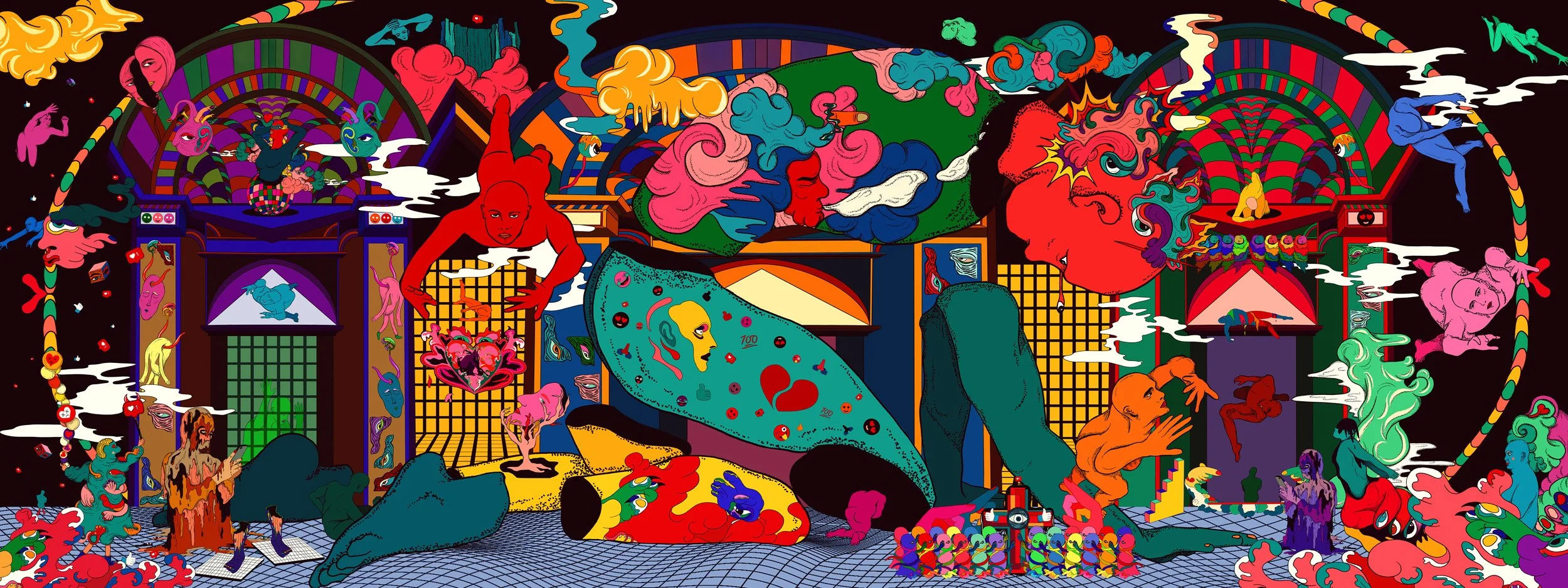
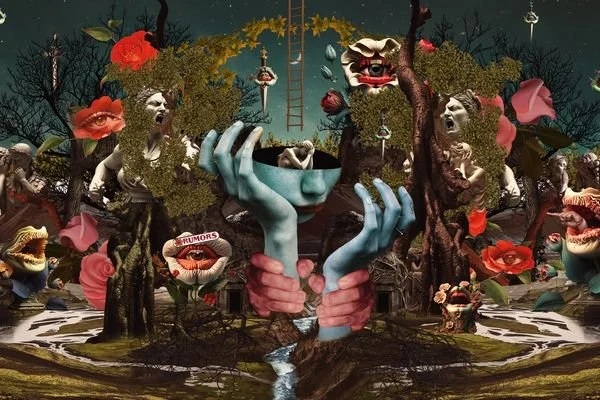
The Korean artist Regina Kim wanders into the world of images as if into a wonderland, inviting the viewer to engage in a dance of reciprocal projection that challenges the scaffolding of social conditioning. Her practice utilises collage, illustration, and, more recently, moving image and the boundless arena of digital technologies, as languages she can meld and reconfigure, so that fragments of the visible, the remembered and the imagined are able to coalesce in unexpected ways. The strange juxtapositions of faces, textures and found ephemera in her work thereby open a question about how we have all been subliminally conditioned to separate the things we perceive in the world into various hierarchies. Each collision in her work acts an argument against these neat divisions imposed by society and culture, offering a method of unpicking constructed boundaries. To engage with Kim’s work is to be made aware of how much of what we consider to be our own identity is also assembled from histories, desires and habits that have been guided and controlled. Her hugely successful installation at the Shanghai Powerlong Museum two years ago, created with the software engineer Tony Lim, extended her practice of cultural assemblage into fully immersive digital environs, allowing her creations to unfold in 360-degrees, drawing the viewer into dizzying hinterlands of unfettered imagination, and her recent show The Unedited Human explored algorithmic rabbit holes to pose the kinds of questions about ‘self’ that the likes of RD Laing arguably first mined in the field of psychiatry. In this in-depth interview with FUTURISTIC DRAGON the celebrated artist explains the impetus behind her invitation to relook at the fragments of our world, and tells us why assembling them in new ways helps us better understand how we can pave the way to an infinity of possibilities.
You are celebrated as one of the most promising young artists of the moment. Would you say that you always knew you would be an artist?
I studied Law and Clothing and Textiles in Korea, so I never imagined I would become an artist. Initially, I came to London to study English, and while doing so, I was looking for schools to study fashion. However, I found that fashion design had too many restrictions when it came to expressing full creativity. Working in a fashion company would require me to consider the company’s style and profitability, which didn’t align with the kind of creative work I wanted to pursue. It was during a visit to Tate Modern that I had what felt like a ‘eureka’ moment. Seeing artists who used such a wide range of materials to tell their own stories made me realise that I don’t have to be a skilled painter to become an artist. It was also the first time I truly understood contemporary art. After returning to Korea, I spent about four months preparing my portfolio and applied for the Fine Art Pre-Master’s course at Kingston University. I chose the Pre-Master’s course because I wanted to see if I genuinely had the talent to pursue art. My time at Kingston was an excellent starting point, which led to me studying my master’s at the Royal College of Art.
“I believe that art is an infinite language, one that allows all of us to see and feel beyond words. It is essential for art to reflect diversity, as it gives us a chance to represent the time we live in”
Why were you first drawn to work in the medium of collage, and what do you love about the surreal?
During my time studying Fine Art at Kingston University, I became fascinated by the concept of diversity and started to notice the many walls and boundaries that exist around us. I found collage to be an ideal medium to express these boundaries and limitations, so I began to develop my practice around it. As I explored collage, I researched the works of many artists and realised how closely related collage is to surrealism. Artists like Salvador Dalí, René Magritte, Pablo Picasso, David Hockney, and Hannah Höch have greatly influenced my perspective, giving me the freedom to see beyond the ordinary. I am captivated by the world beyond reality and aim to create surreal spaces and worlds. I don’t seek to escape reality entirely, though – I draw upon real-life emotions and issues to create imagined worlds that reflect the complexity of the human experience. In today’s world, the theme of diversity is incredibly important. Everything around us – race, culture, art, science – is interconnected and shows a rich blend of diversity. Art is a powerful medium that can capture a range of voices and deliver strong messages. I believe that art is an infinite language, one that allows all of us to see and feel beyond words. It is essential for art to reflect diversity, as it gives us a chance to represent the time we live in. I also believe it is part of an artist’s role to convey social and political messages through their work.
“Curated feeds, smoothed-out visuals, and optimised daily choices do not simply make us more at ease; instead, they often intensify a new kind of psychological anxiety through constant comparison and idealisation”
You certainly mine the socio-political in your work. Your most recent show The Edited Human examines how digital platforms, algorithmic addiction, and media frameworks slice, crop, and alter our sense of self. If technological curation constantly fragments human perception, does the "unedited" human self still exist as an objective reality, or has human identity become inherently tied to continuous digital modification?
I don't think there is such a thing as an unedited human. We begin already edited by family, by language, by other people, by culture. Digital technology is simply a new authority added to that list of editors. What’s different about this editor is that it has no name, it works for me, alone, and it makes money by influencing and persuading me via algorithm marketing etcetera. What's new isn't the editing. It's that the editor has become invisible and anonymous. So, my question isn't 'is there a pure and original human’s ego left?' but 'how much power should an editor hold regarding the ability to edit people?' There is no pure editor, but there are people who are still doing the editing.
If technological platforms edit away our emotional discomfort - by curating pleasant feeds and optimising our daily choices - do they diminish our capacity for profound creativity and authentic joy?
Curated feeds, smoothed-out visuals, and optimised daily choices do not simply make us more at ease; instead, they often intensify a new kind of psychological anxiety through constant comparison and idealisation. This environment widens the gap between the ‘perfect digital persona' and the flawed real self, and that gap can lead to relative contented deprivation and emotional exhaustion. Over time, we become increasingly habituated to comparing our lives with idealised images of others, while our capacity to tolerate emotional friction and discomfort gradually weakens. Yet profound creativity often emerges precisely through that friction, imperfection, and confrontation with the messy realities of lived experience. The more platform culture keeps us within a polished surface of aesthetics, the further we drift from the kind of creativity that grows through struggle, contradiction, and emotional depth. At the same time, as our resilience toward discomfort declines, we may become more dependent on artificial, short-lived pleasures rather than authentic joy. In this sense, the very mechanisms that seem to reduce suffering may paradoxically diminish our capacity for profound creativity and genuine happiness.
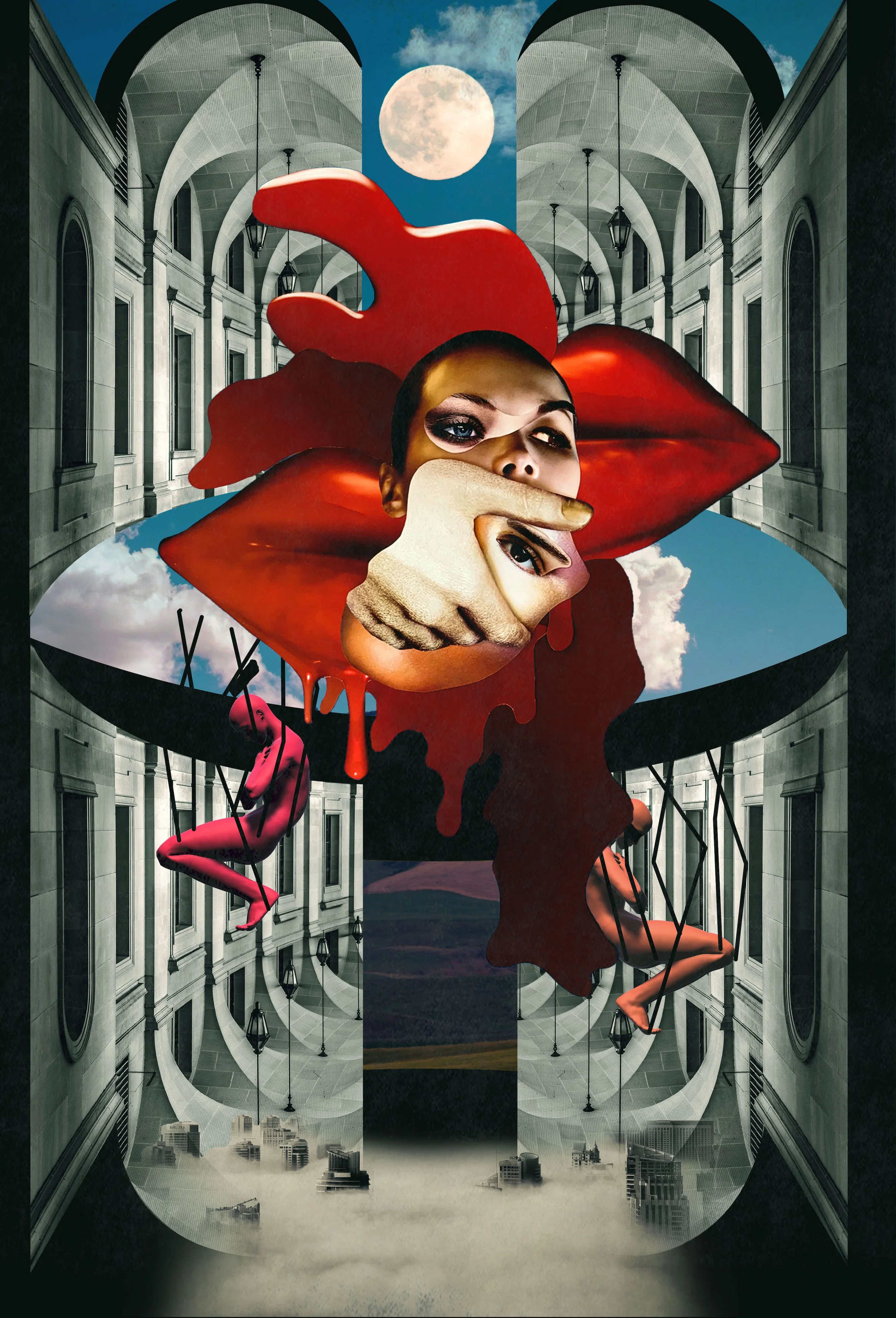
“Algorithmic training data is ultimately an accumulation of biases society has repeated for centuries. To me, algorithmic control and patriarchal control are therefore fundamentally the same”
In your recent piece Untitled (2025) for the Royal College of Art's Repetition publication, you used collage to dissect the 'architecture of perception, control, and repetition'. When algorithmic repetition dictates what we see and how we think, how can an individual form a truly autonomous belief, and how can art disrupt this architectural control to restore genuine agency?
'Untitled (2025)' addresses the suppressed voices of women. It originates from the critical awareness that structural controls imposed on women's bodies and roles are repeated so seamlessly that they come to be perceived as inherently natural. Algorithmic training data is ultimately an accumulation of biases society has repeated for centuries. To me, algorithmic control and patriarchal control are therefore fundamentally the same. Our beliefs and sense of agency are never completely free from the rules and frameworks that society continuously feeds us. The architectural elements in the work represent the biases and stereotypes built over time by others, but they also symbolise the walls I erected to protect myself. Yet those defences, too, were survival mechanisms this same society repeatedly taught me, which means oppression and self-preservation cannot be fully disentangled. Thus, I do not believe a completely 'pure' autonomous belief exists. What I do believe is that new possibilities begin only when those structures are fractured – and that it is entirely possible to create cracks within the repetitive narratives enforced by these systems. Whether algorithmic or institutional, mechanisms of control tend to present themselves as a flawless, unquestionable flow. Through my collage practice, I intentionally dissect images, fragment bodily forms, and expose raw seams and gaps. By disrupting these smoothly packaged structures and revealing their flaws, I prompt viewers to pause and directly confront the perceptual frameworks they have passively accepted as 'natural.' Art does not offer definitive answers. Rather, true agency begins to be re-imagined at the very moment art visualises the fractures and frictions that authority seeks to conceal. It is at that moment that viewers are compelled to question the architecture of their own perception.
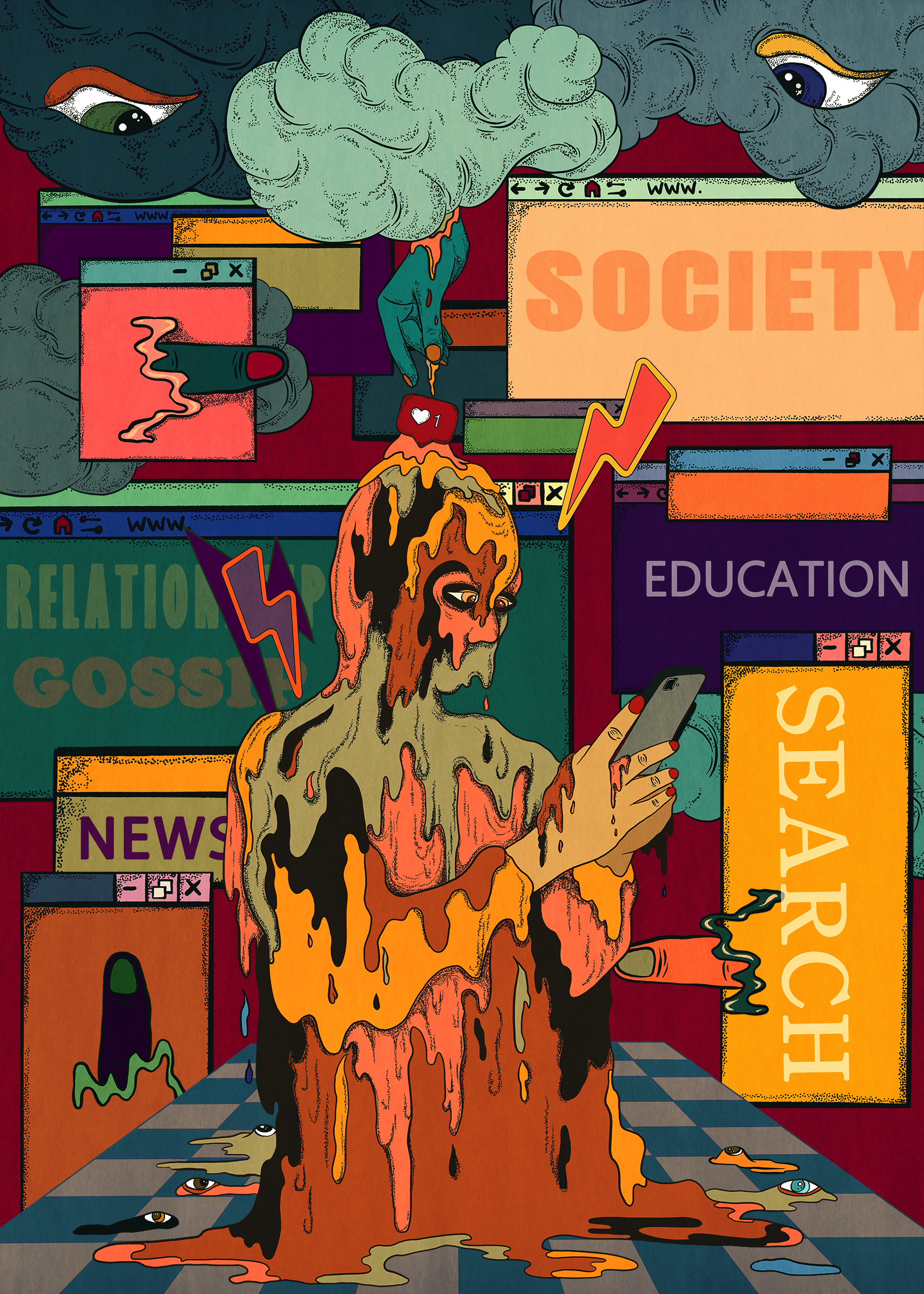
“True agency begins to be re-imagined at the very moment art visualises the fractures and frictions that authority seeks to conceal. It is at that moment that viewers are compelled to question the architecture of their own perception”
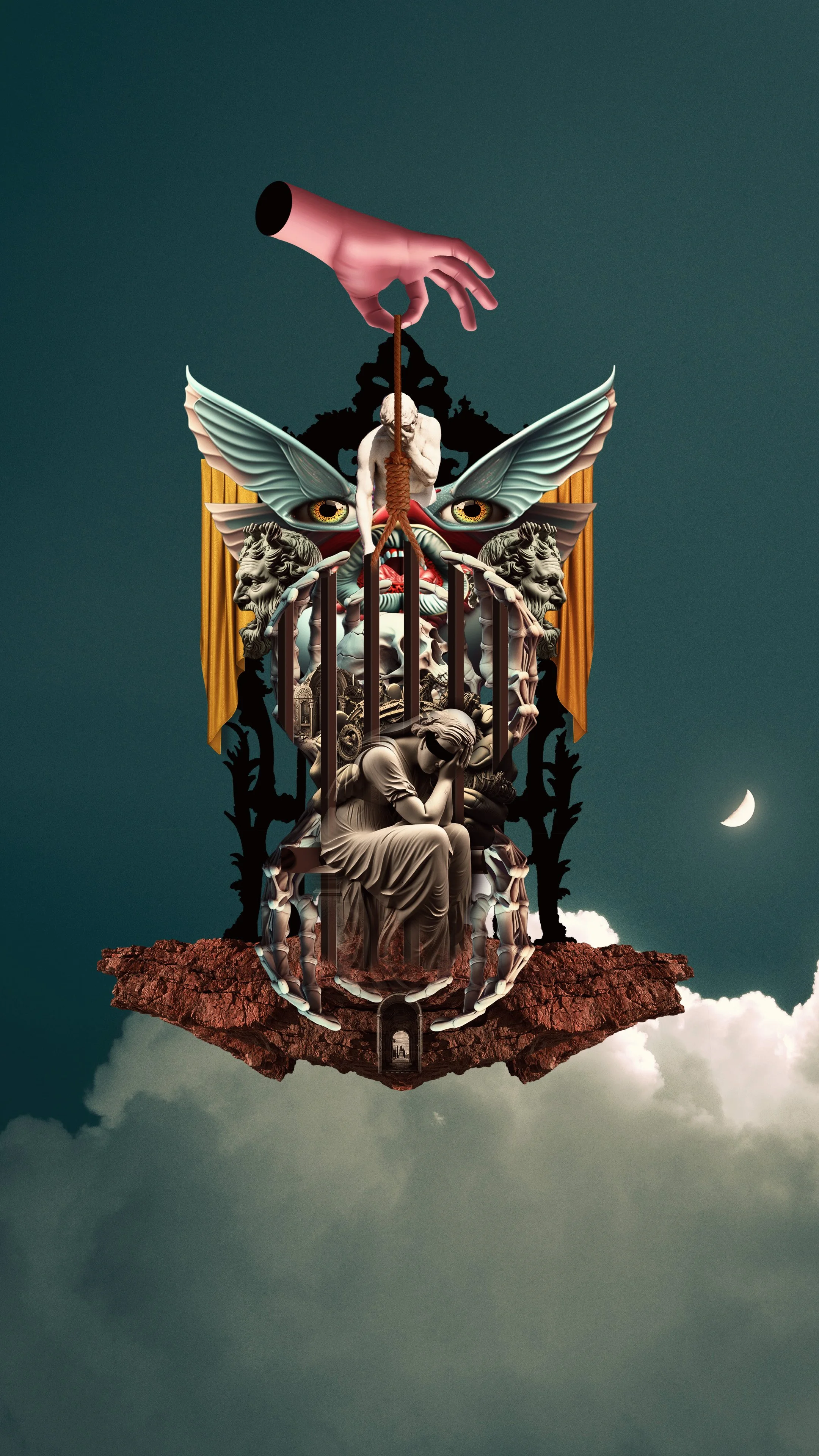
Your recent commentary highlights how a 'giant hand' or systemic structure allows freedom only within a frame designed by the system". Is the freedom we experience in highly monitored digital environments an authentic form of human liberty, or is it merely a structured illusion that pacifies our natural desire for real existential sovereignty?
The freedom we experience is a structured illusion, as it has always been – whether in the physical world or the digital realm. As social beings, we survive and thrive through community and collaboration; yet cooperation only works when individuals agree to surrender a portion of their sovereignty. A group where everyone insists on total, unchecked freedom cannot function; some degree of concession is the price of belonging. What has changed in the digital age is not this fundamental bargain itself, but rather who collects this surrendered sovereignty, and how invisibly they do so. My concept of the ‘giant hand’ illustrates this precisely: a system that both gives and takes from a position of authority. Historically, our sovereignty was edited by family, language, and culture – editors with names and faces. The digital system is simply the newest editor added to that list, but it is fundamentally different in nature: it has no name, operates on each of us individually and privately, and profits from every act of influence and persuasion. What is new is not the act of editing itself, but the fact that the editor has become invisible, anonymous, and monetised. We do possess real power to use digital tools independently to enrich and empower ourselves. But how and when that power is exercised depends entirely on individual agency. Yet, the system remains the gatekeeper of information and knowledge, filtering it as it sees fit – to serve engagement, data collection, and profit: a purpose that exists apart from, and often above, the individual's well-being. Still, recognising this separation is itself a form of freedom: the freedom to see the frame, even while existing within it.
Introduction & Interview by John-Paul Pryor
Find out more about the artist here:
Image Credits: Freedom.exe, 2025, Digital Illustration, print on fabric; The Blind Faith, 2023. Digital collage, moving image; The Forest of Dreams 2023; Untitled (2025) Digital collage, (RCA Repetition Publication); Square In, 2025, Digital Illustration, Print on canvas. All images courtesy of the artist.
Get up-close-and-personal with artists from all over the world and unlock the mysteries of the creative mind.
Read in-depth interviews with the most exciting cultural movers and shakers shaping the creative landscape.
Discover the actors, authors, designers, mavericks and entrepreneurs at the bleeding edge of cultural life.