ART & IMAGE: INTERVIEW
Dream Creature: Roby Dwi Antono
Empathy, Contemporary Surrealism And Spiritual Evolution
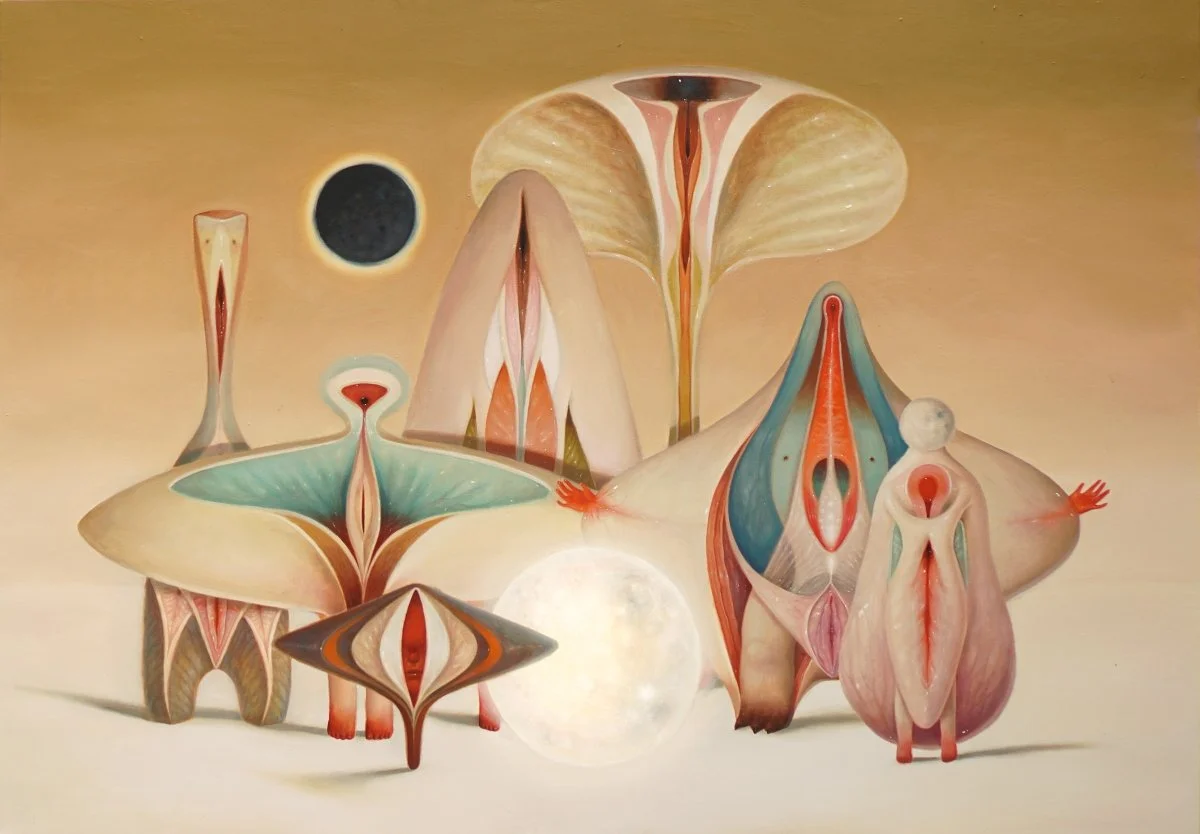
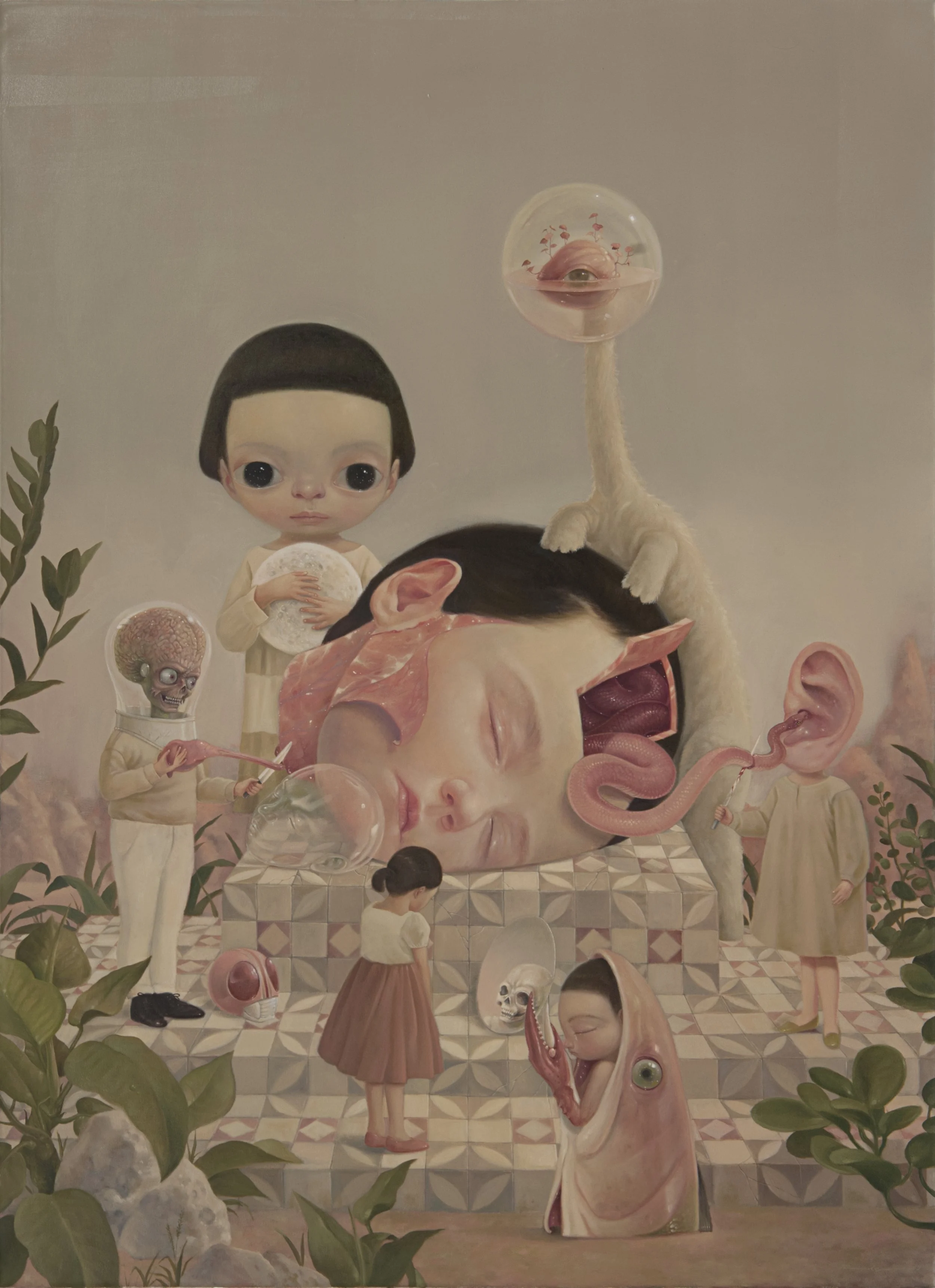
The acclaimed Indonesian artist Roby Dwi Antono is a maker of what one might be tempted to call dreamscapes, although that phrasing tends to imply a softness of refuge and reverie that his canvases resolutely refuse to oblige. They present instead a series of bizarre and cutesy parallel propositions – children standing beside the detritus of crashed spacecraft; animal-human hybrids with an almost comic inclination toward peeling back their own flesh as if to consult a private anatomy; and anomalies so extravagantly weird that language offers few useful adjectives to describe them.
Stylistically, the young artist surfs across multiple painterly genres, while maintaining a keen surrealist drift as an undertow. His images are mysterious and intricately coded, with symbols and signifiers arriving from a veritable smorgasbord of mythological gestures, religious echoes and kitschy futurisms. Antono allows all of these to collide, jostle, argue and overlap, so that the viewer must supply syntax, and try to delineate meaning. Often there is a sense of a faintly comic futurism present in this ordered chaos, as if the future were less an austere dystopian prophecy than a costumed tea-party.
Antono says he seeks to explore mortality and the random sequentiality of cause and effect in his painting practice, and it is fair to say that there is a curious ambivalence to all of the characters presented in his work. The children, for example, are not simply objects of nostalgia or consolation; they are interlocutors in a theatre of oddness. The hybrids, for all their macabre appetites, are not merely spectacles of shock; they possess a kind of private logic, a motive that refuses to be reduced to sensationalism. And the ubiquitous crashed spacecraft – those relics of a dream of technology – read as punctuation marks, or signposts, in a longer story that Antono is hinting at in fragments.
The result is a body of work that delights and disturbs in equal measure, where every pictorial pleasure is underpinned by a philosophical insistence on complexity. In this interview with FUTURISTIC DRAGON, the artist discusses his deeply felt love of surrealism, creating souls for his self-titled dream creatures and devoting himself to spiritual evolution.
Why are you drawn to the surreal and uncanny as an artist, and why have many of your works explored speculative futures?
I feel the poetic nuance, unanswered questions, puzzles and mystical impression of surrealism. I usually imagine the future – things that haven't yet happened, and how they could happen. Temporality and mortality are my favourite issues in surrealism. Time flies. We can’t exactly predict the future. It could be a good thing, or vice versa. Basically, I believe that a human is the accumulation of experience – even the smallest action that we do today can significantly change the future. In that sense, the future should be predictable, but in reality, it is not. The future holds a mysterious side, with many unexpected possibilities that will only become known as time passes. We tend to be anxious about the future, including me – that’s why I always recall my memories in my work.
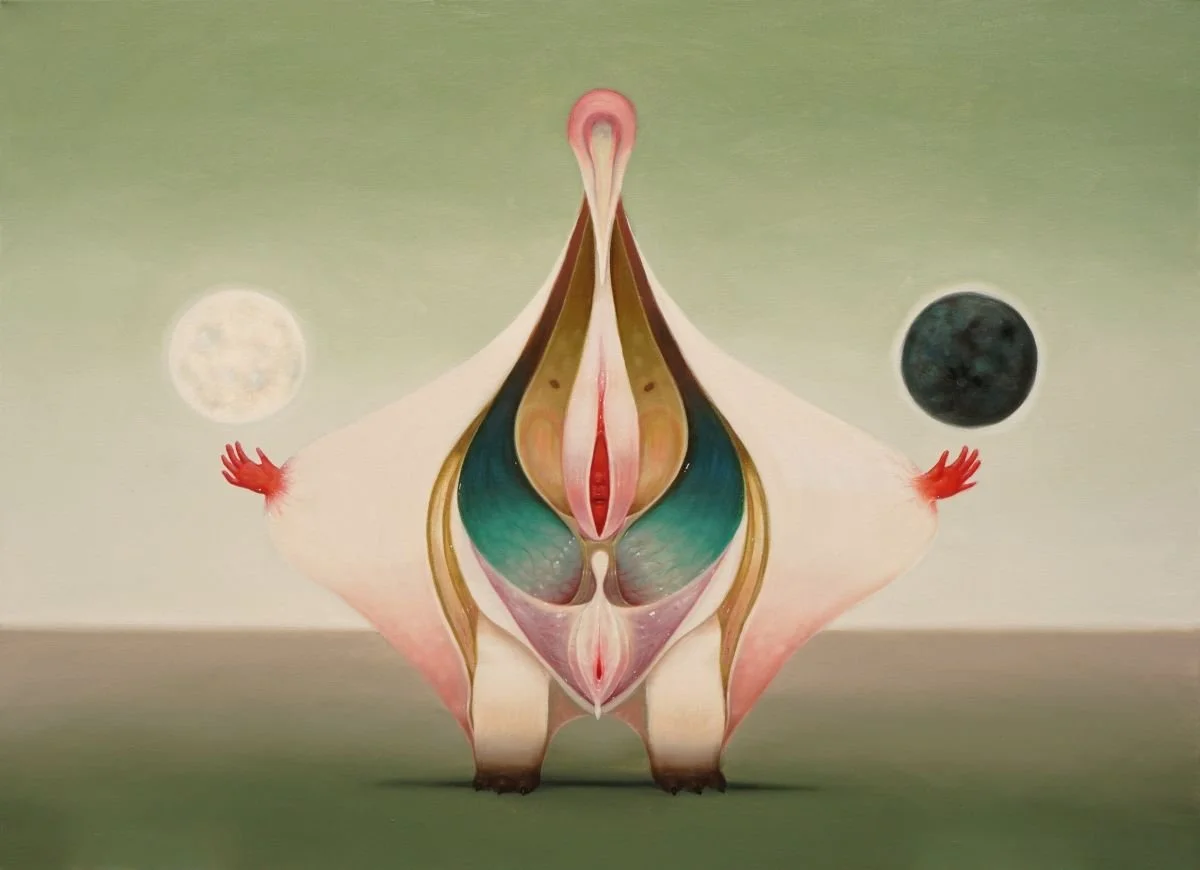
“I feel the poetic nuance, unanswered questions, puzzles and mystical impression of surrealism. I usually imagine the future – things that haven't yet happened, and how they could happen”
Why have you so often been inspired to create animal-human hybrids?
Animal nature is inherent in humans. I also see animals as creatures that have characteristics, and that can behave like humans – both have souls and feelings. Sometimes I get inspiration from my dreams when I sleep. I can’t remember the dream vividly, or represent it accurately after I wake up, but I immediately make a raw sketch of the characters and backgrounds in my dream, so that I don’t forget them. Usually, the characters and settings I dream of are strange shapes, with unusual colours – illogical and abstract. However, it is interesting for me to translate them into visual form. Of course, I add or subtract things according to my imagination, and this process is always exciting to me. It’s like giving a soul to a dream creature.
“As social beings, humans crave harmonious bonds with each other. However, today I see that empathy is greatly eroded by egoism and individualism”
Much of your work has been described as creepy or unsettling – what draws you to explore darkness?
I don’t know exactly why, however I realise that I like juxtaposing scary things and exposed body organs. I am fascinated by how our body organs are connected to each other – how when there is a malfunction in an organ, it will affect the function of another organ – and I am also amazed by how our body can heal itself. Actually, I’m afraid to see blood, wounds, or any sadistic and brutal scenes in movies. I usually just skip that part. On the other hand, I really enjoy painting colours and texture of flesh, vessels, and other organs – these organs have interesting visual characters to me. If you look at it from the conceptual perspective, I have created a series of paintings about autopsies, in which I show the surgery scenes. My Autopsy of Mystery series of paintings talked about empathy, called 'tepo seliro' in Javanese, which is defined as tolerance. Empathy is an attempt to deepen other human feelings in order to have a comprehensive understanding of what others feel. Humans need to look within to understand and reveal the complexity of human feelings. As social beings, humans crave harmonious bonds with each other. However, today I see that empathy is greatly eroded by egoism and individualism.

“The future holds a mysterious side, with many unexpected possibilities that will only become known as time passes”
You’ve described your work as a mirror in which you see yourself - talk to me about that, and the psychological catharsis it provides for you …
The psychological catharsis that is reflected in my works actually helps me feel calmer when completing a piece. Especially for this latest series, in which I have more freedom to stroke my brush, or sometimes directly use my finger or palms to paint, and this method makes me more expressive and free – recalling my childhood memories, when I just drew using my hand freely without thinking about art rules, style, or anything else.
Sometimes, the artwork concept makes me reflect on my life values, or the life journey that I have gone through – is this the life that I want, or is it still far from being perfect in terms of being a better person than I was yesterday? I believe that my series of works reflect personal milestones, in that I find it interesting to review each series as part of my reflection or self-criticism. I’m not good at conveying meaning verbally, but I feel free to speak through my painting. It provides psychological catharsis for me.
Introduction & Interview by John-Paul Pryor
Find out more about the artist here.
Image Credits: We are Together, Roby Dwi Antono, oil on canvas, 2023. Piteron, Roby Dwi Antono, oil on canvas, 2023. Mystery And Memory Part 1, Roby Dwi Antono, oil on canvas, 2020; The Inception of Life, Roby Dwi Antono, 2018. All images courtesy of the artist.
Get up-close-and-personal with artists from all over the world and unlock the mysteries of the creative mind.
Read in-depth interviews with the most exciting cultural movers and shakers shaping the creative landscape.
Discover the actors, authors, designers, mavericks and entrepreneurs at the bleeding edge of cultural life.