Sublime Intimacy: Agata Przyżycka
Mental Health, Eroticism And The Eternal Quest For Beauty
ART: INTERVIEW
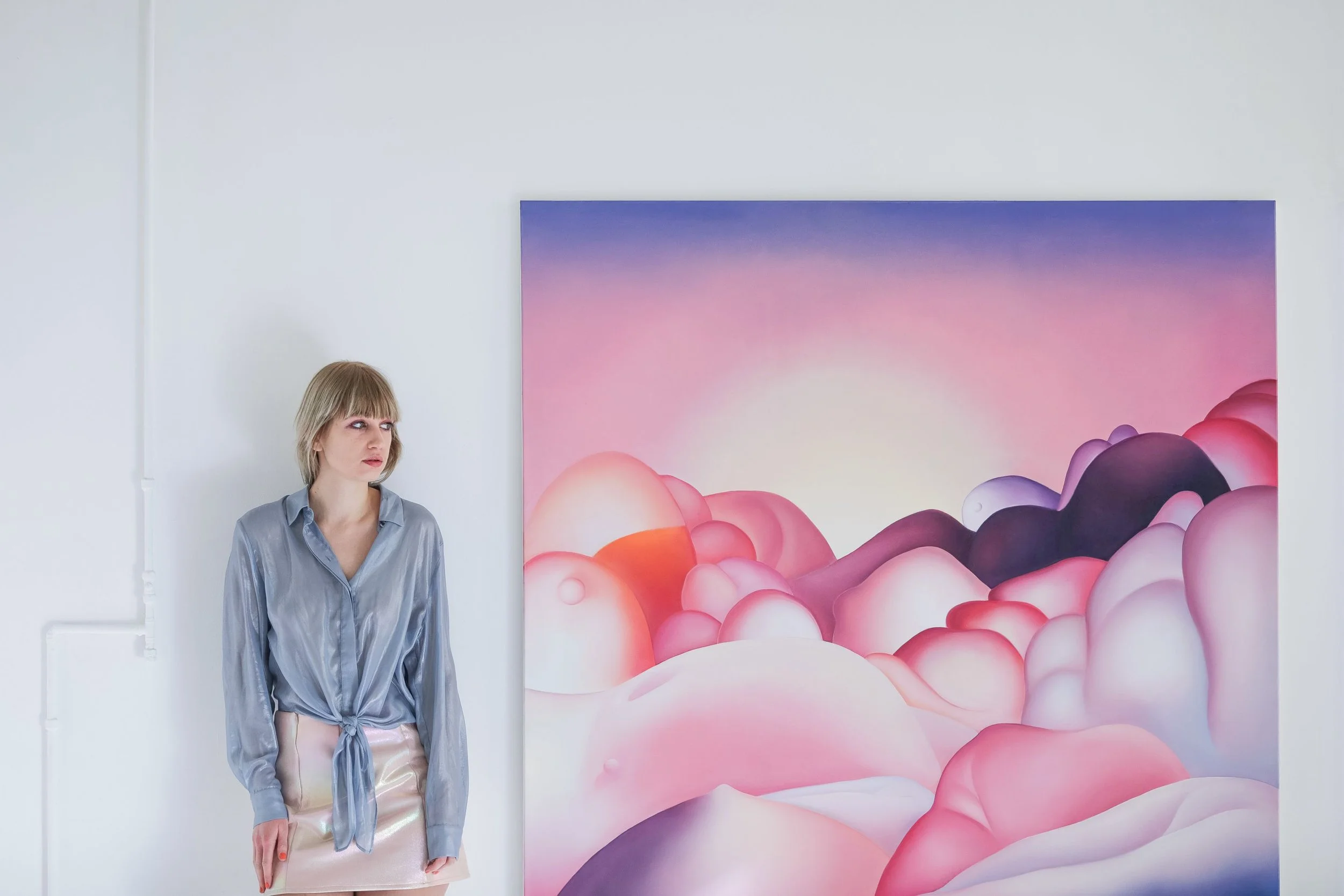
Agata Przyżycka is a young Polish painter whose work moves like a thought that has just become flesh. Her insistently sensual canvases treat the female body not as an object of display but as a field for experiments in perception, in which limbs and curves become topography – the body at once both organism and language, speaking to the viewer in gestures borrowed from landscape.
There are obvious parallels to Georgia O’Keefe in her work, and she describes her practice as a process that seeks to uncover sublime intimacy, with the starting point of each painting often being a photographic session with close friends or family members. These sessions provide an emotional jump-off point for the artist, who then radically alters the forms caught in the eye of her lens into sumptuous abstractions that are both dreamlike and imbued with subtle eroticism – inviting you to deep dive into unfettered reverie.
As such, her practice refuses simple allegory, preferring instead a poetics of relation — between what the eye recognises and what the eye must learn to read. In this interview with FUTURISTIC DRAGON, the artist—whose reputation grows quietly, like light through a shutter—speaks of art not as spectacle but as a means of attention and therapy, loosening the tightness of anxiety and opening a small room in which it becomes possible to breathe..
Talk to me about your childhood. Where does your interest in painting originally stem from?
I took painting classes from early childhood, and it has been very important for me my whole life. It was immediately a form of expression that I liked and understood. I remember that the first exhibition we had from our painting lesson made me really nervous, though, and I still get nervous showing other people my work. I also find it quite difficult to talk about my work. I think I am quite a reclusive person, really – I don’t like to talk with other people so much, and I love the solitude of painting. It’s almost a form of meditation for me, and I can happily spend a lot of time in my workshop alone. I think the first thing that really drew me to art was probably album artwork, because my parents absolutely loved music. I can also remember my parents taking me to Barcelona very young, and the Gaudi Park was just amazing to me – there was this very organic feeling I got from the sculptures. I suppose, even from a very young age, I knew that I wanted to go the academy of fine art, and the first really important thing I became interested in when studying was realist paintings and realist art.
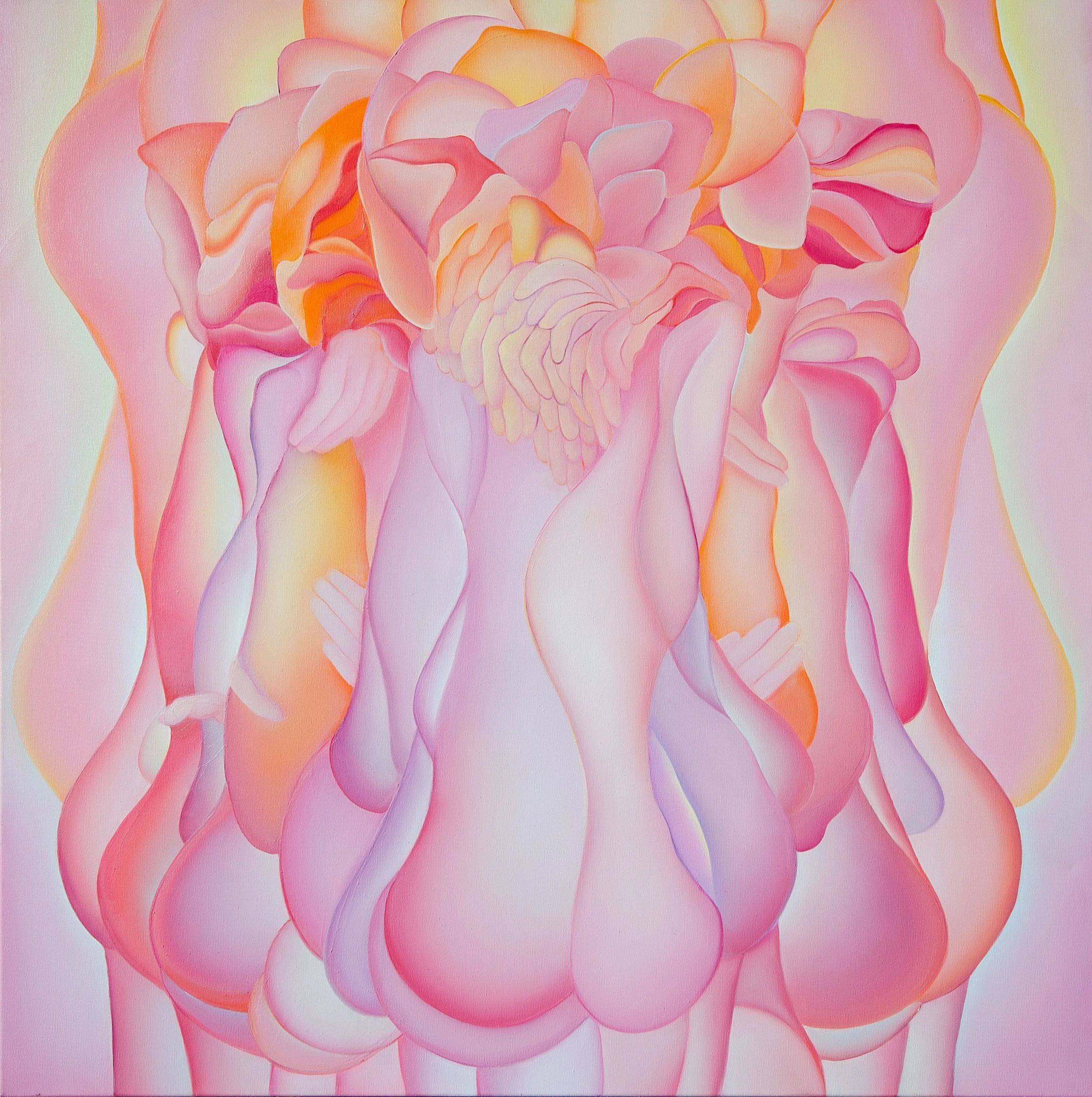
“Femininity is important to me. I consider woman as the source of creation, in a way – the bringer of life.”
Is that same organic feeling something you are seeking to communicate via your own art practice?
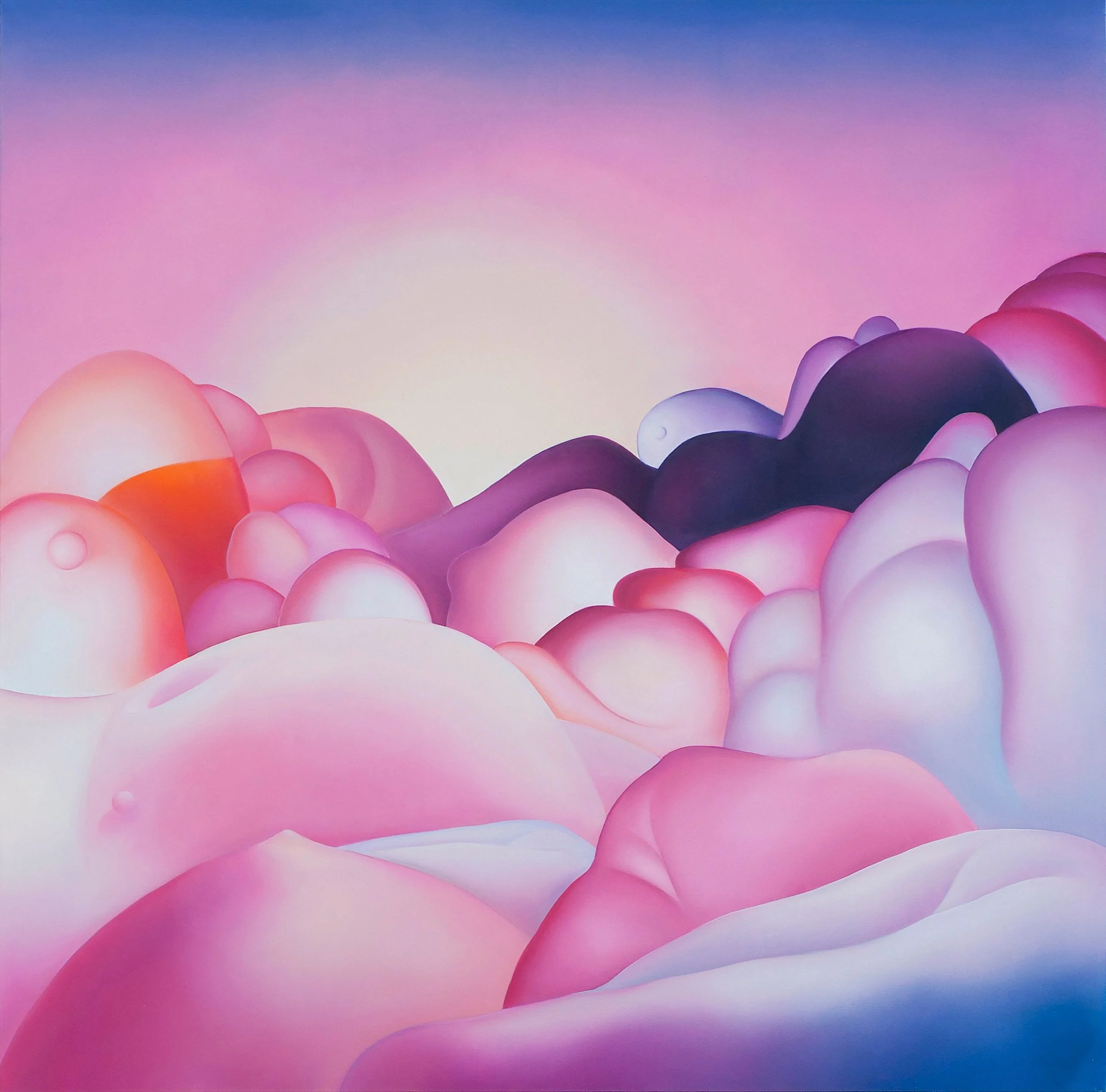
The first thing I wanted to do in my work was to show something that lies behind the everyday, and uncover a kind of erotic intimacy, but, lately, it hasn’t been so important to me. I think I have created my own aesthetic alphabet, and I use the female body as a sign. I do perceive my work as a process to look at nature, language, the body and femininity, and the main topic of my work is to capture the dynamics between those components. Working on a painting is an important and emotional process for me. Before I start, I will usually take a photograph of people I know from close friends and family, to kind of explore that notion of intimacy and the body, and I’m always seeking to go deeper into intimacy by taking the realistic form into abstraction and geometric shapes. I think abstraction has more value for me now than realism, because the viewer can kind of imagine something, without any pressure from me about how the painting should be received, or how they should feel.
How do you feel yourself when you view your work?
I paint a lot and always have a problem working out when to stop painting – it’s a long way for me to go conceptually and I am very much within the process.I actually think that the time I value most is that moment when I actually start the painting, and when I am thinking about it and am not sure what I will do. It’s good for me to have exhibition deadlines because it makes me stop painting when I need to. It also allows me to work on three or four paintings at once. I like doing that because it allows me to create the works as a series that correspond to each other.
Why does it feel so essential to you to approach womanhood and femininity in your art practice?
It’s actually true that I’ve only been painting women’s bodies lately, but in the past I have painted men as well. I’m not sure why I was drawn to focus mainly on women but maybe it’s because the female body is more associated with biology, nature and the sense of a landscape to me. The palette that I use in my painting is generally inspired by the colours of sunsets, or flowers, which I know are pretty common topics. Femininity is just very important to me – I consider woman as the source of creation in a way, the bringer of life. All of my paintings are very close to my heart and play a big emotional part in my everyday life, but, ultimately, I can’t explain why I always come back to the female figure.
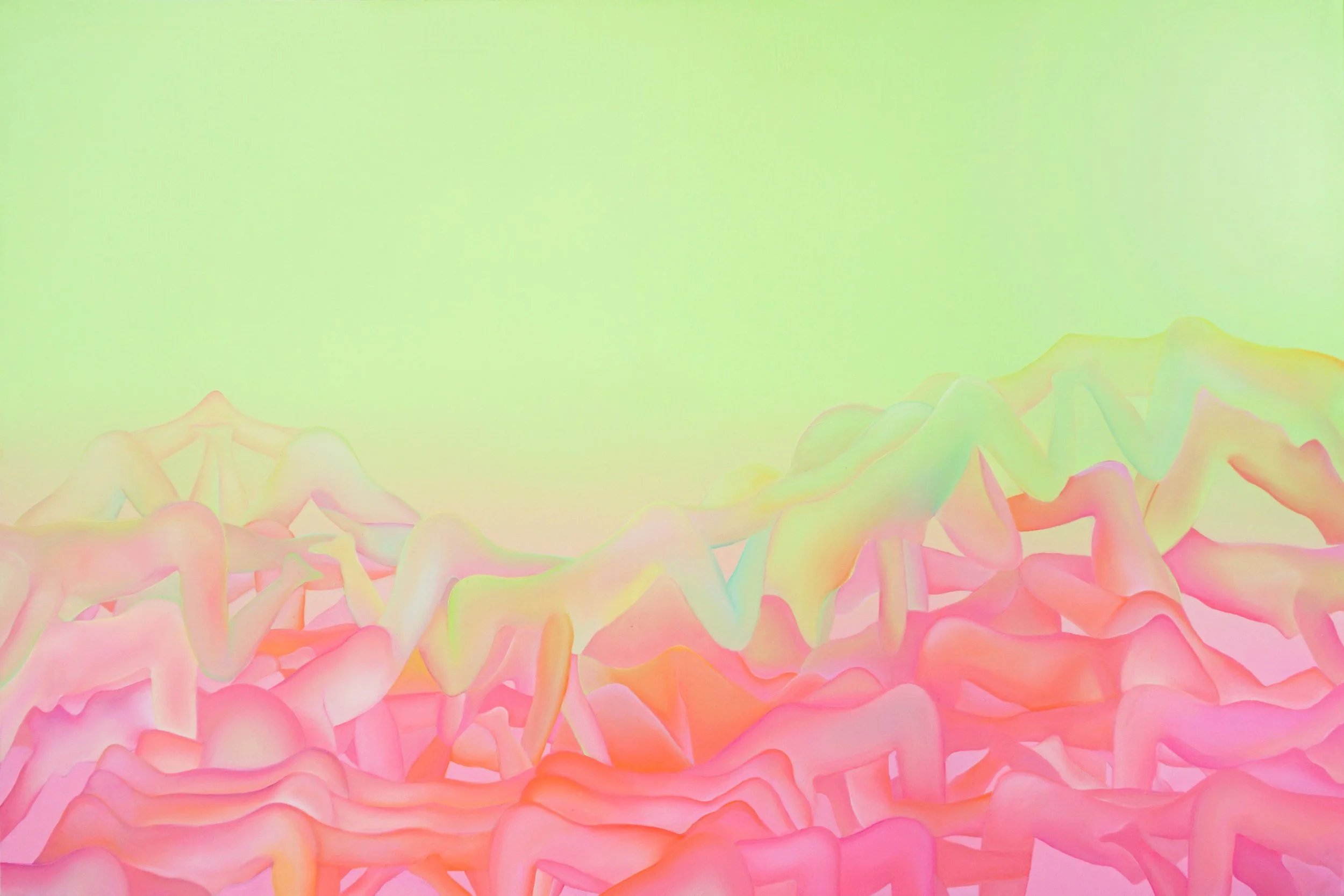
“Beauty is always there, every day in our lives, but we don’t look for it enough”
Does your art act as a kind of therapy for you?
Well, in a way, yoga and painting are very similar practices for me, and art has always been very important therapeutically for me. I can’t ever imagine stopping painting. I can find it difficult to go to work in the day-to-today, and I spend all of my free-time painting because it makes me feel better. I had therapy when I was younger, but my daily routine of painting is really the thing that makes me feel okay and calm, and makes me feel free. I don’t feel anxious or nervous when I paint; I feel that I can become anything on the canvas. I can’t really express why beauty is really so important for me, but I have always really been drawn to beauty, and I look for it every day in nature. Beauty is always there, every day in our lives, but we don’t look for it enough. I need that contact with nature, and my art is my connection to it. I like to spend time with other people, but I can’t ever predict what that will be like, but when I am alone, I am comfortable and I know that I can express myself freely.
Introduction & Interview by John-Paul Pryor
You can find out more about Agata Przyżycka here
Images (top to bottom): portrait of the artist at Kravitz Contemporary by Grzegorz Podsiadlik; Untitled, oil on canvas, 2021, Agata Przyżycka, courtesy of the artist; Trzymam świat Niepojęty, oil on canvas, 2021, Agata Przyżycka, courtesy of the artist; Untitled, oil on canvas, 2021, Agata Przyżycka, courtesy of the artist.
TED PIM ON THE ART OF REFLECTION AND CREATING HIS OWN REALITY
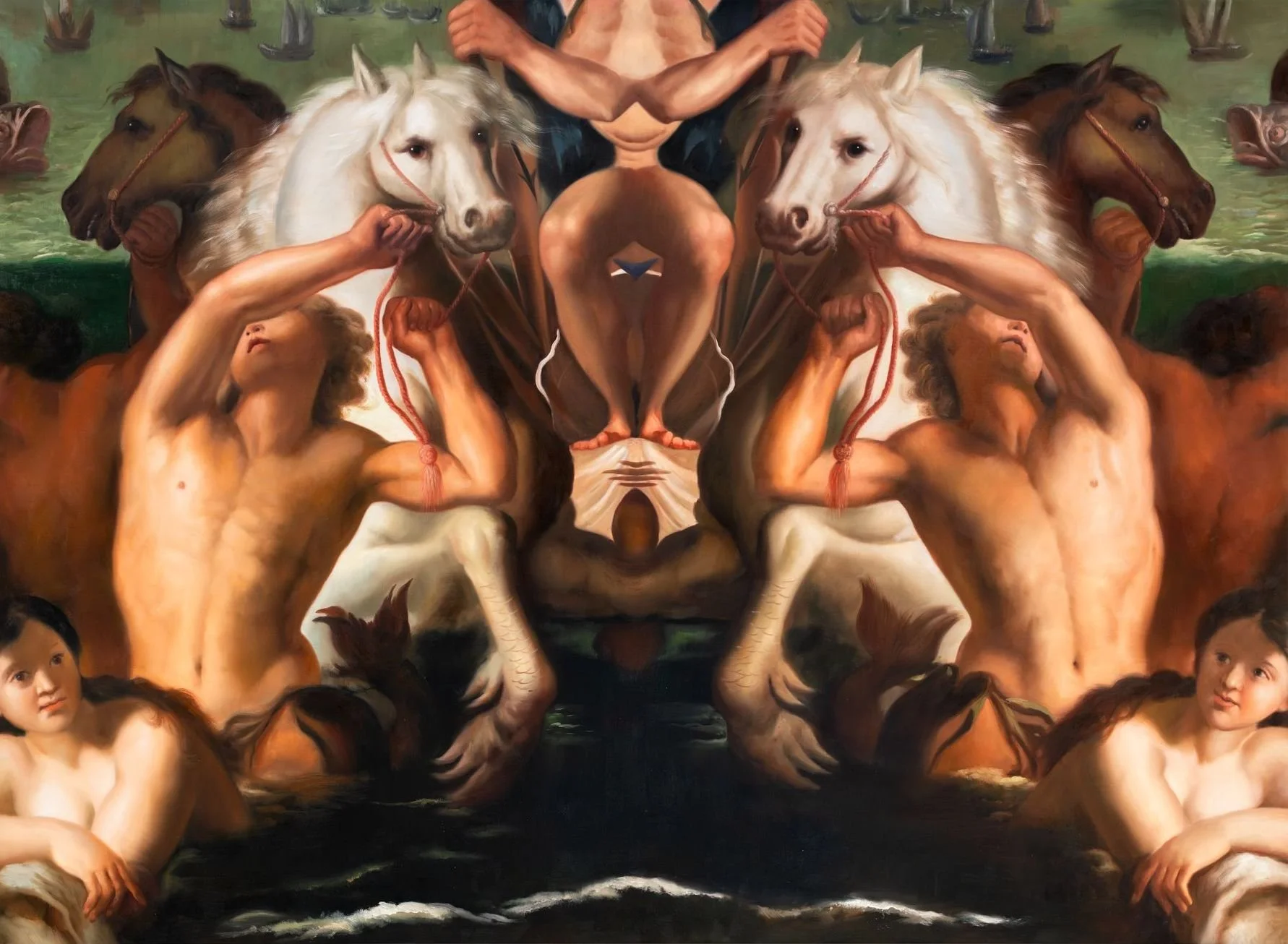
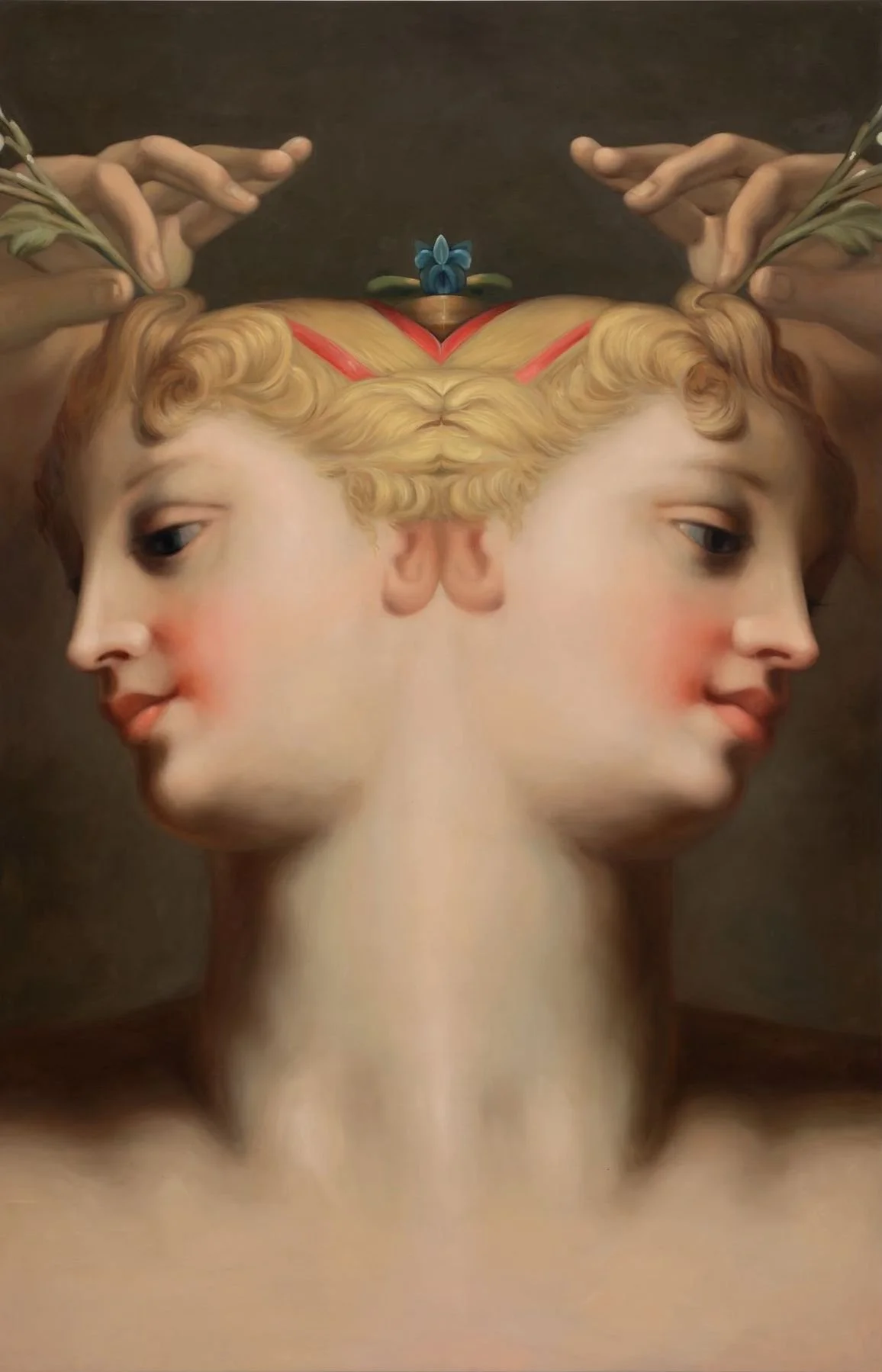
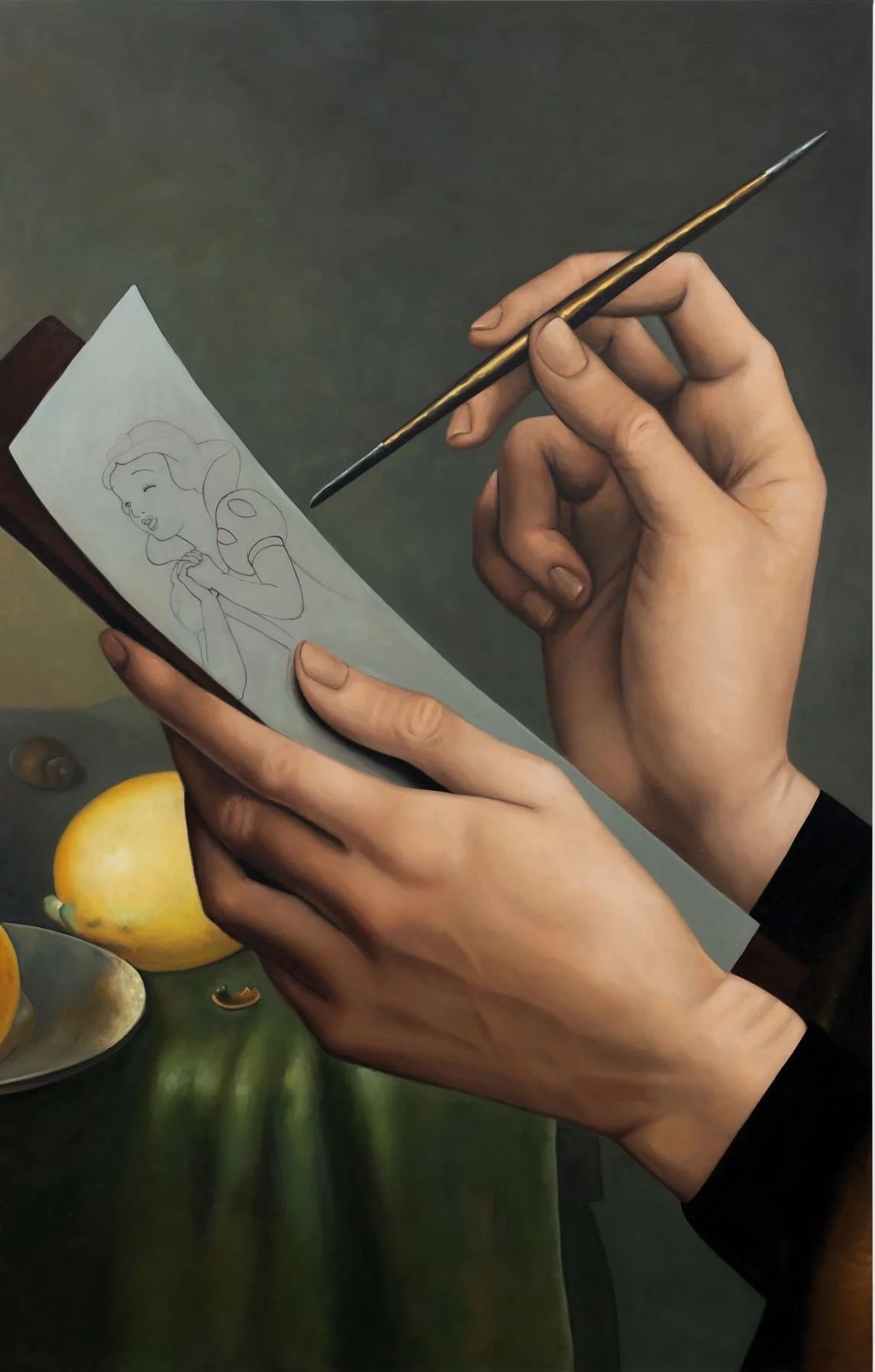
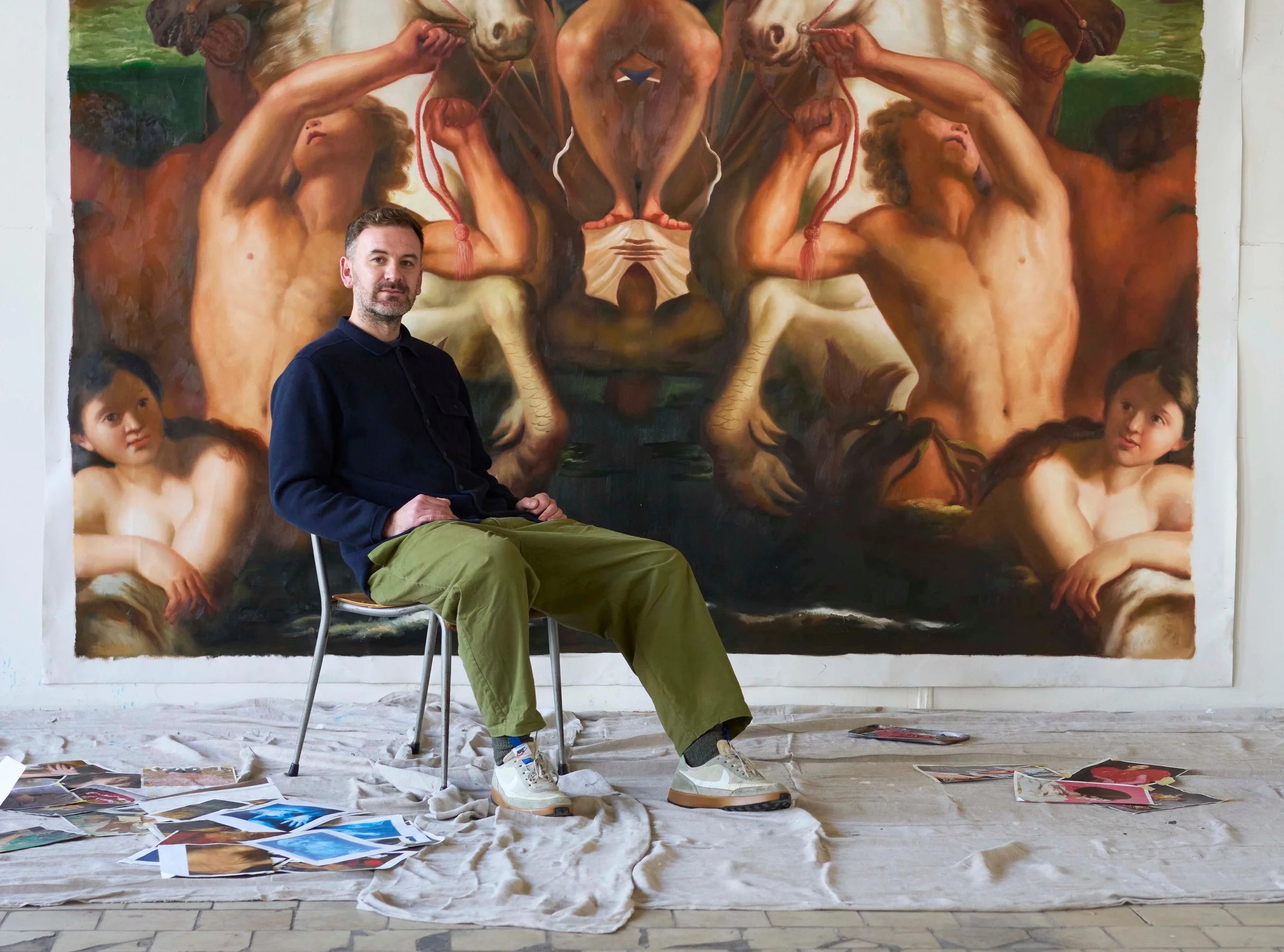
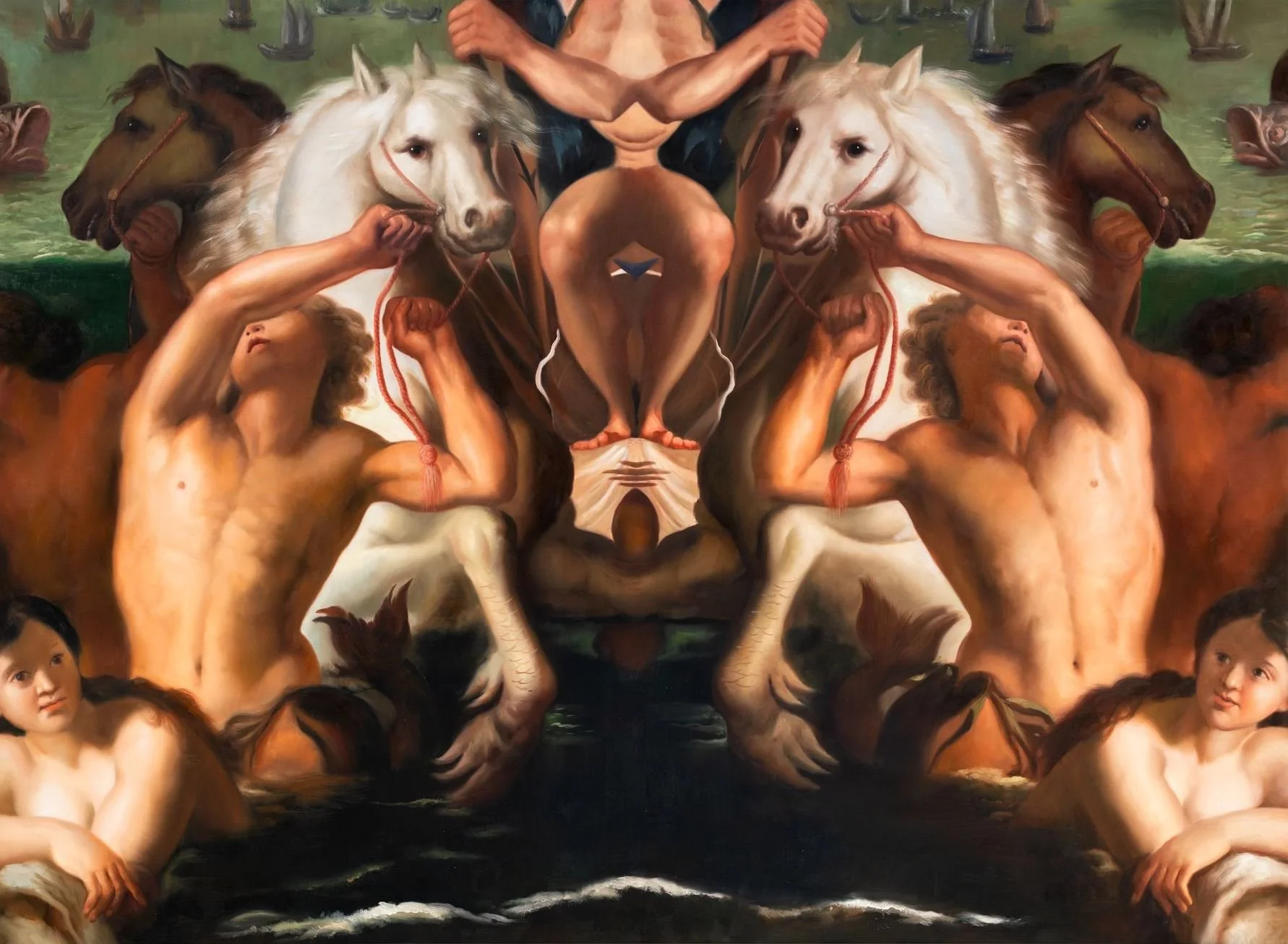
There is an obsessive quality to the work of Belfast-born painter Ted Pim, whose unquestionable craftsmanship is matched only by his unique imagination and passion for blending the aesthetics of the Italian Renaissance and Dutch Old Masters with motifs from Irish folklore and pop-infused ephemera of the the modern age. In finely executed brushstrokes Pim marries high art and the ultra contemporary, creating uncanny works of unsettling beauty that feel at once both reassuringly familiar and enticingly alien. In his latest series of paintings, currently showing at Almine Rech, Pim explores the act of mirroring, playing on the notion of the doppelgänger which has a particular resonance in Irish mythology – intricately reproducing the image created on one side as if the canvas itself were being split at a right angle by a standing mirror. In this interview for House Collective Journal, the painter reflects on his own childhood in Belfast, the enduring influence of religious iconography, and the projections we all now create via the magic mirror of the smartphone.
What was your first real exposure to painting?
I grew up in Belfast in the nineties, and it wasn’t exactly a cultural hub at that time. But my grandad used to take me to the Ulster Museum and it has a Francis Bacon in the collection called Head II. I remember being completely horrified by it, and, you know, it's the most ugly, grotesque, disgusting painting I've ever seen – even now when I look at it, it turns my stomach. It's horrific, I remember ust feeling something when I saw it as a boy, and it’s a feeling that is hard to describe, but I always feel that good art creates that feeling The other one really hit me young was Damien Hirst's A thousand Years – it's the flies and the cow's head in the container, where maggots are forming and turning into flies, and then being zapped by a fly zapper. That also created that same feeling. but when I was a kid, it was all about that Francis Bacon painting for me. As a painter, I've always tried to communicate that feeling, and if I can get even one percent of that feeling that I got from that painting over to the viewer, I'd be quite happy.
Would you say you were drawn to darkness? Were you fascinated by the grotesque?
I don’t know if I was drawn to darkness. It was just about chasing that feeling. I can’t even say that it was an enjoyable feeling, but for painting to do that to someone is pretty remarkable, and it's something I always think about. I've never really thought about why exactly I've been drawn to painting and the old masters in particular. I grew up in a working class catholic background and in my area, everyone had reproductions of Jesus painted in old master style in their houses. It was as if every wall I saw had something to do with religion, so my childhood was sort of saturated by the iconography, and there was always a sense of life and death in the art . It was very segregated, and the community was so controlled by the church, and the sense of importance tied to identifying as an Irish Catholic. I'm not religious, but the Catholic church did do a lot for art in general, you know? They commissioned so many great paintings and great artists. The iconography of the church was so interesting to me, especially with the juxtaposition of living in West Belfast. It's such a polar opposite.
Do you feel your identity is something that is like a stake in the ground that one create, or do you feel like one's identity itself is always in flux and juxtaposition? Does your painting reflect that?
I think it's probably always a state of flux. But especially where I come from, identity is such a big thing – people die over identity, and there are a lot of people who have placed a stake in the ground. I'm not sure how healthy that is, but a lot of people feel it's very important. I think a lot of people just feel like they need a sense of belonging, you know – even if you look at football as a marker of identity, and as your there is the sense of this is who I am and I die for this club. It’s not for meIn terms of painting, ultimately, I'm painting for nobody else apart from myself, and it is a form of escapism into sort of creating my own world. I've joked in the past that my paintings are sort of like what might happen if there was a library and there was an old masters section, an Irish folk section, and a Disney section, and it was blown up. I would be the guy that would go in afterwards and start to piece everything together to create a sort of future reality.
What drew you to the mirroring in your latest series, and what have you learned from the process?
Well, I learned that it’s really difficult to create a mirror image (laughs). With all of my work I tend to go down a rabbit hole of the idea of history repeating itself and transforming. In terms of the mirroring series, I feel like the world in general at the minute is in a state of change in terms of empires falling. I don't know if that's just from the media that sort of creates a feeling of uneasiness, but I feel like we're in a state of transformation. There is a kind of uneasiness in mirroring, and a sense of unfamiliarity and I started to think about the idea of repeating imagery – creating a world that's not fully crystallized to sort of hold up a mirror to society of what's actually going on.
Do you have a definition of beauty, especially as such a fan of the Old Masters?
I don't have a definition of beauty. It's feeling based, for me. I certainly can find beauty in a lot of different things, and I'm drawn to certain images, but I don't think about why very often. I will rip out a lot of pages from books without considering what the context is or what the meaning behind the images is. I just look visually and if I'm drawn to something, I'll then use it in my painting. I suppose beauty is always transforming –currently we’re being told what beauty is by the media, a kind of beauty as it is perceived in fashion or glamour, but if you look at the Old Masters then it’s clear that what they perceived as beauty is totally different in outlook. It’s a strange world we live in now, and social media is even changing what we think of as beauty – in the past five years, you can see how people are starting to look like an Instagram filter in real life, and that in itself is quite a frightening kind of mirroring, because it plays into people's own insecurities.
How do you feel about the rise of generative art and AI?
When it first came out, I probably felt a bit threatened, but I have been speaking to artists who have now embraced it, and one particular director who has started to use it to create storyboards. I can see how people are using it to sort of help the process. I feel like real art is all about expression, feelings and ideas, though, and AI does not have that, so the more I think of it, I'm not threatened at all. I can certainly see why certain industries should be afraid, but I'll still paint no matter what, you know? Even if AI art does exist and people are respecting that as an art form, I don't really care because I'll still be going to the studio and painting – I go into the studio everyday and paint nine to five and nothing will change that.
Never Odd or Even exhibits at Almine Rech, London, until May 18.
Interview by John-Paul Pryor