Sublime Intimacy: Agata Przyżycka
Mental Health, Eroticism And The Eternal Quest For Beauty
ART: INTERVIEW
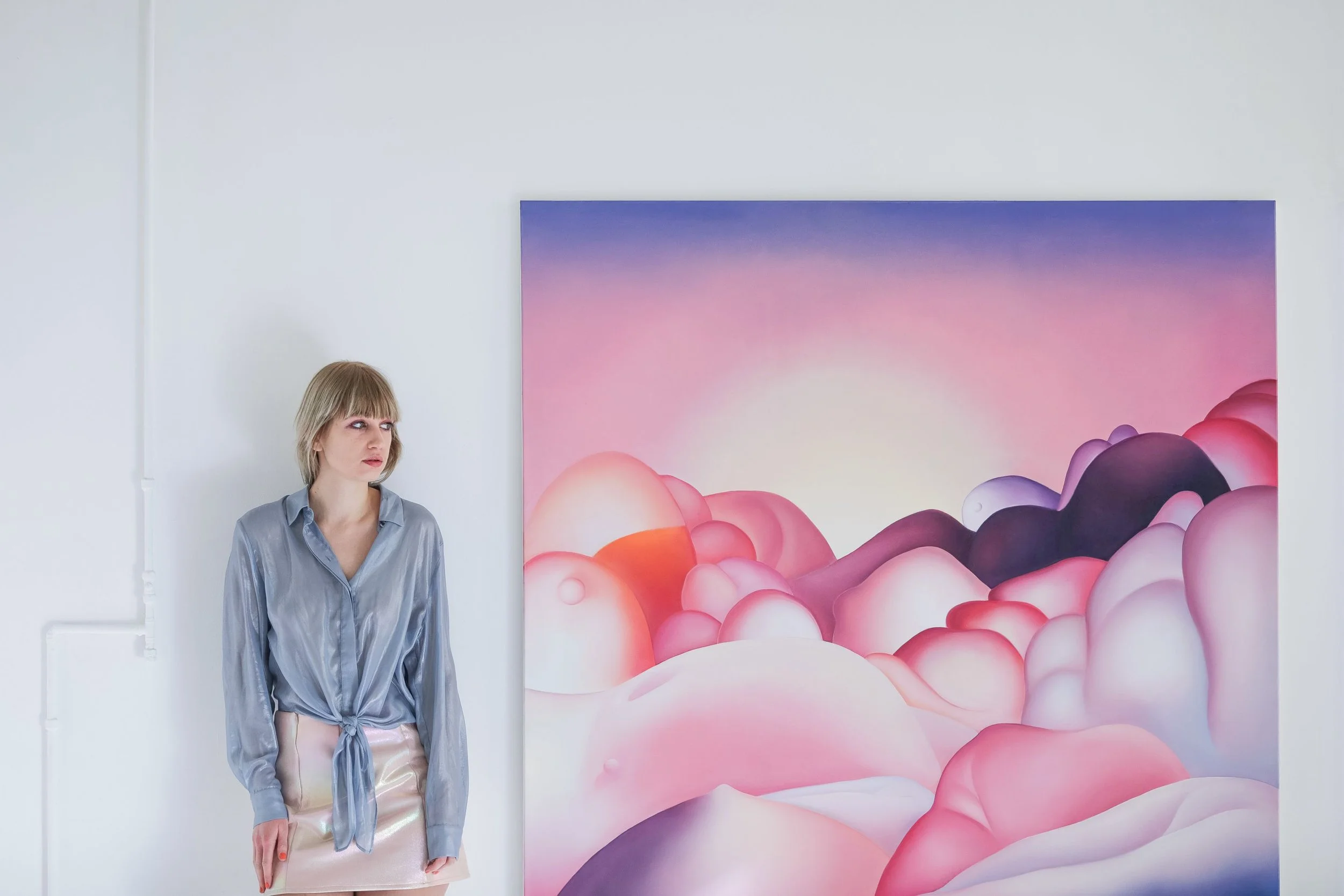
Agata Przyżycka is a young Polish painter whose work moves like a thought that has just become flesh. Her insistently sensual canvases treat the female body not as an object of display but as a field for experiments in perception, in which limbs and curves become topography – the body at once both organism and language, speaking to the viewer in gestures borrowed from landscape.
There are obvious parallels to Georgia O’Keefe in her work, and she describes her practice as a process that seeks to uncover sublime intimacy, with the starting point of each painting often being a photographic session with close friends or family members. These sessions provide an emotional jump-off point for the artist, who then radically alters the forms caught in the eye of her lens into sumptuous abstractions that are both dreamlike and imbued with subtle eroticism – inviting you to deep dive into unfettered reverie.
As such, her practice refuses simple allegory, preferring instead a poetics of relation — between what the eye recognises and what the eye must learn to read. In this interview with FUTURISTIC DRAGON, the artist—whose reputation grows quietly, like light through a shutter—speaks of art not as spectacle but as a means of attention and therapy, loosening the tightness of anxiety and opening a small room in which it becomes possible to breathe..
Talk to me about your childhood. Where does your interest in painting originally stem from?
I took painting classes from early childhood, and it has been very important for me my whole life. It was immediately a form of expression that I liked and understood. I remember that the first exhibition we had from our painting lesson made me really nervous, though, and I still get nervous showing other people my work. I also find it quite difficult to talk about my work. I think I am quite a reclusive person, really – I don’t like to talk with other people so much, and I love the solitude of painting. It’s almost a form of meditation for me, and I can happily spend a lot of time in my workshop alone. I think the first thing that really drew me to art was probably album artwork, because my parents absolutely loved music. I can also remember my parents taking me to Barcelona very young, and the Gaudi Park was just amazing to me – there was this very organic feeling I got from the sculptures. I suppose, even from a very young age, I knew that I wanted to go the academy of fine art, and the first really important thing I became interested in when studying was realist paintings and realist art.
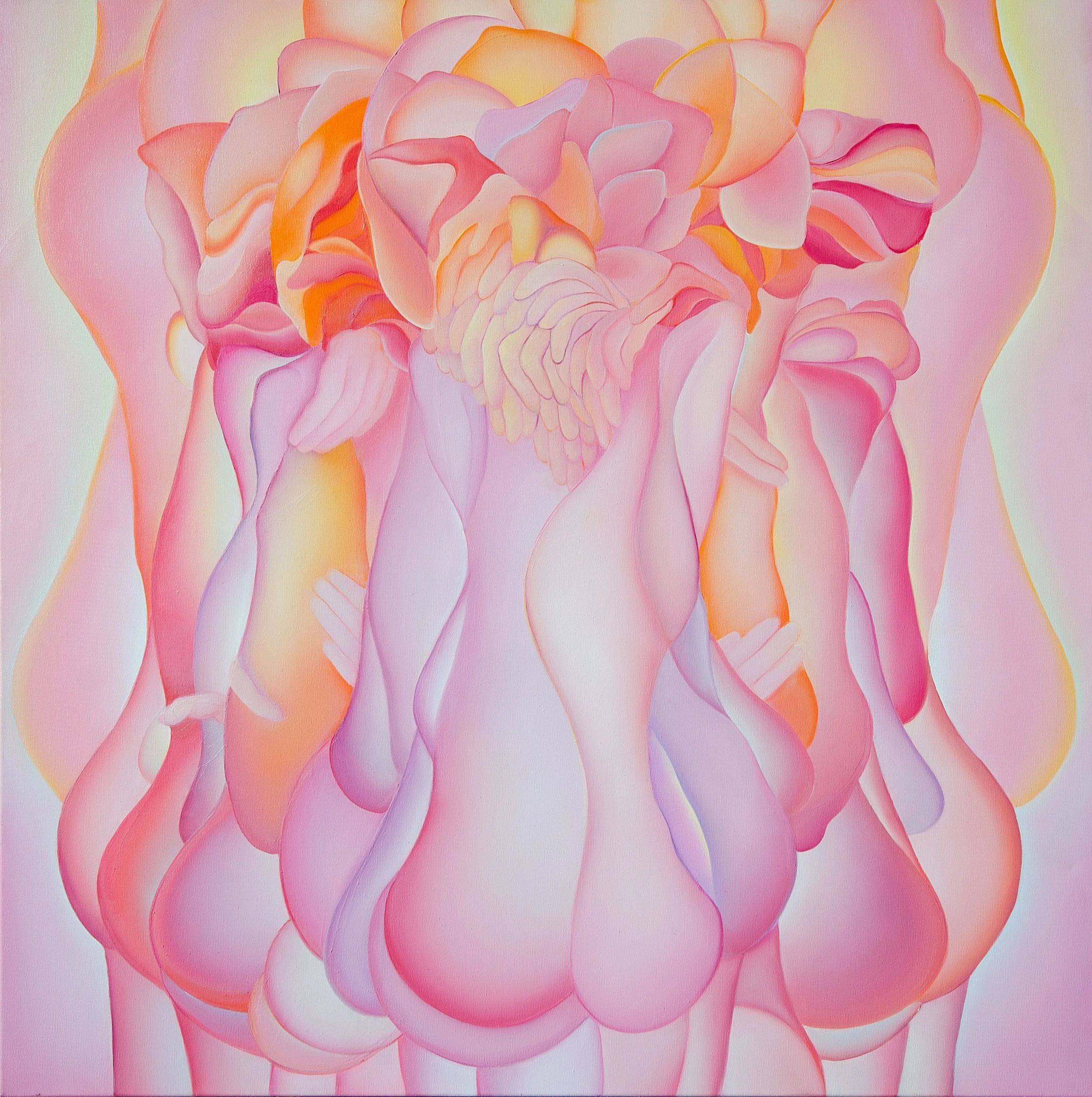
“Femininity is important to me. I consider woman as the source of creation, in a way – the bringer of life.”
Is that same organic feeling something you are seeking to communicate via your own art practice?
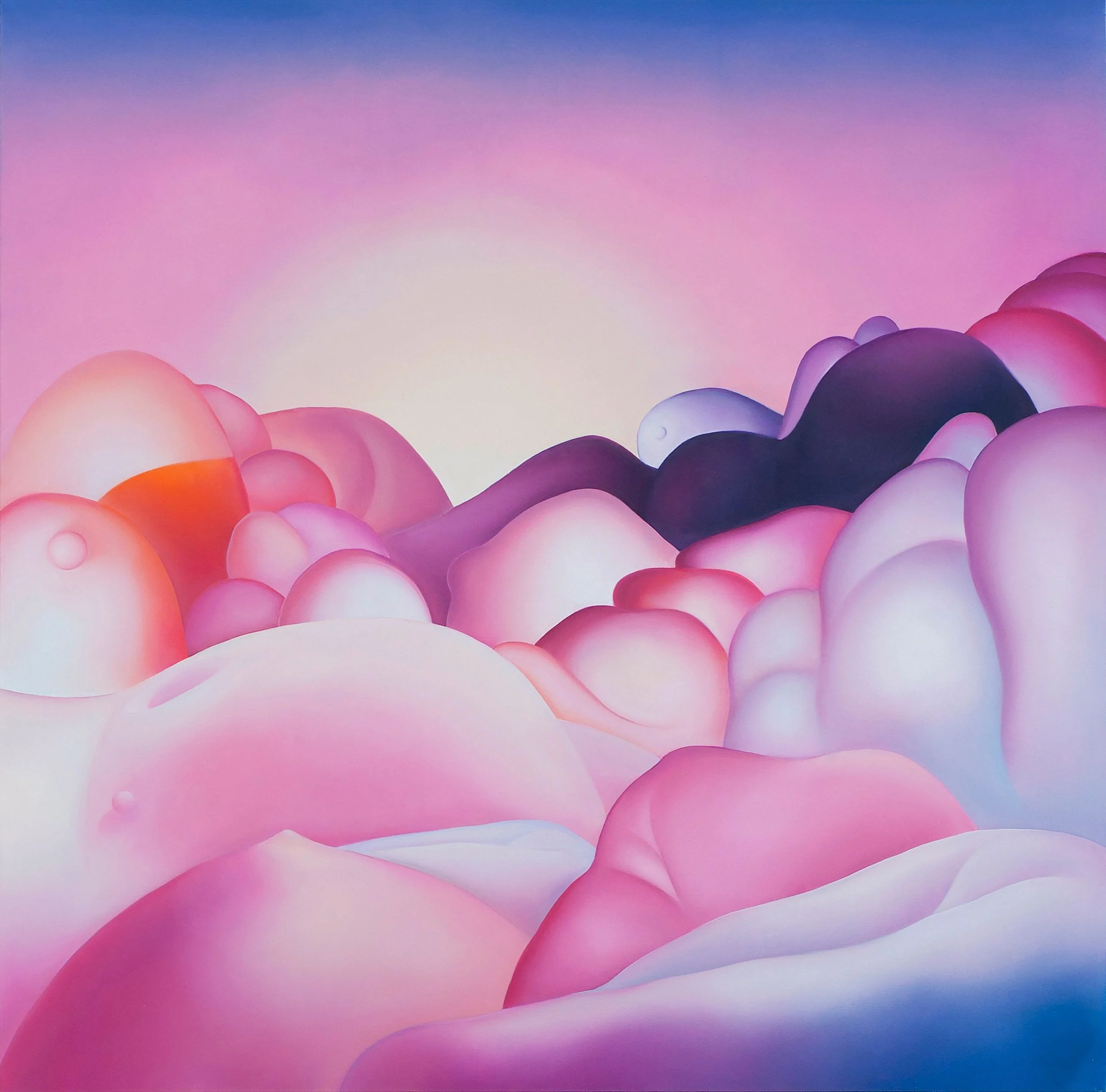
The first thing I wanted to do in my work was to show something that lies behind the everyday, and uncover a kind of erotic intimacy, but, lately, it hasn’t been so important to me. I think I have created my own aesthetic alphabet, and I use the female body as a sign. I do perceive my work as a process to look at nature, language, the body and femininity, and the main topic of my work is to capture the dynamics between those components. Working on a painting is an important and emotional process for me. Before I start, I will usually take a photograph of people I know from close friends and family, to kind of explore that notion of intimacy and the body, and I’m always seeking to go deeper into intimacy by taking the realistic form into abstraction and geometric shapes. I think abstraction has more value for me now than realism, because the viewer can kind of imagine something, without any pressure from me about how the painting should be received, or how they should feel.
How do you feel yourself when you view your work?
I paint a lot and always have a problem working out when to stop painting – it’s a long way for me to go conceptually and I am very much within the process.I actually think that the time I value most is that moment when I actually start the painting, and when I am thinking about it and am not sure what I will do. It’s good for me to have exhibition deadlines because it makes me stop painting when I need to. It also allows me to work on three or four paintings at once. I like doing that because it allows me to create the works as a series that correspond to each other.
Why does it feel so essential to you to approach womanhood and femininity in your art practice?
It’s actually true that I’ve only been painting women’s bodies lately, but in the past I have painted men as well. I’m not sure why I was drawn to focus mainly on women but maybe it’s because the female body is more associated with biology, nature and the sense of a landscape to me. The palette that I use in my painting is generally inspired by the colours of sunsets, or flowers, which I know are pretty common topics. Femininity is just very important to me – I consider woman as the source of creation in a way, the bringer of life. All of my paintings are very close to my heart and play a big emotional part in my everyday life, but, ultimately, I can’t explain why I always come back to the female figure.
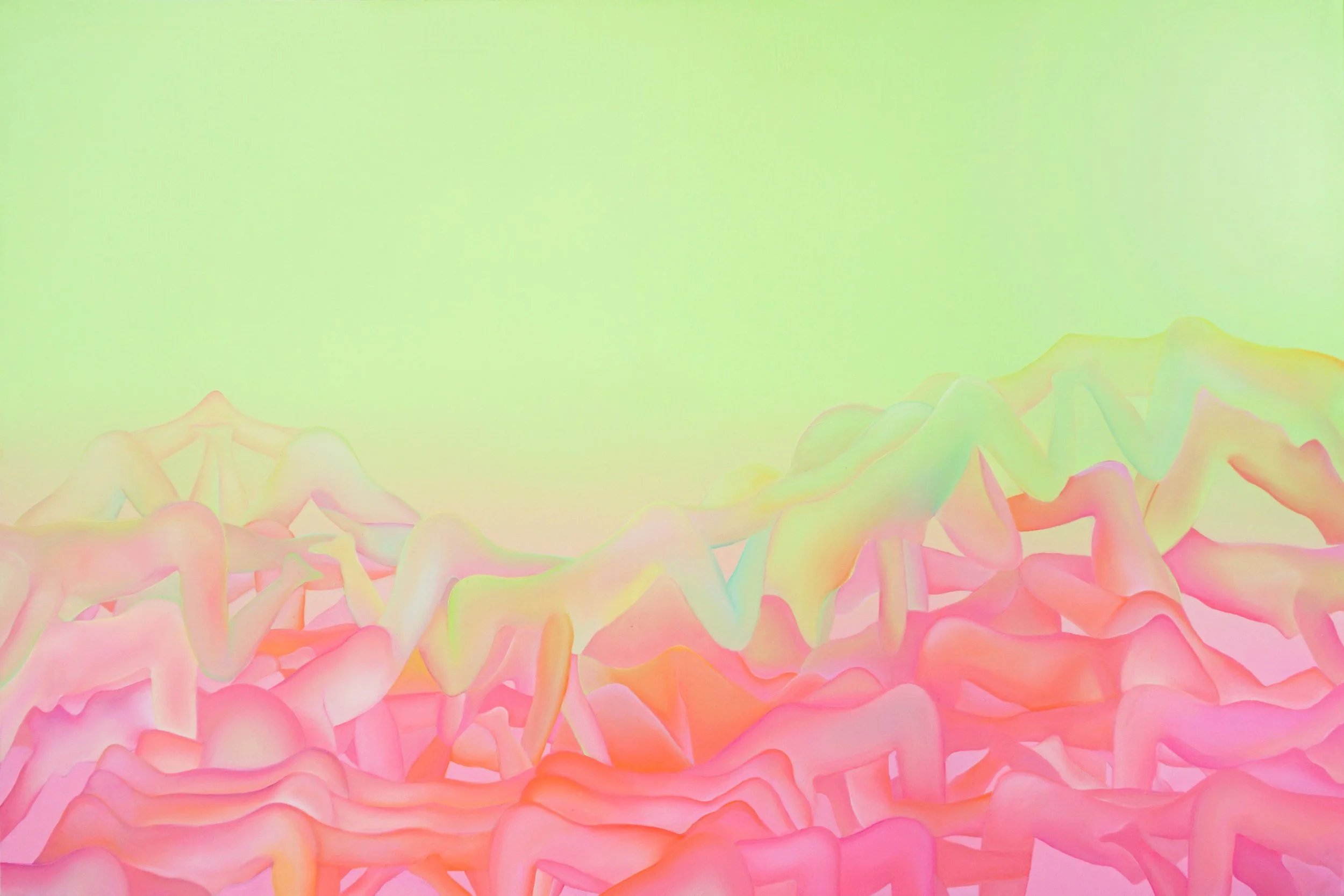
“Beauty is always there, every day in our lives, but we don’t look for it enough”
Does your art act as a kind of therapy for you?
Well, in a way, yoga and painting are very similar practices for me, and art has always been very important therapeutically for me. I can’t ever imagine stopping painting. I can find it difficult to go to work in the day-to-today, and I spend all of my free-time painting because it makes me feel better. I had therapy when I was younger, but my daily routine of painting is really the thing that makes me feel okay and calm, and makes me feel free. I don’t feel anxious or nervous when I paint; I feel that I can become anything on the canvas. I can’t really express why beauty is really so important for me, but I have always really been drawn to beauty, and I look for it every day in nature. Beauty is always there, every day in our lives, but we don’t look for it enough. I need that contact with nature, and my art is my connection to it. I like to spend time with other people, but I can’t ever predict what that will be like, but when I am alone, I am comfortable and I know that I can express myself freely.
Introduction & Interview by John-Paul Pryor
You can find out more about Agata Przyżycka here
Images (top to bottom): portrait of the artist at Kravitz Contemporary by Grzegorz Podsiadlik; Untitled, oil on canvas, 2021, Agata Przyżycka, courtesy of the artist; Trzymam świat Niepojęty, oil on canvas, 2021, Agata Przyżycka, courtesy of the artist; Untitled, oil on canvas, 2021, Agata Przyżycka, courtesy of the artist.
THOMAS RUFF ON GALACTIC DAYDREAMING AND BEAUTIFUL PORNOGRAPHY
The German artist Thomas Ruff has been challenging ways of seeing for 30 years, questioning the pre-supposed validity of the photographic image and engaging us in a game of smoke and mirrors where our fantasies and projections complete what we believe we perceive. His latest double-whammy at The Gagosian, London, focuses on his huge, sometime three-dimensional, colour-saturated close-ups of the surface of Mars and his celebrated series of images from porn sites, which take some of the most graphic, voyeuristic sexual excesses and lend them an ethereal, almost classical aspect. These two main strains are complemented by works from his "jpegs" series – which blow up and reveal the glitch-heavy grid-like DNA of the digital image – and "subtrats", his gloriously psychedelic abstractions of Manga cartoons. While together the shows provide a cohesive overview of his artistic concerns for those uninitiated with his work, AnOther chose to talk to him chiefly about his most recent series ma.r.s – reworked satellite images of such imposing size that it feels almost as if one could walk into their heavily cratered, lonely landscapes. Here, the artworld legend discusses his early memories, the potential manipulation of human history via Photoshop and why every image is a mirror of its beholder.
Can you remember the very first images that fired your imagination?
That’s a hard question. I have to confess I have no idea. I guess I had my first telescope just before puberty. I tried to look at the sky but that was very disappointing with the small telescope, so I was looking at astronomy magazines, and there I saw the really interesting images – these things you cannot see with a telescope; that you need rockets and satellites to see.
Where did that fascination stem from and why has it endured?
Maybe it’s just a fascination with cosmology – the fact the evolution of the stars and planets started with a big bang. I was born in 1958 and the 60s were very optimistic in terms of technology. I read magazines about how by the year 2000 we would be flying around in cars that were no longer on the street. There was this kind of technological fascination and strange optimism – everybody thought in 20 years we would have solved all the problems of people on earth and have machines that could make planetary voyages.
What is the significance in going so close-in on the surface of Mars, and what are your key concerns in this work?
The photographs are fictional. I change the perspective from a satellite view to an airoplane view, so this is a vision that astronauts in probably 20 or 40 years will have. So, it’s a fiction and, at the same time, it’s realistic… We have the technology to look at things much more precisely now, and it is fun going very close on a small print trying to find the smallest details of the landscape – then looking at the impact of size, creating a kind of different physical presence. I think the big question of photography right now is who’s taking the photograph – is it the photographer or is it a machine; a satellite or the high-rise cameras that are all over the cities? It’s the question of authorship. The next question is the question of altering such images now that we live in the time of the digital photograph – can we believe the image; can we trust the image?
Do you see our relationship with the image getting to the point where we might have digitally-enhanced vision? Who then would be the author, and indeed, the viewer?
I think I cannot comment on that, because technology just goes on and on and you cannot stop it – you cannot step back from it. People think of new technology and say it will make life easier, but I think a lot of people will be lost in this new world and will not… okay, they will survive but they will be completely confused.
Why do you reveal the DNA of the digital image in your blown-up series of JPEGS?
I just want to make it obvious. For fourteen years we have had the digital image, and it has such a different structure to analogue film. The structure is the pixel, and now you don’t only have the pixel but you also have the compression to make them smaller – to send them via the web and make the distribution higher. People are looking at these images and thinking they are true, but they don’t think about what the image consists of, they take the photograph as transparent and they mix it with reality – our brain is very brilliant at interpreting even the lowest resolution, it creates images. So, these questions of mine are very much about the structure of photography but there’s also other factors – even the compression gives a structure to the image, and then you have the distribution. In that instance, it’s not a machine that produces the image but it’s software, and it doesn’t matter whether it’s software or a machine – it’s not handmade, it has been done for us and we cannot control it.
What’s your reasoning in saying to us: "Look, it’s not real. Don’t accept it as reality." What’s the purpose?
I want to tell people to be careful if you look at photographs – don’t believe everything that you’re looking at because it’s either a pre-arranged reality or it’s reality, yes, but then afterwards the image is altered. I don’t know who said it, but someone said that in the future the illiterate is someone who cannot read photographs, because he can be manipulated in any way.
If history is made up of digitally manipulated images it will be rewritten, and it will be impossible to ever find the original; the truth…
Yes, it’s like 1984.
Do you believe you are completely alone when you experience an artwork, or do you think there’s a point where one can have a communal perceptive experience?
I think maybe there can be a kind of common sense, but I don’t think there can be an identical view on one image. We are all individuals and we all have our own experiences, and we have developed our consciousness and dealt with our lives in different ways. They are small graduations but, yes, everybody’s unique and everybody’s unique belief or thought comes into play – the images are all mirrors, we all see what we want to see.
Thomas Ruff: ma.r.s runs until April 14 at Gagosian Gallery Britannia Street, London, and Thomas Ruff: nudes runs until April 21 at Gagosian Gallery Davies Street, London.