Sublime Intimacy: Agata Przyżycka
Mental Health, Eroticism And The Eternal Quest For Beauty
ART: INTERVIEW
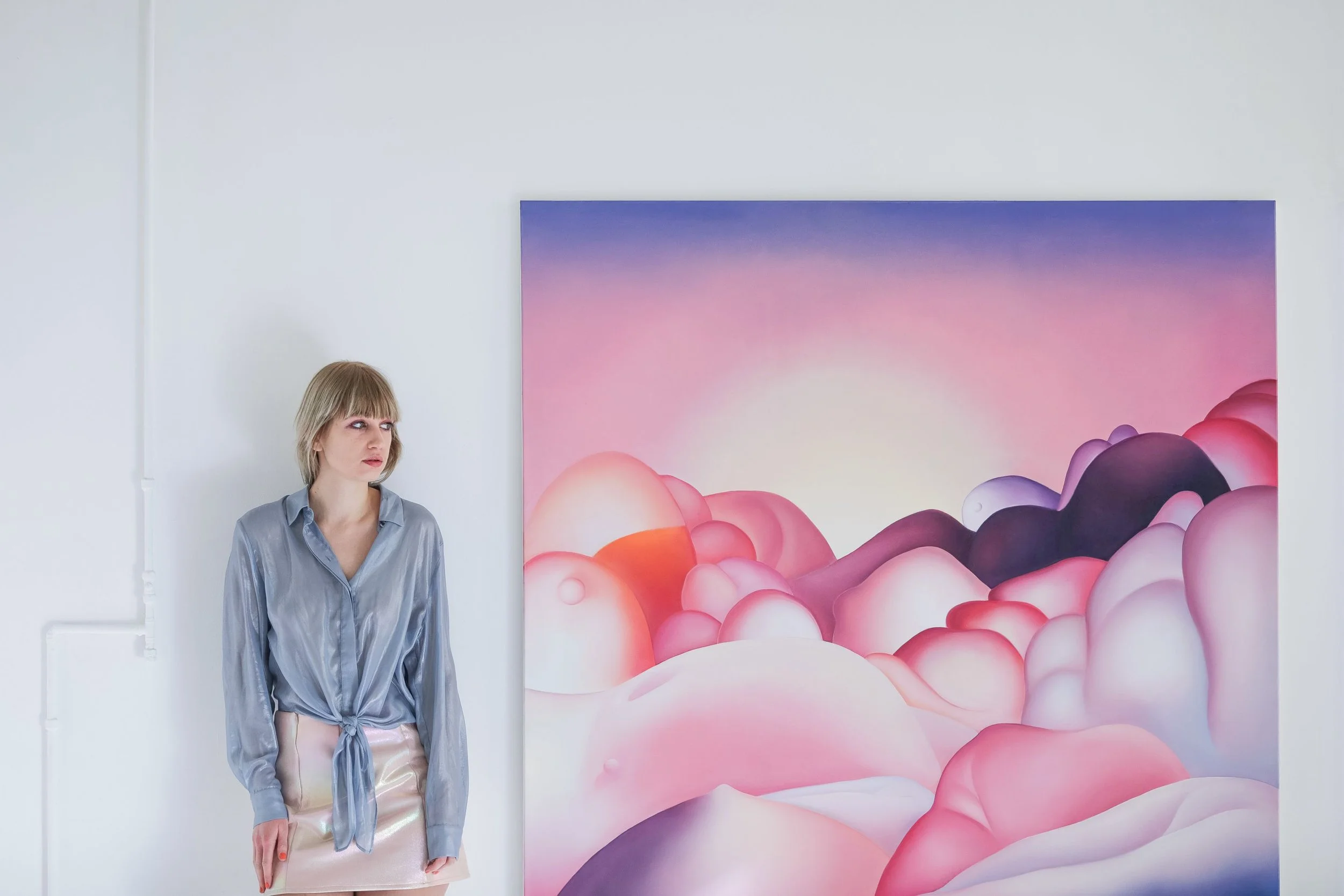
Agata Przyżycka is a young Polish painter whose work moves like a thought that has just become flesh. Her insistently sensual canvases treat the female body not as an object of display but as a field for experiments in perception, in which limbs and curves become topography – the body at once both organism and language, speaking to the viewer in gestures borrowed from landscape.
There are obvious parallels to Georgia O’Keefe in her work, and she describes her practice as a process that seeks to uncover sublime intimacy, with the starting point of each painting often being a photographic session with close friends or family members. These sessions provide an emotional jump-off point for the artist, who then radically alters the forms caught in the eye of her lens into sumptuous abstractions that are both dreamlike and imbued with subtle eroticism – inviting you to deep dive into unfettered reverie.
As such, her practice refuses simple allegory, preferring instead a poetics of relation — between what the eye recognises and what the eye must learn to read. In this interview with FUTURISTIC DRAGON, the artist—whose reputation grows quietly, like light through a shutter—speaks of art not as spectacle but as a means of attention and therapy, loosening the tightness of anxiety and opening a small room in which it becomes possible to breathe..
Talk to me about your childhood. Where does your interest in painting originally stem from?
I took painting classes from early childhood, and it has been very important for me my whole life. It was immediately a form of expression that I liked and understood. I remember that the first exhibition we had from our painting lesson made me really nervous, though, and I still get nervous showing other people my work. I also find it quite difficult to talk about my work. I think I am quite a reclusive person, really – I don’t like to talk with other people so much, and I love the solitude of painting. It’s almost a form of meditation for me, and I can happily spend a lot of time in my workshop alone. I think the first thing that really drew me to art was probably album artwork, because my parents absolutely loved music. I can also remember my parents taking me to Barcelona very young, and the Gaudi Park was just amazing to me – there was this very organic feeling I got from the sculptures. I suppose, even from a very young age, I knew that I wanted to go the academy of fine art, and the first really important thing I became interested in when studying was realist paintings and realist art.
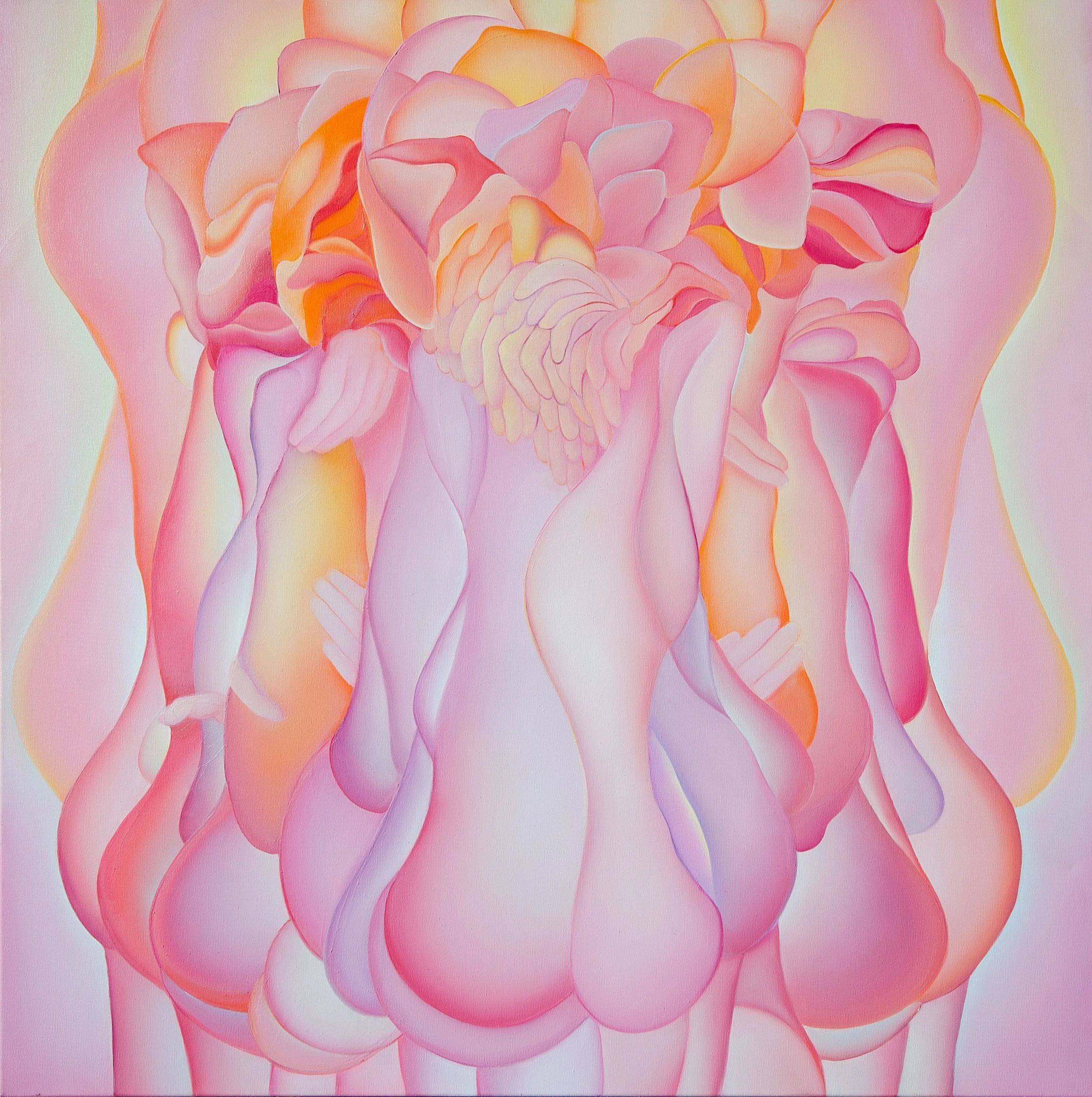
“Femininity is important to me. I consider woman as the source of creation, in a way – the bringer of life.”
Is that same organic feeling something you are seeking to communicate via your own art practice?
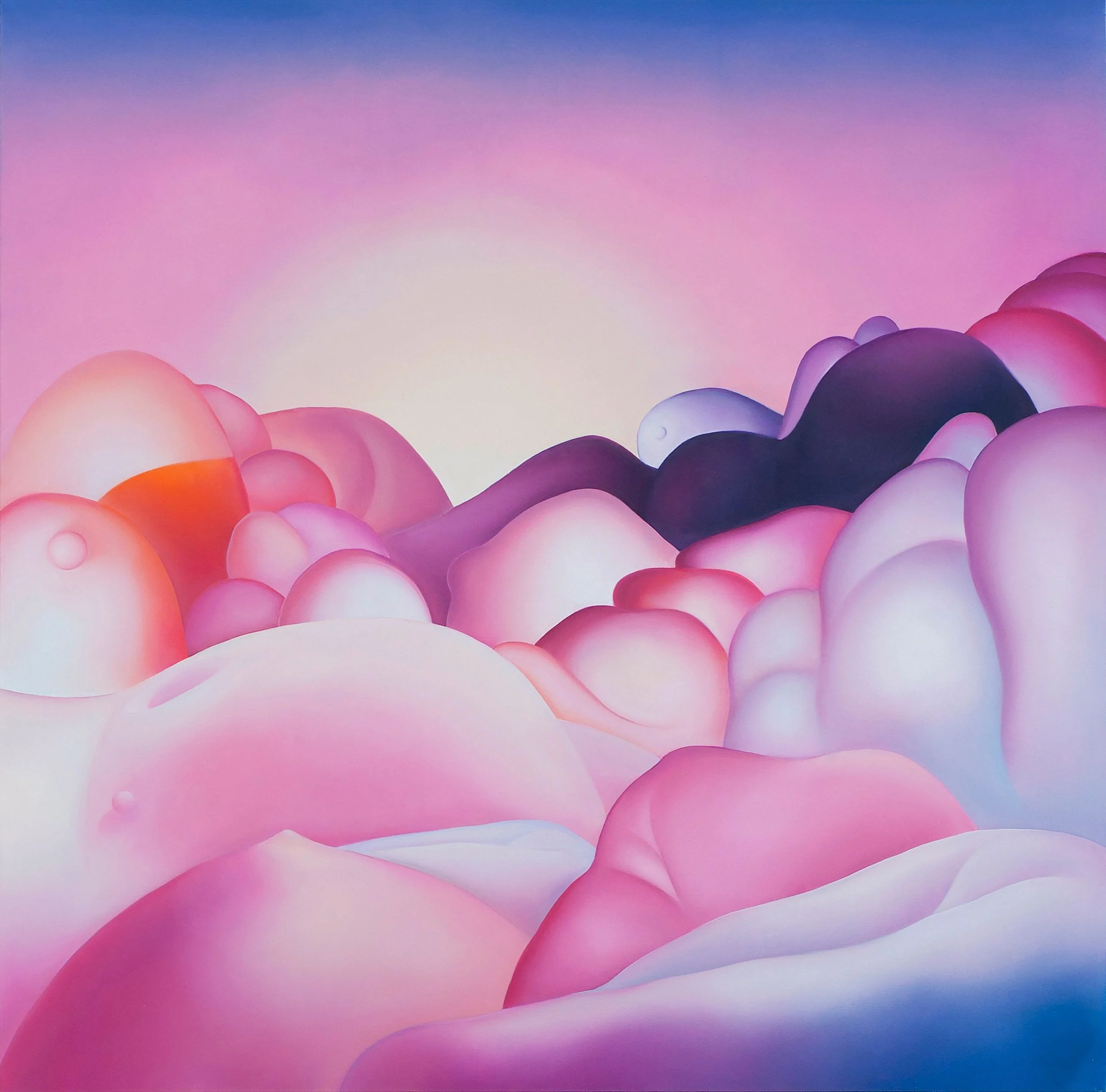
The first thing I wanted to do in my work was to show something that lies behind the everyday, and uncover a kind of erotic intimacy, but, lately, it hasn’t been so important to me. I think I have created my own aesthetic alphabet, and I use the female body as a sign. I do perceive my work as a process to look at nature, language, the body and femininity, and the main topic of my work is to capture the dynamics between those components. Working on a painting is an important and emotional process for me. Before I start, I will usually take a photograph of people I know from close friends and family, to kind of explore that notion of intimacy and the body, and I’m always seeking to go deeper into intimacy by taking the realistic form into abstraction and geometric shapes. I think abstraction has more value for me now than realism, because the viewer can kind of imagine something, without any pressure from me about how the painting should be received, or how they should feel.
How do you feel yourself when you view your work?
I paint a lot and always have a problem working out when to stop painting – it’s a long way for me to go conceptually and I am very much within the process.I actually think that the time I value most is that moment when I actually start the painting, and when I am thinking about it and am not sure what I will do. It’s good for me to have exhibition deadlines because it makes me stop painting when I need to. It also allows me to work on three or four paintings at once. I like doing that because it allows me to create the works as a series that correspond to each other.
Why does it feel so essential to you to approach womanhood and femininity in your art practice?
It’s actually true that I’ve only been painting women’s bodies lately, but in the past I have painted men as well. I’m not sure why I was drawn to focus mainly on women but maybe it’s because the female body is more associated with biology, nature and the sense of a landscape to me. The palette that I use in my painting is generally inspired by the colours of sunsets, or flowers, which I know are pretty common topics. Femininity is just very important to me – I consider woman as the source of creation in a way, the bringer of life. All of my paintings are very close to my heart and play a big emotional part in my everyday life, but, ultimately, I can’t explain why I always come back to the female figure.
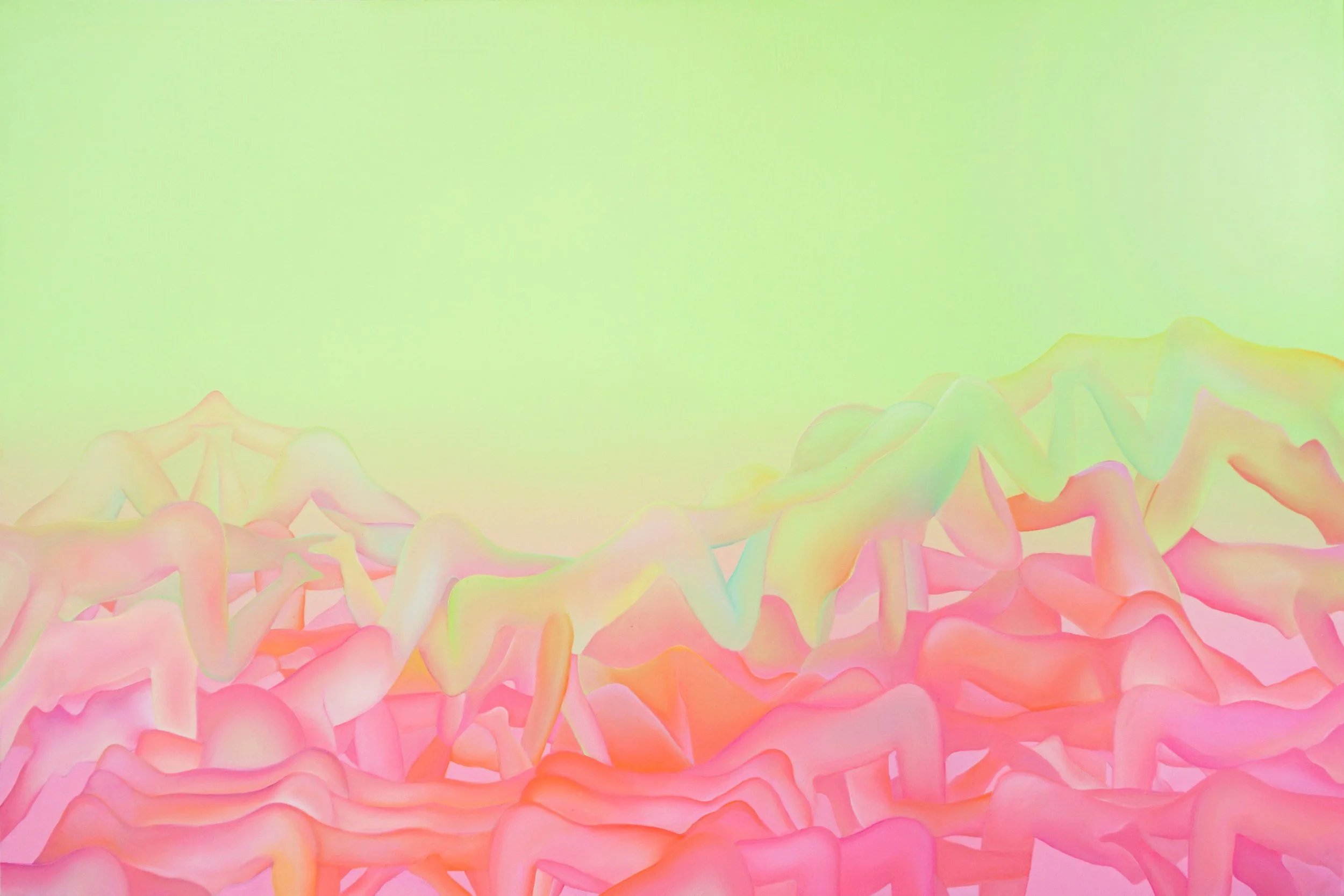
“Beauty is always there, every day in our lives, but we don’t look for it enough”
Does your art act as a kind of therapy for you?
Well, in a way, yoga and painting are very similar practices for me, and art has always been very important therapeutically for me. I can’t ever imagine stopping painting. I can find it difficult to go to work in the day-to-today, and I spend all of my free-time painting because it makes me feel better. I had therapy when I was younger, but my daily routine of painting is really the thing that makes me feel okay and calm, and makes me feel free. I don’t feel anxious or nervous when I paint; I feel that I can become anything on the canvas. I can’t really express why beauty is really so important for me, but I have always really been drawn to beauty, and I look for it every day in nature. Beauty is always there, every day in our lives, but we don’t look for it enough. I need that contact with nature, and my art is my connection to it. I like to spend time with other people, but I can’t ever predict what that will be like, but when I am alone, I am comfortable and I know that I can express myself freely.
Introduction & Interview by John-Paul Pryor
You can find out more about Agata Przyżycka here
Images (top to bottom): portrait of the artist at Kravitz Contemporary by Grzegorz Podsiadlik; Untitled, oil on canvas, 2021, Agata Przyżycka, courtesy of the artist; Trzymam świat Niepojęty, oil on canvas, 2021, Agata Przyżycka, courtesy of the artist; Untitled, oil on canvas, 2021, Agata Przyżycka, courtesy of the artist.
VENETIA BERRY ON RECLAIMING THE FEMALE FORM AND THE ART OF CALM
Venetia Berry is a young London-based artist whose work seeks to explore femininity and contemporary womanhood, and her ethereal free-flowing abstract depictions of the female form have attracted the favourable attention of the likes of designer Alex Eagle, who had the foresight to exhibit Berry at her London studio early in her career, The Saatchi Gallery, and contemporary art titans Hauser & Wirth, who invited her to contribute to their Elephant Family group show. The love is more than deserved. The talented graduate of the Royal Drawing School forwards a unique aesthetic that has shades of both Matisse and Miró, without ever feeling expressly influenced by either, and there is something thoroughly modern about her often bright colour palette – which reflects the vivacious and positive personality of its creator. Here, the artist, increasingly recognised as an ascendant star of her generation, talks to Collective Culture about de-sexualized femininity, reclaiming the male gaze and why beauty does not have to be synonymous with a lack of substance.
What would you say are the core concerns of your work?
My work is all based around creating a feeling of femininity, whatever that means to whoever is looking at it. It has evolved from being based around body positivity, or lack of it, which has often been my case, to being focused around mental health and my own struggle to find a feeling of calm within myself. They say that painting is like keeping a diary, and I am beginning to see that now, as certain artworks take me through the different landmarks in my life. The running theme throughout the last few years has been femininity, my relationship with it and also the expectations of it within society. My work is now becoming more and more abstract as I strive to represent a feeling and to bring out a feeling within the viewer. I am intent on creating an artwork with harmony and balance within. I also think I rely on my practice more heavily than I realise for my mental health. One of the main meanings behind my work is to represent my own search for peace within myself. I have tried many different routes to tackle my anxiety, but painting has always been the constant that calms my anxieties and quieten my mind.
How would you describe yourself as a painter? What tradition would you say you are working in?
My route as a painter has proceeded along the very well trodden path of beginning my career with painting from life, and slowly getting more abstract. I started my career working solely in oil paints, which I became less tolerant to as time evolved. I began to have headaches every time I worked from the harsh chemicals involved with oil painting. After a chance meeting with Tracy Emin, she advised me to move onto acrylics, as the quality now is much the same. So I did! And I have been happily working in acrylics ever since, loving the fast drying time, which allows me to work at a pace that suits me far better.
Why do you focus upon the abstracted female form?
I would happily move to another subject, if I had the urge. But I still feel there is so much more to explore when abstracting the female form. As a woman, I have always enjoyed the aspect of reclaiming the female form from male artists of art history. Their work is beautiful in its own right, of course. I just think it is important to show the female body from the female perspective. I have never painted the painting I exactly want to create, which I hope never changes, as otherwise I would have nothing to strive towards.
Who would you say is your greatest inspiration?
Without a shadow of a doubt it would be Helen Frankenthaler. She has inspired me so deeply for years. She was an abstract expressionist and only recently has her work started to receive the critical acclaim it so rightly deserves. She works in large pools of spooling colour – colours bleeding into one another – and she creates harmony, balance and depth within her work. They are often based around creating the feeling of being in nature, and they feel very transformative. I really could look at her work forever. She was the inventor of soak stain, a painting technique where the canvas is unprimed. I have been using this technique in my most recent works and the feeling of the work does feel and look different.
How do you think ideas about beauty are changing?
Beauty is in the eye of the beholder. This notion that love and emotion can affect how one sees things fascinates me. Beauty is subjective, and so is art. Something that one person resonates with, another will not. As a typical people-pleaser, it is important for me to take this notion through life and within my work. The realities being that you only have yourself through everything, so you may as well try to be true to yourself in whatever you do. Beauty within art was seen in the past as too ‘feminine’. A woman’s work would be beautiful, a man’s spectacular. Helen Frankenthaler was criticised for making her work too beautiful. After having seen her current show at Dulwich Picture Gallery (on until 18th April 2022), I would agree, but in no way would I see this as a criticism. I think beauty is now being embraced again within contemporary art. Work can be beautiful and still have the same depth of meaning behind it. In my own work, I suppose I do strive for beauty, however, I don’t necessarily word it this way. I strive for balance, harmony, depth, colour, meaning, abstraction – amongst others.
What would you say are your key concerns in your representation of women?
My concern when representing anyone who identifies as female is to feel like I am not trying to push my own life experience onto anyone else. My life experience is unique, as is everyone else's, but I am also very aware that my experience has been overwhelmingly privileged as a cis-gender, white female living in the UK. I want women to be able to look at my work and find something of themselves within it, not the other way around.
How is your practice evolving?
I am currently working on a new body of work for an exhibition. I have been working with soaking and dying linen with paints and inks. This method encourages an element of chance and lack of control, something that is so important to embrace. It can often lead to happy accidents. For these works, I have been abstracting the form further, in the attempt to create a feeling as opposed to directly communicating a shape or body. I would love people to walk away from my work thinking about their view on what it is to identify as female, or what femininity means to them and what that might mean. For example, in the past I have had straight men telling me that my work is very sexual. In fact, it is quite the opposite, I aim to de-sexualise the female form and delve deeper into character. Women have so often been sexualised in the media and art, so this comment is understandable, and also represents the world that said straight men have grown up in. On the other hand, I have had woman expressing to me that my work has encouraged their own body positivity and empowered them.
You can find out more about Venetia Berry here.